


EU budget summit ends with no deal on long-term budget or Ukraine loan
Leaders will try again in December, as Germany ties the bloc's next seven-year budget to a Ukraine loan it wants all 27 countries to share.

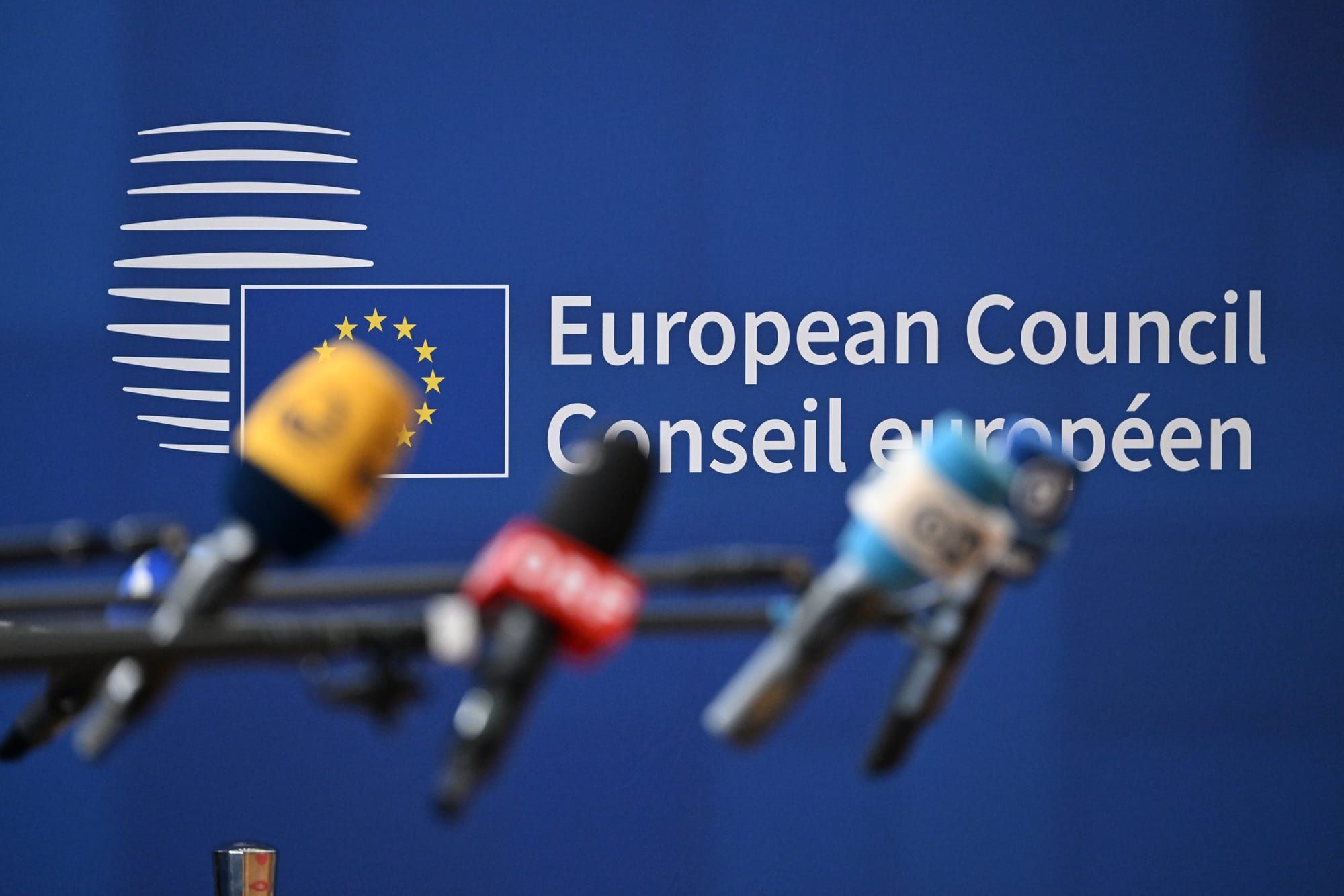
Microphones at the European Council's press point in Brussels, where EU leaders speak to reporters during summits. Photo, October 2026: Stenbocki maja (Estonian Government Office) / Wikimedia Commons / CC BY 4.0
Who covered this
On this page · sections
The short version
- EU leaders ended a Brussels summit without agreeing on their 2028–2034 budget or a new €45 billion loan for Ukraine.
- Germany says it won't back the budget unless all 27 countries share the loan, and three still won't.
- Leaders will try again at their December summit, before 2027 elections could make a deal harder.
Documents in this story · 3
- Remarks by President António Costa at the press conference following the special European Council of 26 November 2026European Council · Press release · Nov. 27Open Archived
- European Council conclusions on Ukraine, Dec. 18, 2025published by the EU's diplomatic service, EEAS · Web pageOpen Archived
- Treaty on the Functioning of the European Union, Article 312EUR-Lex · Web pageOpen Archived
EU leaders ended a budget summit in Brussels early Friday with no deal on the bloc's 2028–2034 budget and no decision on a €45 billion (about $49 billion) Ukraine loan. "We didn't reach an agreement," said António Costa, the European Council president, who called off the summit's second day.
The two fights are now one. Germany's chancellor, Friedrich Merz, has threatened to veto the budget unless every member country signs up to the loan, and three still object. Leaders meet again in December, hoping to settle both before a run of big elections in 2027.
Why it matters to you
Ukraine's money is the most urgent stake. Russia's attacks on energy and civilian sites, along with disruptions to Black Sea trade, are straining Ukraine's finances, and the new loan is meant to cover 2027. The European Commission, the EU's executive arm, would borrow the money on markets, with about $22 billion for the economy and $27 billion for the armed forces, the AP reported.
The budget itself sets what Europe spends on farmers, poorer regions and defense for seven years. Missing the end-of-year target doesn't mean money runs out, but laws and spending programs need much of 2027 to pass before money can flow in January 2028. The December summit is the next chance to lock both in.
How the EU budget summit and the Ukraine loan stalled
The talks ran for about 12 hours on Thursday, and the split on the loan barely moved. Costa said 24 member states supported the proposal, and that one of them, Bulgaria, would take part only in its non-military part. That leaves Slovakia, the Czech Republic and Hungary, which objected to the loan. Bulgaria's prime minister, Rumen Radev, said his country has a large diaspora in Ukraine and would put no money toward weapons.
On the budget, the old camps held. Costa's proposal from last weekend cut about 10% from the Commission's plan. Reports differ on its size. The Guardian put it at €1.78 trillion, and the BBC at €1.58 trillion, a figure that includes €140 billion to repay pandemic-era borrowing. After the talks, Costa said some countries asked for further cuts while most opposed them, and a large majority asked him not to squeeze farm and regional funds.
Not every leader stayed at the table. The BBC reported that four countries wanting a smaller budget, Denmark and Austria among them, walked out after several hours. Euronews counted seven, Germany included, that boycotted Costa's small-group sessions. Merz said the day had brought "new movement" toward a smaller budget.
The next round is set for December. The BBC said the European Council announced a summit on Dec. 17 and 18, and Merz said talks would resume at a two-day summit starting Dec. 17. Leaders did agree on one name Thursday, picking Spain's Pablo Hernández de Cos to lead the European Central Bank, with the formal appointment due in December.
Why Germany tied the Ukraine loan to the budget
The link between the two fights comes from the rules, and from what happened last year. In December 2025, leaders approved a €90 billion loan to cover Ukraine's needs for 2026 and 2027. Hungary, Slovakia and the Czech Republic opted out through "enhanced cooperation," a treaty tool that lets a group of countries go ahead while others stay out and carry no liability.
The budget has no such exit. Under Article 312 of the EU treaty, the seven-year budget is adopted by the Council acting unanimously, with the European Parliament's consent. Any one government can block it, Germany included.
That is the lever Merz is pulling. Earlier this month he threatened to hold up the budget unless every member committed to Ukraine without exception. A blocked budget would hurt net recipients of EU funds most, and Slovakia, Hungary and the Czech Republic are all net recipients. Slovakia's prime minister, Robert Fico, has accused Merz of blackmail. Arriving at the summit, Czech Prime Minister Andrej Babiš said: "Financing of Ukraine should be negotiated separately."
Moscow weighed in too. Kremlin spokesman Dmitry Peskov said the EU's plans would make Kyiv less ready for a peace process and more set on continuing the war.
How France's 2027 election reached the summit
France's 2027 presidential race came into the room. Marine Le Pen, the National Rally leader and the race's frontrunner, wants to cut France's payments to the budget and stop funding Ukraine. During the summit she called the talks "underhanded political manoeuvring to thwart the democratic will of the French people."
President Emmanuel Macron answered on the sidelines. He said it was a kind of arrogance for Le Pen to act as if she already ran France, since she has not been elected. He has also set a deadline of his own, Dec. 31 at the latest, and a condition: "I will not sign an unbalanced agreement."
What we don't know yet
Whether Slovakia, the Czech Republic and Hungary will join the loan, or Germany will accept an opt-out like last year's, is still unsettled. Costa said only that the loan question will come back in December.
The size of the budget is also open. Hungary's prime minister, Peter Magyar, said a deal around Christmas looked unlikely, NTD reported. If leaders miss the year-end goal, new governments chosen in 2027 could make a deal even harder.
The case each side makes
Germany and the net contributors
Countries that pay more into the budget than they get back want it smaller and aimed at new needs. "We can't and we mustn't take on more debt," Merz said Thursday, listing a strong economy, the single market and defense as priorities. Dutch Prime Minister Rob Jetten said the budget must be modernized and downsized to reach a deal.
On Ukraine, Merz said aid the EU gives must be backed by the EU as a whole, all 27 members and not 23 or 24. Sweden's prime minister, Ulf Kristersson, said it was unacceptable to accept EU support for Ukraine while refusing to pay for it.
The cohesion countries and the loan's holdouts
A large group led by France and Italy, known as the friends of cohesion, defends the farm and regional funds that make up about two-thirds of the budget. Babiš said his country still has no highway to Austria and needs new hospitals. Macron said lowering long-term spending would be a strategic mistake.
The loan's holdouts say Ukraine should be kept apart from the budget. Babiš said the EU should do everything to support peace in Ukraine, but that his citizens' lives come first. Hungary opposes making such aid an obligation, and Magyar put the chances of a deal on Thursday at "virtually zero."
Financing of Ukraine should be negotiated separately.
How coverage differs
Most of this coverage was written before anyone knew the result. The BBC told its readers the summit ended with no deal and a walkout; AP's final story, which the Daily Mail ran, reported no deal but not the walkout.
If you read the left 4 of 21 outlets
You saw the summit open, not close.
If you read the center 4 of 12 outlets
You knew it had stalled.
If you read the right 5 of 21 outlets
You heard from Moscow and Budapest.
Sources
Left
4 of 21 left-leaning outlets we track reported this
- The Guardian: EU leaders braced for clashes over Ukraine aid at budget talks, Nov. 26
- Associated Press: EU leaders seek to bridge their differences and agree on a budget deal and a new loan for Ukraine, Nov. 26
- ABC News (AP copy): EU leaders seek to agree on a budget deal and a new loan for Ukraine, Nov. 26
- The Independent (AP copy): EU leaders seek to bridge their differences and agree on a budget deal and a new loan for Ukraine, Nov. 26
Center
4 of 12 center outlets we track reported this
- BBC News: EU leaders fail to bridge budget splits as talks stall, Nov. 27
- Reuters: EU leaders aim for budget deal before the end of the year, Merz says, Nov. 26
- The Hill (AP copy): EU leaders split over budget spending and a $49 billion loan to Ukraine, Nov. 26 (headline only; link not resolvable from its feed)
- NewsNation (AP copy): EU leaders divided over budget spending as they weigh a $49 billion loan to Ukraine, Nov. 26 (headline only; link not resolvable from its feed)
Right
5 of 21 right-leaning outlets we track reported this
- The Washington Times (AP copy): EU leaders split over budget spending and a $49 billion loan to Ukraine, Nov. 26
- Daily Mail (AP copy): EU leaders split over budget spending and a $49 billion loan to Ukraine, Nov. 26–27
- Newsmax (AP copy): EU Leaders Seek to Bridge Their Differences and Agree on a Budget Deal and a New Loan for Ukraine, Nov. 26 (headline only; link not resolvable from its feed)
- NTD: EU Leaders Seek Bloc Consensus on $1.7 Trillion Budget, Ukraine Funding, Nov. 26
- Breitbart: Forever War: E.U. Leaders Prepare ANOTHER Big New Loan for Ukraine, Nov. 26
Other reporting
Primary
- European Council: Remarks by President António Costa at the press conference following the special European Council of 26 November 2026, Nov. 27 (the Council's site refuses agents; read in full as reproduced by Press Club Brussels Europe) · Archived copy
- European Council conclusions on Ukraine, Dec. 18, 2025 (published by the EU's diplomatic service, EEAS) · Archived copy
- Treaty on the Functioning of the European Union, Article 312 (EUR-Lex) · Archived copy
This article was produced by AI under our Editorial Standards. Corrections are reviewed before they go live.
How coverage differs
Keep reading
The newest World stories.
The Fair Witness Daily
Every morning around 7 a.m. Eastern, seven days a week.
Friday’s editionFree
In Friday’s Daily
Then the Spin Meter: one divided story, set side by side as the left, center and right told it.
Free. One email a day.
Unsubscribe in one click. Already a member? Sign in













Discussion
Any free account can join the discussion.