


Canada's Supreme Court upholds most of Quebec's religious symbols ban
The ruling lets Quebec keep overriding religious-freedom rights for its public workers, and other provinces are using the same power.

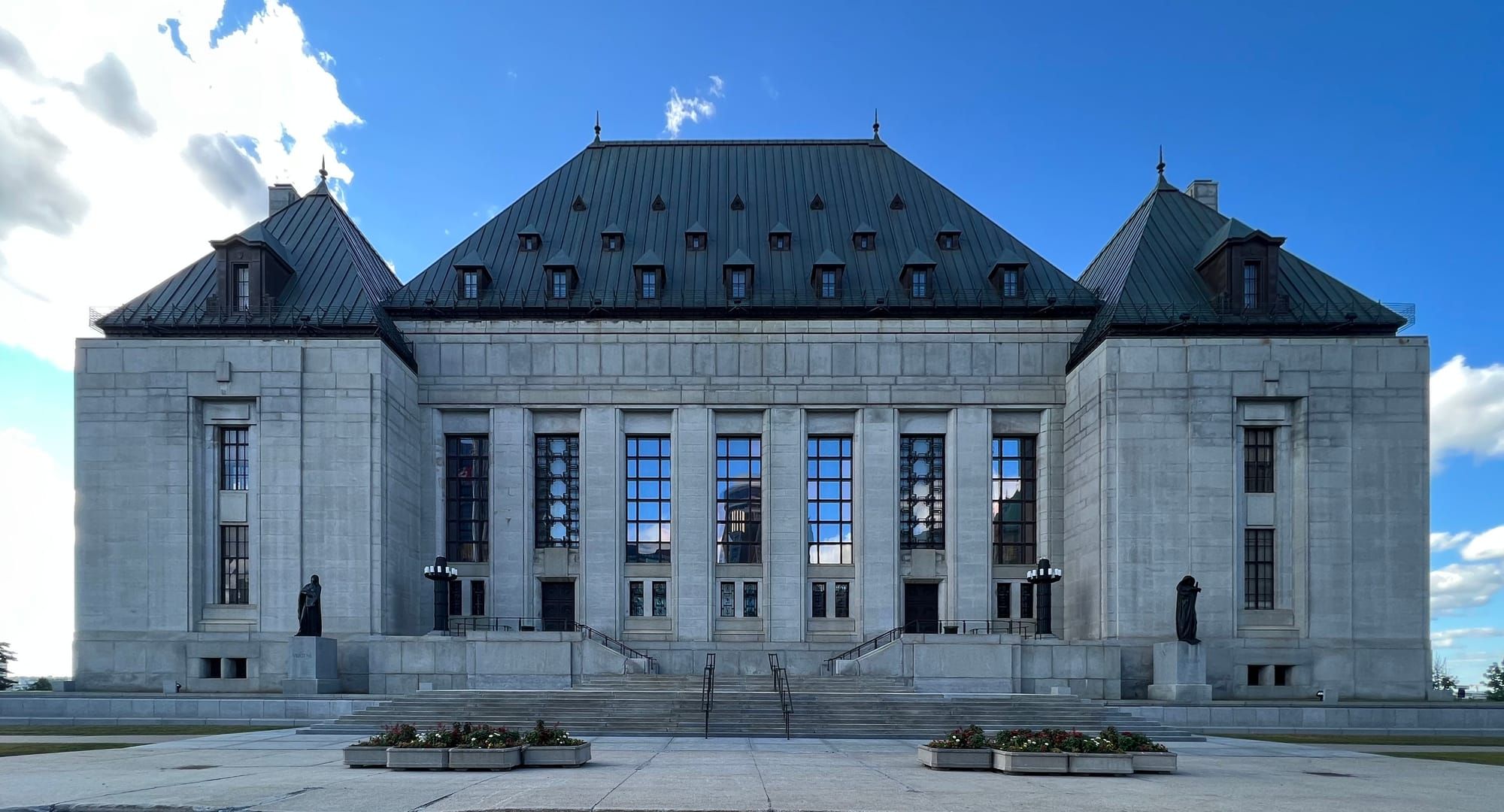
The Supreme Court of Canada in Ottawa, which released its ruling on Quebec's Bill 21 on Friday. Photo, July 2022: Dwong33 / Wikimedia Commons / CC0
Who covered this
On this page · sections
The short version
- Canada's Supreme Court upheld most of Quebec's ban on religious symbols for teachers, police and other public employees.
- The ruling lets Quebec keep overriding some Charter rights in advance, a power Alberta, Ontario and Saskatchewan also use.
- Quebec's override lapses in 2029 unless renewed, and its government wants to extend the ban to elementary school students.
Documents in this story · 3
- Judgment in English Montreal School Board v. Quebec (Attorney General), file 41231Supreme Court of Canada · Court ruling · Nov. 27Open Archived
- Case brief, English Montreal School Board v. Quebec (Attorney General)Supreme Court of Canada · Court rulingOpen Archived
- Canadian Charter of Rights and Freedoms, sections 3, 28 and 33Justice Laws website · Web pageOpen Archived
Canada's Supreme Court on Friday upheld most of Quebec's ban on religious symbols for teachers, police and other public employees, ruling that the province could shield it in advance from most rights claims.
The decision is the last word in the court fight over Bill 21, Quebec's 2019 secularism law, and only one piece of it fell: a rule that members of Quebec's legislature work with their faces uncovered. The ruling also shows every province how far it can go with the Charter's notwithstanding clause, which lets governments override some rights for five years at a time.
Why it matters to you
For people who work for Quebec's government, the question is now settled. Public school teachers, police officers, government lawyers and others in positions of authority can't wear a hijab, turban, kippah or cross on the job. Opponents say the ban falls hardest on Muslim women and limits their access to public-sector jobs. "This is the end of the legal road," said Joe Ortona, chair of the English Montreal School Board, which challenged the law.
The ruling reaches past Quebec. Alberta, Ontario and Saskatchewan have used the same clause to shield laws on transgender youth and striking workers. The court didn't rule on those uses, which leaves them for future court battles. Quebec's own government may go further: it wants to extend the symbols ban to elementary school students.
How the Supreme Court ruled on Quebec's religious symbols law
The court held that Quebec used the clause validly to protect the ban. Bill 21 "is rooted in Quebec's legitimate and historical commitment" to keeping the state secular, Chief Justice Richard Wagner wrote for the majority. The judgment runs about 520 pages by the Guardian's count, and 521 by UPI's.
The judges split on several questions. Six of the seven judges found the clause was used validly, the Guardian and The Globe and Mail reported. But three, Justices Andromache Karakatsanis, Michelle O'Bonsawin and Sheilah Martin, would have struck down the ban on another ground: the Charter's promise that its rights apply equally to men and women. They lost that point 4-3, the Globe reported. The school board said it had lost very narrowly.
The challengers lost on schooling too. The court rejected the claim that the ban violates the rights of Quebec's English-speaking minority to run its own schools. Karakatsanis and O'Bonsawin would have accepted it, according to a summary by the Canadian Constitution Foundation.
The face-covering rule for legislators was different. The court found it violates the Charter's guarantee that citizens may run for and hold a seat in a legislature.
Why the override couldn't save the face-covering rule
The Charter's own text explains why the fight ran along those lines. Section 33 lets Parliament or a province declare that a law operates notwithstanding section 2 or sections 7 to 15. Those cover freedom of religion and expression, legal rights and equality rights. They don't cover the right to vote and sit in a legislature, minority-language schooling or the equal guarantee for men and women. So those were the only Charter claims that could still defeat Bill 21, and only the legislators' claim won.
The clause also runs on a clock. A declaration expires after five years unless the legislature passes it again. Quebec renewed Bill 21's in 2024, so it lapses in 2029 unless it is renewed again.
The court also gave judges a new tool. By 4-3, it ruled that courts may declare a shielded law in breach of the Charter even though the law stays in force. But a different 4-3 majority, led by Wagner, declined to make that declaration about Bill 21, the Globe reported. "This Court should not be silent," Karakatsanis and O'Bonsawin wrote, when people ask it to say a law breaches their rights.
How Bill 21 reached Canada's top court
Quebec adopted the law on June 16, 2019, under then-Premier François Legault, and invoked the clause from the start. The province says the law keeps religion and government apart. That stance grew out of Quebec's rejection of the Roman Catholic Church's influence. The court tied it to the Quiet Revolution of the 1960s and 1970s.
A Quebec Superior Court judge upheld most of the law in April 2021, the Supreme Court's case brief says. He struck down the face-covering rule for legislators and exempted English-language schools from the ban. The province's Court of Appeal kept the first ruling but reversed the schools exemption in February 2024. The Supreme Court heard the appeal over four days in March, with 51 interveners, the outside groups and governments allowed to weigh in, including a record six attorneys general. The federal government urged the court to limit provinces' use of the override, and it lost that bid.
The ruling arrives in a busy week for Quebec's government. Premier Paul St-Pierre Plamondon's Parti Québécois government has pledged a referendum on independence before 2030. This week a Quebec judge suspended a law that made the oath to King Charles III optional for legislators, and the government appealed. The legislature is due to meet on Dec. 1.
What we don't know yet
Quebec hasn't introduced the bill to extend the ban to elementary students, so its scope and timing are unknown. If it comes, the government would have to decide whether to shield it with the clause as well.
It also isn't clear how often lower courts will use their new power to declare shielded laws in breach of the Charter. Challengers to the Alberta, Ontario and Saskatchewan laws may now ask them to. Such a ruling leaves the law in force. But Justice Martin wrote that it would give notice when a legislature uses the override.
Ottawa's next step is open too. Prime Minister Mark Carney said his government would study the ruling closely, and that it was too early to talk about changing the Constitution.
The case each side makes
Quebec and the law's supporters
St-Pierre Plamondon cast the ruling as a win for Quebec's own choices. "Secularism has prevailed," he told reporters in Quebec City, the Montreal Gazette reported, in an account the New York Sun cited. He said judges' power to make declarations weakens the clause and Quebec's autonomy, and that this setback strengthens the case for independence.
Supporters say elected legislatures, not judges, should have the final word on questions such as the state's religious neutrality. That was the bargain the provinces struck when the Charter was written. Alberta Premier Danielle Smith called the clause a legitimate and essential part of the Constitution and the ruling a win for provincial rights. The Bloc Québécois and the Conservative Party of Quebec praised the decision, and Quebec's Liberal opposition welcomed it.
The challengers
The groups that sued say the ruling leaves minority rights to the will of whoever governs. Stephen Brown, chief executive of the National Council of Canadian Muslims, called it "an unrestricted licence for every government in the country" to pass such laws. The Canadian Civil Liberties Association said it was deeply disappointed that the law remains in force.
They also point to the three judges who found the ban breaches the equal guarantee for men and women, and to the new power to make declarations. Amrit Kaur, a Sikh appellant, said the ruling makes clear the law violates rights, the Globe reported. Manitoba Premier Wab Kinew called Bill 21 legislative racism and urged people to take their cases to trial courts. Ortona said the board would keep pressing for political change.
This is the end of the legal road.
How coverage differs
Quebec's and Alberta's premiers welcomed the ruling, but of the outlets compared here only the right-leaning New York Sun let readers hear them. Elsewhere the angle varied: the Guardian explained the 1980s bargain behind the override, and Newsweek's headline named only Muslim headscarves.
If you read the left 6 of 21 outlets
You got the bargain behind the clause.
If you read the center 4 of 12 outlets
You heard it as a test of unity.
If you read the right 4 of 21 outlets
You heard from the premiers.
Sources
Left
6 of 21 left-leaning outlets we track reported this
- The Guardian: Canada's top court upholds Quebec law barring public sector workers from wearing religious symbols, Nov. 27
- Politico: Canada's top court upholds Quebec's religious symbols ban. Bigger battles loom., Nov. 27
- AP: Canada's Supreme Court largely upholds a Quebec ban on religious symbols for public servants, Nov. 27 (headline only; text unavailable; link not resolvable from its feed)
- ABC News (AP copy): Canada's Supreme Court largely upholds Quebec ban on religious symbols for public servants, Nov. 27
- PBS NewsHour (AP copy): Canada's Supreme Court largely upholds a Quebec ban on religious symbols for public servants, Nov. 27
- The Independent (AP copy): Canada's Supreme Court largely upholds Quebec ban on religious symbols for public servants, Nov. 27
Center
4 of 12 center outlets we track reported this
- Reuters: Canada's Supreme Court to rule on Quebec's law on religious symbols in test of Canadian unity, Nov. 27; its post-ruling story, "Canada's top court upholds Quebec law banning religious symbols in test of unity" (headline only; link not resolvable from its feed)
- BBC News: Canada's top court largely upholds Quebec ban on religious symbols for public servants, Nov. 27
- Newsweek: Canada's Supreme Court upholds muslim headscarf ban in landmark ruling, Nov. 27
- UPI: Canadian Supreme Court upholds Quebec law banning religious symbols, Nov. 27
Right
4 of 21 right-leaning outlets we track reported this
- The New York Sun: Quebec Gets a Supreme Court Win Just Days After Setback on Oath to King Charles, Nov. 27
- The National Desk: Canada's top court upholds Quebec law barring religious symbols for many public workers, Nov. 27
- The Washington Times (AP copy): Canada's Supreme Court largely upholds Quebec's ban on religious symbols, Nov. 27
- Daily Mail (AP copy): Canada's Supreme Court largely upholds a Quebec ban on religious symbols for public servants, Nov. 27
Other reporting
- The Globe and Mail: Supreme Court upholds Quebec's Bill 21 in landmark ruling on Charter of Rights, Nov. 27 (Toronto-based national newspaper)
- The Globe and Mail: Premiers welcome decision on Quebec secularism law as rights groups vow to continue fight, Nov. 27 (Toronto-based national newspaper)
- Canadian Constitution Foundation: The Supreme Court of Canada's Bill 21 decision explained, Nov. 27 (Canadian legal charity that advocates for constitutional rights)
Primary
- Supreme Court of Canada: judgment in English Montreal School Board v. Quebec (Attorney General), file 41231, Nov. 27 · Archived copy
- Supreme Court of Canada: case brief, English Montreal School Board v. Quebec (Attorney General) · Archived copy
- Canadian Charter of Rights and Freedoms, sections 3, 28 and 33 (Justice Laws website) · Archived copy
This article was produced by AI under our Editorial Standards. Corrections are reviewed before they go live.
How coverage differs
Keep reading
The newest World stories.
The Fair Witness Daily
Every morning around 7 a.m. Eastern, seven days a week.
Friday’s editionFree
In Friday’s Daily
Then the Spin Meter: one divided story, set side by side as the left, center and right told it.
Free. One email a day.
Unsubscribe in one click. Already a member? Sign in





Discussion
Any free account can join the discussion.