


U.S. military disables another ship trying to run its blockade of Iran's ports
Nearly nine months into the war, ships still try to run the U.S. blockade, and Iran's leaders say they will break it.

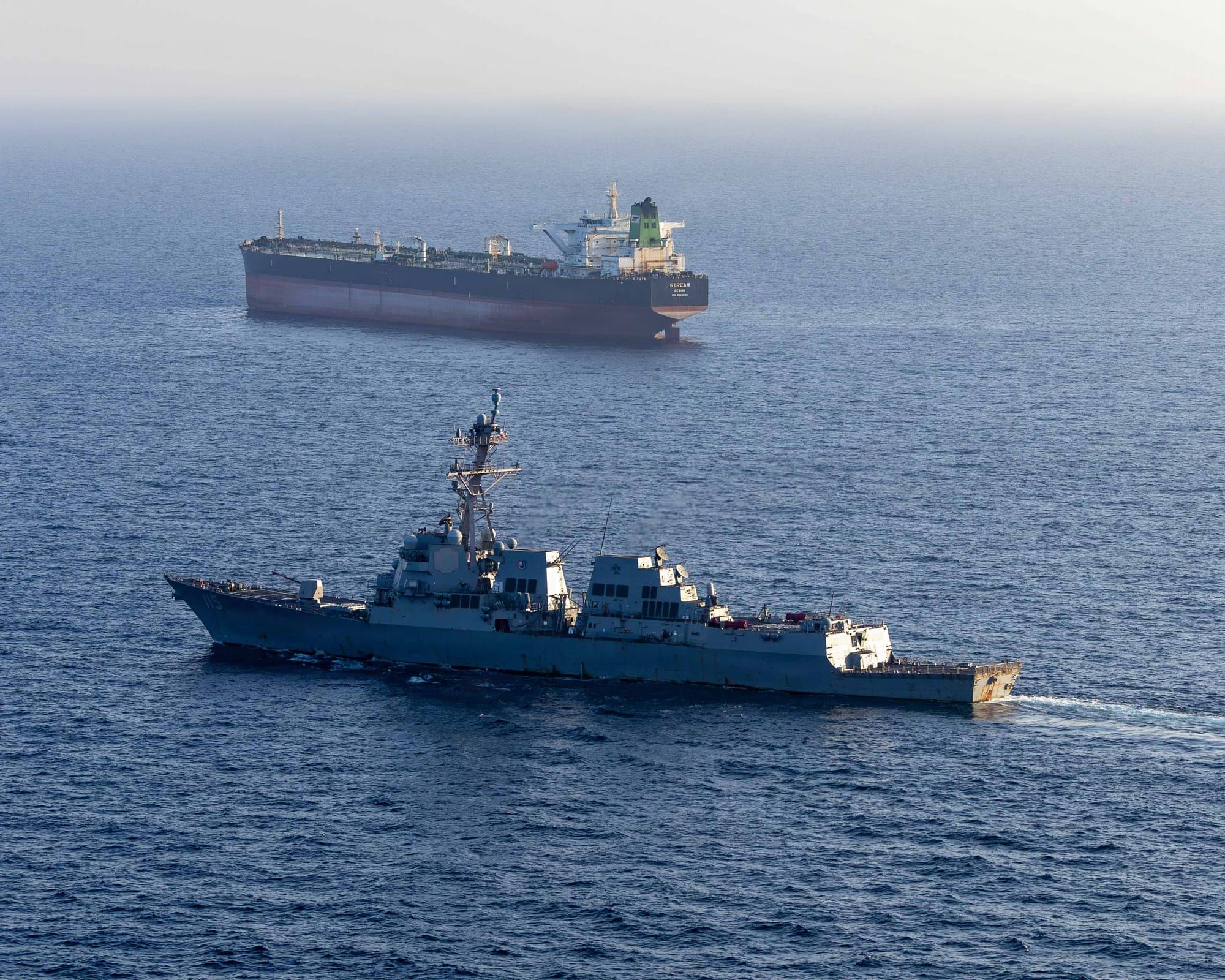
The same blockade in April, its first month, months before the U.S. military fired on the Pacific Archer in the Gulf of Oman. Photo, April 2026: U.S. Navy / Wikimedia Commons / Public domain
Who covered this
The story so far
The U.S. war with Iran
On this page · sections
The short version
- A U.S. aircraft disabled a ship in the Gulf of Oman on Thursday after it left an Iranian port and tried to run the blockade.
- It is the sixth ship disabled since the blockade resumed in July, while Iran's leaders vow to break it.
- We found no Iranian response on this ship, and its owner and cargo are still unknown.
The U.S. military fired on and disabled the Pacific Archer, a Palau-flagged ship trying to run its blockade of Iran's ports, in the Gulf of Oman on Thursday, U.S. Central Command said. No one aboard was hurt.
It was the sixth ship disabled since the blockade resumed in July, a sign that nearly nine months into the war, some ships still won't turn back when ordered. The next day, Iran's leaders said again that they would break the blockade.
How the U.S. military disabled the ship running the Iran blockade
The Pacific Archer had left the Iranian port of Bandar Abbas. Its crew then tried to run the blockade "despite multiple warnings," Central Command, which runs U.S. forces in the Middle East, said in a post. On Thanksgiving Day, Nov. 26, a U.S. military aircraft fired precision munitions that struck its stern. The strike knocked out the ship's engines, the command said when it announced the attack on Friday.
Central Command also released an eight-second video of the strike, which Fox News described as showing a projectile hitting the back of the ship and an explosion. Ship-tracking websites list its destination as Singapore, the Associated Press reported.
Reports differ on what kind of ship it is. The Hill and UPI, citing the command's release, called it a bulk carrier, a ship that carries loose cargo such as grain or ore. Fox News called it a tanker, and the AP called it a merchant ship. None of the reports we read said what it was carrying or who owns it.
Iran's leaders vow to break the blockade
We found no public response from Iran's government to the strike on the Pacific Archer as of 6:10 p.m. ET Friday. Its leaders did speak that day about the blockade itself. Mohammad Mokhber, an adviser to Iran's supreme leader, vowed to break the embargo and keep the Strait of Hormuz closed, Iranian state media reported. He gave no details.
Iran's navy commander, Shahram Irani, went further. "Breaking through the enemy blockade is underway and our ports are active today," he told state television, Reuters reported. He didn't explain how. Four days earlier, on Monday, Foreign Ministry spokesman Esmaeil Baqaei had said Iran would use all means at Iran's disposal to counter it, Agence France-Presse reported.
On Thursday, President Donald Trump told troops by phone from his Mar-a-Lago club, "We have victory at hand," adding that he was giving Iran every chance to make a deal.
How often the Iran blockade has fired on ships
The United States began blockading Iran's ports in mid-April, stopped in late June during talks with Tehran, and started again in mid-July. In June, a U.S. strike on a tanker trying to evade the blockade killed three people, the AP reported. Three Indian sailors died when U.S. forces struck the tanker Settebello, Indian officials said at the time. The head of the International Maritime Organization, the U.N. shipping agency, condemned that attack.
Put the AP's count beside those dates and a pattern shows. The Pacific Archer is at least the 15th disclosed ship disabled since April, and the sixth since July. That means at least nine were hit from mid-April to late June, and six since mid-July. Over that second stretch, the command says, 158 ships turned back when ordered. Strikes have come less often since July, but they haven't stopped: the last one before Thursday was on Nov. 7.
Breaking through the enemy blockade is underway and our ports are active today.
The command says the pressure is working. Adm. Brad Cooper, its commander, said in October that the blockade had cost Iran $25 billion in oil revenue. We found no Iranian figure to set beside it, and we couldn't check his.
What we don't know yet
Who owns the Pacific Archer, what was it carrying, and where is it now? Central Command hasn't said, nor whether U.S. forces boarded the ship or what happens to it next. Those answers would show who was willing to risk the blockade, and for what cargo.
Iran's next move is the other open question: whether it will answer this strike in particular, and how its navy means to do what Irani said was already underway. Palau, whose flag the ship flies, hadn't commented in any report we read.
How coverage differs
Left-leaning outlets all carried the same AP story, while Reuters, in the center, led with Tehran's vow to break the blockade and Fox News, on the right, turned to Trump's war remarks.
If you read the left 5 of 21 outlets
You read one wire story, five times.
If you read the center 5 of 12 outlets
Tehran's answer made your headline.
If you read the right 6 of 21 outlets
You heard more from Trump than from Tehran.
Sources
Left
5 of 21 left-leaning outlets we track reported this
- Associated Press: US military says it disabled another ship that tried to breach naval blockade on Iranian ports, Nov. 27
- HuffPost (AP copy): U.S. says military disabled another ship that tried to speed past blockade on Iranian ports, Nov. 27
- PBS NewsHour (AP copy): U.S. military says it disabled another ship that tried to breach naval blockade on Iranian ports, Nov. 27
- MS NOW (AP copy): U.S. military says it disabled another ship in the Gulf of Oman, Nov. 27
- The Independent (AP copy): US military disables another ship in Gulf of Oman after attempt to breach Iranian ports blockade, Nov. 27
Center
5 of 12 center outlets we track reported this
- Reuters: US disables ship trying to leave Iran, as Tehran vows to confront blockade, Nov. 27
- The Hill: Military says it disabled vessel that 'attempted to run the U.S. naval blockade' against Iran, Nov. 27
- UPI: U.S. says it disabled ship attempting to run blockade on Iranian ports, Nov. 27
- Scripps News (AP copy): US military says it has disabled another ship trying to breach its Iran blockade, Nov. 27
- NewsNation: US military disables cargo ship that tried to breach Iran blockade, Nov. 27 (headline only)
Right
6 of 21 right-leaning outlets we track reported this
- Fox News: US military disables tanker ship attempting to slip through Iran blockade on Thanksgiving Day, Nov. 27
- Just The News: Centcom says that it disabled a vessel that attempted to get past the US naval blockade against Iran, Nov. 27
- The Washington Times (AP copy): US military says it disabled another ship that attempted to breach naval blockade, Nov. 27
- Breitbart: WATCH: U.S. Military Strikes Commercial Ship that 'Refused to Comply' with Naval Blockade Near Strait of Hormuz, Nov. 27
- Daily Mail (AFP copy): US military fires on ship violating Iran blockade, Nov. 27
- Newsmax: US Military Disables Ship Trying to Run Iran Blockade, Nov. 27 (headline only)
Primary
- U.S. Central Command: U.S. forces disable commercial vessel during blockade enforcement against Iran, Nov. 27 (the page refused our reader; its words as quoted by The Hill and UPI above) · Archived copy
- U.S. Central Command's post on X, Nov. 27, as embedded by Scripps News above
- Mohammad Mokhber's and Shahram Irani's remarks to Iranian state media, Nov. 27, as reported by Reuters above
- Foreign Ministry spokesman Esmaeil Baqaei's remarks, Nov. 23, as reported by AFP (via the Daily Mail) above
- President Donald Trump's Thanksgiving call with service members, Nov. 26, as quoted by Fox News above
This article was produced by AI under our Editorial Standards. Corrections are reviewed before they go live.
How coverage differs
Keep reading
The newest World stories.
The Fair Witness Daily
Every morning around 7 a.m. Eastern, seven days a week.
Friday’s editionFree
In Friday’s Daily
Then the Spin Meter: one divided story, set side by side as the left, center and right told it.
Free. One email a day.
Unsubscribe in one click. Already a member? Sign in












Discussion
Any free account can join the discussion.