


Drone attack in Kuwait kills two Italians; Kuwait and Italy blame Iran, which denies it
The deaths pull Italy into Kuwait's dispute with Tehran over who sent the drones, a question no public evidence has yet settled.

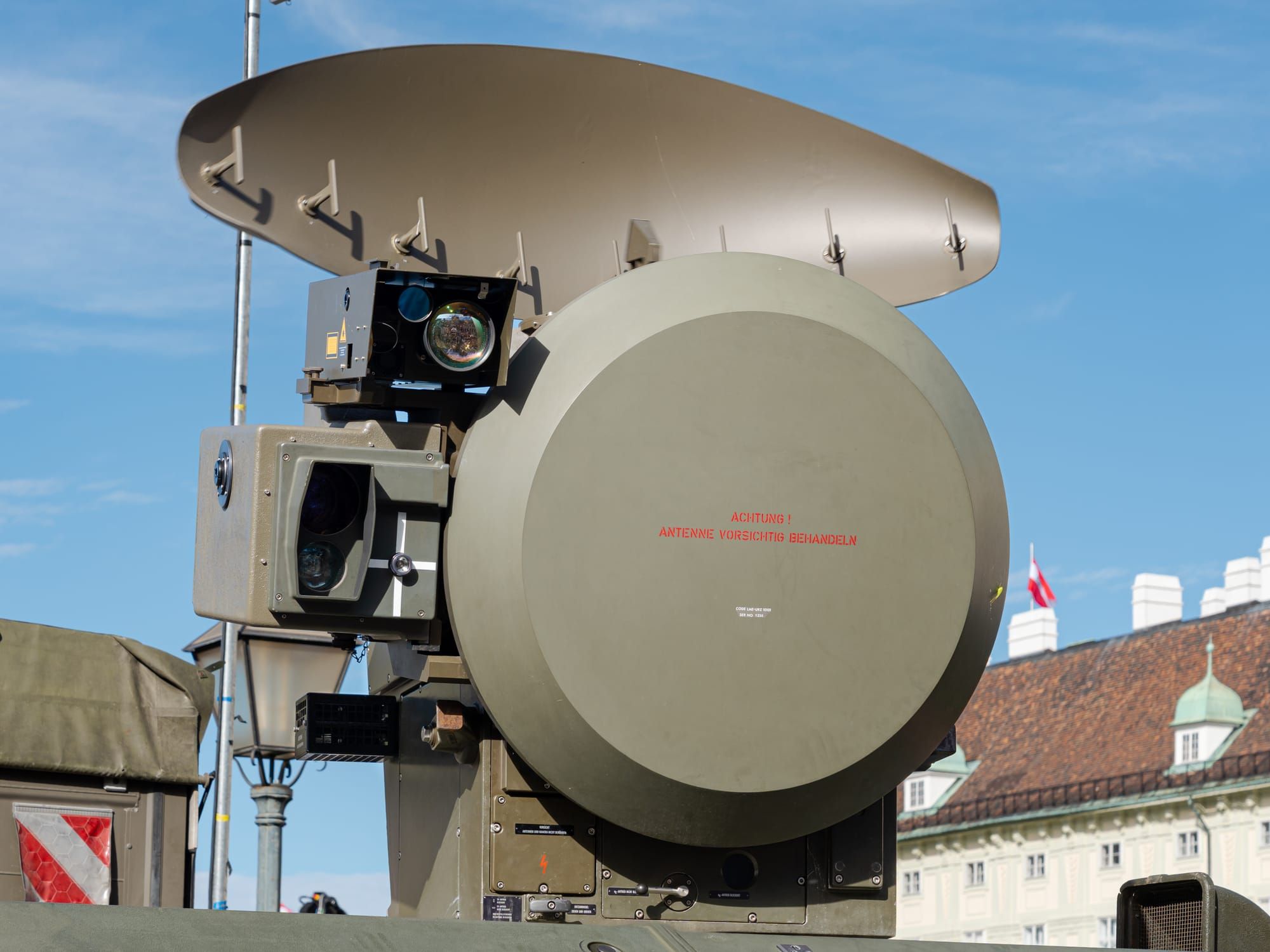
A Skyguard air-defense radar unit in Austria, the kind of system the Italians killed in Kuwait were maintaining, Fox News reported. Photo, October 2023: Aciarium / Wikimedia Commons / CC BY 4.0
Who covered this
The story so far
The U.S. war with Iran
On this page · sections
The short version
- Two Italian technicians were killed Thursday when drones hit an air-defense site in Kuwait, and Kuwait and Italy blamed Iran.
- Iran denied any role and offered a joint investigation, while Italy said it would lodge a complaint with Iran's embassy.
- Who launched the drones is still unsettled, and Kuwait and Italy haven't said whether they will take up Iran's offer.
Two Italians maintaining Kuwait's air defenses were killed Thursday when drones hit a military site, in what Kuwait and Italy called an Iranian drone attack. Iran denied any involvement and offered to help investigate.
The deaths pull Italy into a dispute with Tehran over who sent the drones. It was the second reported Iranian attack on Kuwait this month, and the first of the two to kill anyone. Fair Witness reported Nov. 18 that Iran fired drones at a Kuwaiti air base that hosts U.S. forces; Kuwait reported no casualties then.
How the drone attack in Kuwait killed two Italian technicians
Kuwait's Defense Ministry said its forces spotted and engaged several drones in its airspace. At first it said falling debris had wounded four people at a military facility; later it said the two Italians had died of their injuries. A ministry spokesman, Col. Saud Abdulaziz Al-Atwan, called it a "heinous Iranian aggression," the Associated Press reported. Neither Kuwait nor Italy has said where the site is.
The two men were working at an air-defense surveillance station, Foreign Minister Antonio Tajani said. They were technicians for Rheinmetall Italia, the Italian arm of the German arms maker Rheinmetall. Italy's Foreign Ministry said they were maintaining detection antennas for an air-defense system used by Kuwait's armed forces, which Fox News named as the Skyguard system. Rheinmetall declined to comment. A Kuwaiti and a Pakistani were also hurt; Tajani told Italy's Senate the Kuwaiti was an army captain.
Tajani told senators that, after a powerful explosion, "both of our compatriots, according to information coming from Kuwait, have died." He later said the drone was made in Iran, and he told the AGI news agency that Italy would lodge a complaint with Iran's embassy. Prime Minister Giorgia Meloni sent her condolences to the families. European Commission President Ursula von der Leyen said Europe must "step up pressure on Iran," Kuwait's Arab Times reported.
Iran denies the attack and calls the deaths suspicious
Iran's government denies it. Abolfazl Shekarchi, a senior spokesman for Iran's armed forces, said Iranian forces had carried out no military operations in the region, Iranian state media reported. Iran's embassy in Rome denied the claims on X and warned against false-flag operations meant to draw Europe into the conflict.
Foreign Minister Abbas Araghchi called his Italian and Kuwaiti peers to offer sympathy. "The incident is suspicious and looks like a precooked recipe for war," he wrote, Fox News reported. He said Iran was ready to work with Kuwait and Italy to find the cause. Tajani's answer to the denial was that "numerous pro-Iranian militias operate in the region," CNN reported.
A third account came from outside Iran's government. Mohammad Marandi, a former adviser to Iran's nuclear negotiating team, said on X that Ukraine had likely staged the attack to show its worth to President Donald Trump. The only reason he gave was that Ukrainian operatives are present across the region, and we found no Iranian official repeating the claim.
Ukraine has sent drone experts to Kuwait and other Gulf states to help them fight off Iranian drones, Fox reported. We found no public response from Ukraine's government to Marandi's claim as of 8:45 p.m. ET Thursday. In March, Ukraine's Foreign Ministry called an Iranian envoy's earlier charges about its Gulf specialists false, Ukrinform, Ukraine's state news agency, reported.
What the U.N. resolution says about proxies
The question of who sent the drones runs into a U.N. text Kuwait has already used. After the Nov. 18 attack, Kuwait said Iran had broken Security Council Resolution 2817, adopted in March. Its text demands that Iran stop attacking Kuwait and five other Gulf states and Jordan. It also demands that Iran stop threatening its neighbors, "including the use of proxies."
That clause bears on Tajani's point about militias, because its demand covers provocations and threats made through proxies, not only by Iran's own forces. But the resolution sets no way to decide who launched a given drone, and no penalty. That leaves the facts to whatever Kuwait, Italy and Iran can show.
The incident is suspicious and looks like a precooked recipe for war.
What we don't know yet
We don't know where the drones came from or who launched them. Kuwait and Italy have named Iran, and Tajani said the drone was made there, but neither has made public any evidence we could find. Whether they take up Araghchi's offer to look into it together may decide if all three ever agree on what happened.
We also don't know where the site is or how badly it was damaged, beyond the ministry's word that there was material damage. Italy hasn't said what its complaint to Iran's embassy will ask for. Nor is it clear whether Europe's calls for more pressure will lead to sanctions. Ukraine's government hasn't answered Marandi.
How coverage differs
How you heard Iran's denial depended on the outlet, not the side: CNN set it against Tajani's militia remark, the BBC put it in its headline, and Fox's headline credited Iran with a former adviser's claim about Ukraine.
If you read the left 3 of 21 outlets
You heard Rome answer Tehran.
If you read the center 2 of 12 outlets
You got the denial up top.
If you read the right 3 of 21 outlets
You met the Ukraine theory first.
Sources
Left
3 of 21 left-leaning outlets we track reported this
- CNN: Two Italians killed in alleged Iranian drone attack on Kuwait; Tehran denies involvement, Nov. 26
- NBC News (Reuters copy): Two Italians killed in attack on Kuwait site, Iran denies involvement, Nov. 26
- Associated Press: Israeli strikes kill 10 in Gaza as Iranian drones kill 2 Italians in Kuwait, and other Mideast news, Nov. 26
Center
2 of 12 center outlets we track reported this
Right
3 of 21 right-leaning outlets we track reported this
- Fox News: Iran accuses Zelenskyy of 'false flag' Kuwait drone strike op to get Trump's attention, Nov. 26
- Daily Mail (AP copy): Israeli strikes kill 10 in Gaza as Iranian drones kill 2 Italians in Kuwait, and other Mideast news, Nov. 26
- Newsmax: EU Urges More Pressure on Iran After Deadly Kuwait Strike, Nov. 26 (headline only)
Other reporting
Primary
- U.N. Security Council: Resolution 2817 (2026), S/RES/2817, March 11 · Archived copy
- Italian Foreign Minister Antonio Tajani's remarks to the Senate, Nov. 26, as quoted by Reuters above
- Italian Foreign Ministry statement, Nov. 26, as reported by BBC News, CNN and Fox News above
- Kuwait Defense Ministry and army statements, Nov. 26, as reported by Reuters, the AP and BBC News above
- Iranian Foreign Minister Abbas Araghchi's posts on X and Telegram, Nov. 26, as quoted by Fox News and Reuters (via NBC News) above
- Iran's embassy in Rome, post on X, Nov. 26, as quoted by Fox News above
- Iranian armed forces spokesman Abolfazl Shekarchi's statement to Iranian state media, Nov. 26, as reported by Reuters (via NBC News) above
This article was produced by AI under our Editorial Standards. Corrections are reviewed before they go live.
How coverage differs
Keep reading
The newest World stories.
The Fair Witness Daily
Every morning around 7 a.m. Eastern, seven days a week.
Friday’s editionFree
In Friday’s Daily
Then the Spin Meter: one divided story, set side by side as the left, center and right told it.
Free. One email a day.
Unsubscribe in one click. Already a member? Sign in


















Discussion
Any free account can join the discussion.