Air monitors find no lead after Army's Iowa detonation; lab results still pending
Air readings found no lead, but whether lead dust settled on schools, playgrounds and fields depends on lab results that could start Friday.

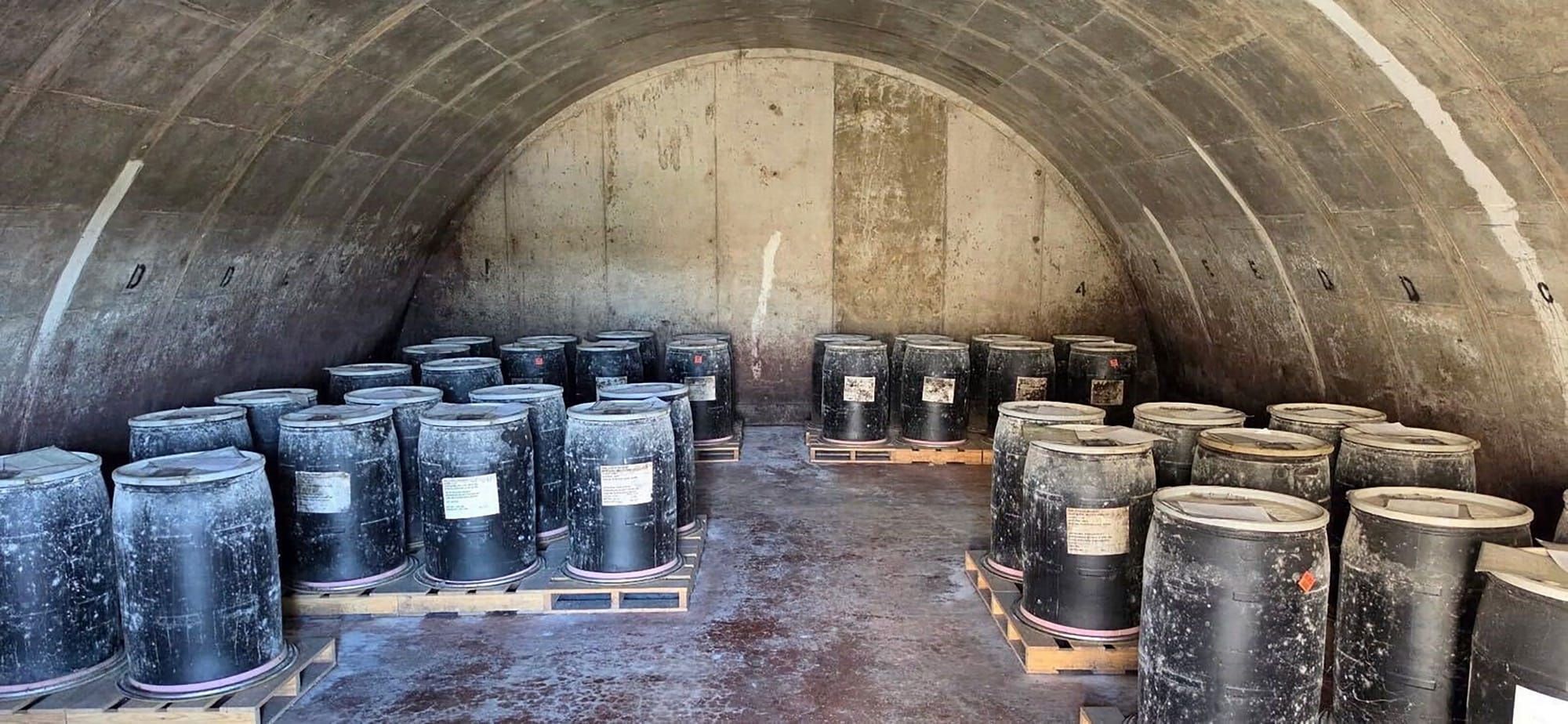
The stockpile in storage, in a Pentagon photo released before Wednesday's blasts destroyed all 68 barrels. Photo, November 2026: U.S. Department of Defense / Wikimedia Commons / Public domain
Who covered this
The story so far
The Army's plan to detonate lead azide in Iowa
On this page · sections
The short version
- The Army destroyed nearly 5 tons of lead azide in Iowa on Wednesday, and air monitors have detected no lead since.
- Air readings can't show whether lead reached soil, water or playgrounds, and lead is especially dangerous to children and pregnant women.
- EPA lab results on more than 1,000 samples could start arriving Friday, and the permit requires the Army to propose any cleanup.
Documents in this story · 2
- RecordGuidance for schools and child care facilities, planned lead azide detonation fact sheetIowa Department of Health and Human Services · Web page · Nov. 23Open Archived
- RulingOrder denying the emergency motion for stay, Iowa Environmental Council v. EPA, No. 26-3374, Nov. 23 (CourtListener copy)U.S. Court of Appeals for the Eighth Circuit · PDFOriginal Archived
Air monitors have detected no lead since the Army's Iowa detonation of nearly 5 tons of lead azide on Wednesday, but lab results on soil, water and dust were still pending Thursday morning.
The two blasts at the Iowa Army Ammunition Plant near Middletown went off around 9 a.m. local time Wednesday and destroyed all 68 barrels, with no secondary explosions, the Associated Press reported. Fair Witness reported Tuesday that a federal appeals court had let the Army go ahead.
Now the question has moved from the sky to the ground. Lead is especially dangerous to children and pregnant women, so for families in Middletown and on farms downwind toward Missouri, what settled on playgrounds and fields matters most.
Early lead results from the Army's Iowa detonation
Federal officials lifted the shelter-in-place order on Wednesday. In a joint statement, six federal agencies, including the Army, the EPA and FEMA, said all air monitoring results available at the time "show no detectable lead," and that residents could safely resume normal activities. CBS News reported that four EPA monitoring stations detected zero lead in the air 15 minutes after the blast, and again two hours later.
On Thursday, the EPA said its real-time air monitors had reported "zero detection of airborne lead throughout the region" since the blast, the New York Post reported. Those monitors give the quick answer. The fuller one will come from labs, where crews have shipped more than 1,000 air, water, soil and dust samples, none of them back yet. About 300 EPA staff and contractors resampled more than 130 buildings tested before the blast, and crews planned to sample schools, daycares, churches and playgrounds on Thanksgiving Day.
The Army had tried to keep the lead on site. It surrounded the two earth-covered bunkers with sand-filled barriers and used more than 3,600 gallons of foam and blocks of ballistic gel to trap lead particles, The Washington Times reported.
Why clean air readings aren't the last word
The Army's own forecasts covered more than the air. Iowa's health department told schools in a Nov. 23 fact sheet that the Army's maps showed two kinds of exposure: breathing lead in the air, and touching lead dust that settles on soil, playgrounds and buildings. The same sheet called those maps "modeled projections, not confirmed measurements," and said the Army would publish a final estimate of the affected area after the blast.
The permit spells out what comes next. Under it, the Army had to start sampling soil and surfaces people touch within 24 hours of the detonation, then propose a plan and schedule for any cleanup, the appeals court's order shows. The lab results will decide whether that plan has any work in it, and where.
That answer will take time, said Andrew Whelton, an environmental engineering professor at Purdue University. He called the air data promising but said samples must be tested in a lab, the AP reported. "This should take days to weeks," he said, adding that communities may get different advice depending on their distance from the site and the wind.
Officials call it a success as critics ask for answers
President Donald Trump wrote on Truth Social, "Great job by the Army, and others, in Iowa," about five hours after the blast. Maj. Gen. Eric Shirley, who led the operation, said the Army had cut the risk to people in Middletown and beyond "as close to zero as is humanly possible." Acting Army Secretary Adam Telle and the Republican governors of Iowa and Missouri also said it appeared to be a success, the AP reported.
The groups that sued to stop the blast said their lawsuit and public pressure forced the Army to add protections. Sarah Green, executive director of the Iowa Environmental Council, said Iowa and its neighbors deserve a full accounting of how the stockpile reached a crisis, the AP reported. Gov.-elect Rob Sand, a Democrat, had left the decision to federal officials. Afterward he called for transparency and said, "The lead-up to the detonation should never have been so chaotic and unclear," ABC News reported.
Citing unnamed sources, CBS News reported that administration officials are asking why the problem was not raised to senior leaders sooner. The Pentagon referred CBS's questions to the Army, which had not responded, CBS said.
This should take days to weeks
What we don't know yet
Lab tests have yet to show whether any lead dust settled on the ground around Middletown, or how far downwind it reached. The first results could arrive as early as Friday, the Post reported. The agencies have pledged to share sampling results as they become available.
The other unknown is the cleanup. If the samples find lead that needs cleanup, the Army's proposed plan under the permit will say what gets cleaned and how fast.
How coverage differs
The clean air readings reached readers on every side; what came next differed. CBS News told readers the White House wants to know why it learned so late; the New York Post said the labs, not the monitors, will settle it.
If you read the left 13 of 20 outlets
You heard the doubts alongside the praise.
If you read the center 8 of 11 outlets
You got the Army's verdict first.
If you read the right 12 of 20 outlets
You got the barriers and the sample count.
Sources
Left
13 of 20 left-leaning outlets we track reported this
- NBC News (AP copy): Army says detonation of bomb chemicals in Iowa a 'success', Nov. 26
- CBS News: Blindsided by lead-based explosives in Iowa, White House now searching for accountability, sources say, Nov. 25
- ABC News: Federal officials say 'zero' airborne lead detected after Iowa munitions blast, Nov. 25
- NPR: Army detonates nearly five tons of lead-based explosives in Iowa, Nov. 25
Center
8 of 11 center outlets we track reported this
Right
12 of 20 right-leaning outlets we track reported this
Primary
- Iowa Department of Health and Human Services: Guidance for schools and child care facilities, planned lead azide detonation fact sheet, Nov. 23 · Archived copy
- U.S. Court of Appeals for the Eighth Circuit: Order denying the emergency motion for stay, Iowa Environmental Council v. EPA, No. 26-3374, Nov. 23 (CourtListener copy) · Archived copy
This article was produced by AI under our Editorial Standards. Corrections are reviewed before they go live.
How coverage differs
Keep reading
The newest U.S. stories.
The Fair Witness Daily
Every morning around 7 a.m. Eastern, seven days a week.
Thursday’s editionFree
In Thursday’s Daily
Then the Spin Meter: one divided story, set side by side as the left, center and right told it.
Free. One email a day.
Unsubscribe in one click. Already a member? Sign in