Trump administration proposes new tariffs on China, the EU and 12 other economies
Most rates would stay inside earlier trade deals, but China's would stack on top of the duties it has paid since 2018.

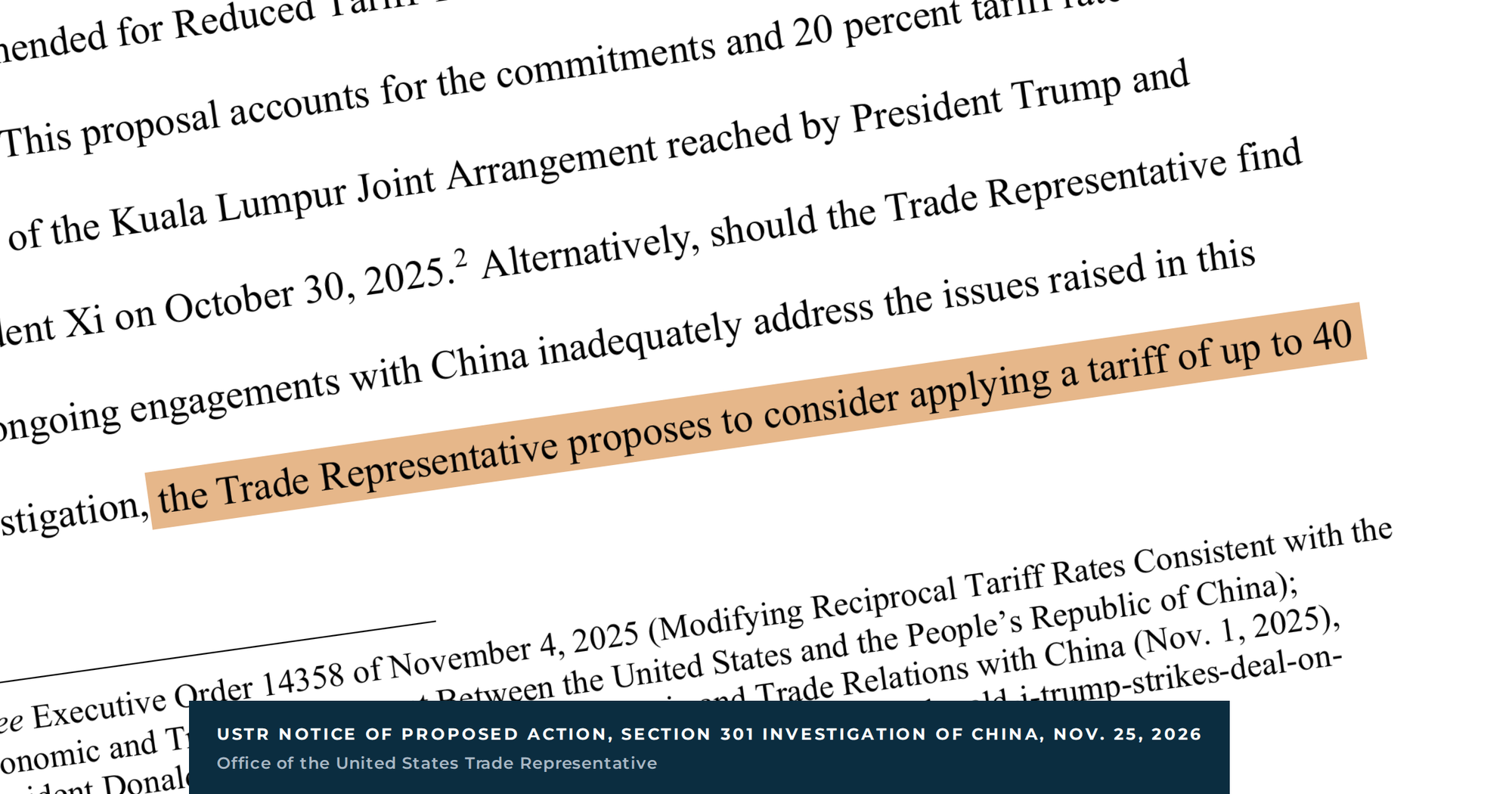
The trade office's notice on China sets a 20% top rate but keeps a fallback of up to 40% if talks with Beijing fall short. Document: Office of the United States Trade Representative; graphic: Fair Witness
Who covered this
On this page · sections
The short version
- The Trump administration proposed new tariffs on China, the EU and 12 other economies, saying their industrial policies create excess factory capacity.
- Most rates would stay inside earlier deals, but Chinese goods could face up to 20% on top of older duties, paid by U.S. importers.
- Written comments are due Jan. 5, and public hearings start Jan. 25 in Washington.
Documents in this story · 3
- ReleaseUSTR notice of proposed action, Section 301 investigation of China, Nov. 25, 2026USTR · PDF · Nov. 25Original Archived
- ReleaseUSTR makes determinations and proposes actions in 14 Section 301 investigations relating to structural excess capacityUSTR · Press release · Nov. 25Open Archived
- ReleaseUSTR initiates Section 301 investigations relating to structural excess capacity and production, March 11USTR · Press releaseOpen Archived
The Trump administration proposed new tariffs on China, the EU and 12 other economies on Wednesday, ruling that their industrial policies create excess factory capacity that burdens U.S. commerce.
For most of the 14, the new rates would stay inside the ceilings set in trade deals with President Donald Trump, so many may not face a large increase at the border. China is the exception. Its proposed rate of up to 20% would come on top of the roughly 25% it has paid on many goods since 2018. Nothing takes effect yet: the public can comment until Jan. 5, and hearings begin Jan. 25.
Why it matters to you
A tariff is a tax that U.S. importers pay when goods cross the border, and Trump's tariffs have added to consumer prices. The Yale Budget Lab estimates that the tariffs already in force cost each U.S. household about $900, The Guardian reported.
How much more you pay depends on where a product comes from. Goods from the EU, Japan, South Korea, Switzerland and Taiwan face a proposed rate of up to 15%, counted together with ordinary duties. The EU, Japan, South Korea and Taiwan accepted that 15% ceiling in earlier deals. Chinese goods are the ones that could see a real increase.
The process is open to anyone. Companies, trade groups and members of the public can file written comments or ask to testify through the trade office's online portal by Jan. 5, the notices say. The hearings start Jan. 25 at the U.S. International Trade Commission in Washington.
How Trump's new tariffs on China and the EU would work
The office of the U.S. trade representative, led by Jamieson Greer, issued 14 separate findings under Section 301 of the Trade Act of 1974. That law lets Washington answer foreign trade practices it finds unfair, discriminatory or burdensome, after a formal investigation. Each finding comes with its own proposed tariff, and the rates differ widely.
Greer said the net effect would be small for most partners. "When it all nets out, it really will just top up a few percentage points," he told CNBC. The new duties would not stack on the 10% or 12.5% tariffs the administration put on 60 trading partners in July over what it called lax enforcement of forced-labor bans. They would also respect the caps in trade deals, a senior official told Reuters.
China gets different treatment. Its notice proposes up to 20% on most goods and up to 10% on a list of others, and it exempts goods on a joint U.S.-China list recommended for lower tariffs. Those goods are worth about $30 billion, a U.S. official said. A year-old truce that caps China's new rate at 20% expires Jan. 10.
What the notices show that the headlines didn't
Reuters called China's 20% the highest rate on the list. The trade office's own list sets higher ceilings for two countries, though China's rate would stack on its older duties. Vietnam faces a proposed rate of up to 35%, and India up to 25%. Both notices name a lower rate, 20% for Vietnam and 17% for India, if either signs a trade deal that answers the findings. So for those two countries, the final rate depends on talks.
The China notice holds a lever of its own. It says the 20% reflects the truce Trump and Chinese leader Xi Jinping reached on Oct. 30, 2025. If the trade office finds that talks with China fall short, the notice proposes up to 40% on all Chinese goods instead. Outlets reported that 40% figure in different ways. NBC News said it could come if talks fail, while The Guardian described about 40% as the total tax once the new tariff is added.
When it all nets out, it really will just top up a few percentage points
How the tariff fight got here
The investigations began in March, covering 16 economies. Wednesday's findings name 14 of them. The trade office made no finding on Mexico or Norway, and Greer said Mexico's report would take a little more time.
Section 301 became the main tool after the Supreme Court in February struck down the tariffs Trump had imposed under an emergency powers law, the International Emergency Economic Powers Act. Trump then used another part of the trade law to put a 10% tariff on imports worldwide, before replacing it in July with forced-labor tariffs of up to 12.5%. A lawsuit against those July tariffs is waiting on a ruling from the Court of International Trade.
The politics have shifted too. Democrats won control of Congress in this month's midterms, and a Reuters/Ipsos poll afterward found that 62% of those asked would support efforts to repeal the tariffs. The proposal also comes a week after Trump met Xi in Shenzhen, a meeting the senior official praised while saying both sides want stability.
What we don't know yet
No one knows yet what the final rates will be, because the trade office can change any of them after the comments and hearings. Greer said he expected broad negotiations with the partners to follow. Whether India or Vietnam signs a deal that brings its rate down is part of that.
China's next step is unclear. Beijing criticized the idea of overcapacity before the notices came out but did not threaten to retaliate. We found no public response from China's Commerce Ministry to the formal notices as of noon ET Wednesday. The truce runs out on Jan. 10, more than two weeks before the hearings, and no report we read said whether it will be extended.
The start date is also uncertain. Greer said he didn't expect any of the tariffs to take effect for at least a couple of months, while the official told Reuters the process could push them into January.
The case each side makes
The Trump administration
Greer argues that the partners on the list make more than they can use at home and push the rest onto world markets, including America's. In his statement, he said they relied on subsidies, wage suppression and other practices that tilt trade their way while eroding America's factories. He said leaders from Trump and Joe Biden to Xi had named the problem at global meetings without fixing it.
He said the tariffs would "level the playing field for American workers." He also said the bill would be modest for most partners, because the rates respect the deals they signed, and that the partners know what is coming.
China and the other targets
China rejects the premise. "The so-called 'overcapacity' is a false issue," Foreign Ministry spokesperson Guo Jiakun said Wednesday, Reuters reported. He said China opposes using the idea as an excuse for political pressure, and that tariff and trade wars help no one.
The European Commission answered the findings on Wednesday. Its spokesperson, Olof Gill, said the EU firmly rejects the idea that Europe is a source of overcapacity and called Europe one of the regions hit hardest by it. The Commission said it would study the findings and expects any new tariff to respect the 15% ceiling in its deal with Washington. Gill made the same case in March, when the investigations began, saying the EU "does not consider itself a contributor to structural excess capacity," Euronews reported.
How coverage differs
Reuters and The Guardian set the tariffs beside the midterm losses and household costs. Fox Business and The Washington Times gave the rates, the list and the dates, with no word on voters or prices.
If you read the left 12 of 20 outlets
You heard Greer, then saw the bill.
If you read the center 5 of 11 outlets
You saw the vote in the headline.
If you read the right 5 of 20 outlets
You mostly got rates and dates.
Sources
Left
12 of 20 left-leaning outlets we track reported this
Center
5 of 11 center outlets we track reported this
Right
5 of 20 right-leaning outlets we track reported this
- Fox Business: Trump admin to raise tariffs on China, EU, other trading partners, Nov. 25
- The Washington Times: U.S. tariffs target China, EU and 12 other trading partners over excess factory capacity, Nov. 25
- New York Post: US proposes new tariffs on 14 trading partners, including China, Japan, EU and India, Nov. 25
Other reporting
Primary
- USTR: USTR makes determinations and proposes actions in 14 Section 301 investigations relating to structural excess capacity, Nov. 25 · Archived copy
- USTR: Notice of determination and proposed action in the Section 301 investigation of China, Nov. 25 · Archived copy
- USTR: USTR initiates Section 301 investigations relating to structural excess capacity and production, March 11 · Archived copy
This article was produced by AI under our Editorial Standards. Corrections are reviewed before they go live.
How coverage differs
Keep reading
The newest Economy stories.
The Fair Witness Daily
Every morning around 7 a.m. Eastern, seven days a week.
Wednesday’s editionFree
In Wednesday’s Daily
Then the Spin Meter: one divided story, set side by side as the left, center and right told it.
Free. One email a day.
Unsubscribe in one click. Already a member? Sign in