PCE inflation rose to 3.8% in October as markets bet on a December Fed rate hike
Core prices are rising at their fastest yearly pace since late 2023, and a Fed rate increase on Dec. 9 would make borrowing cost more.

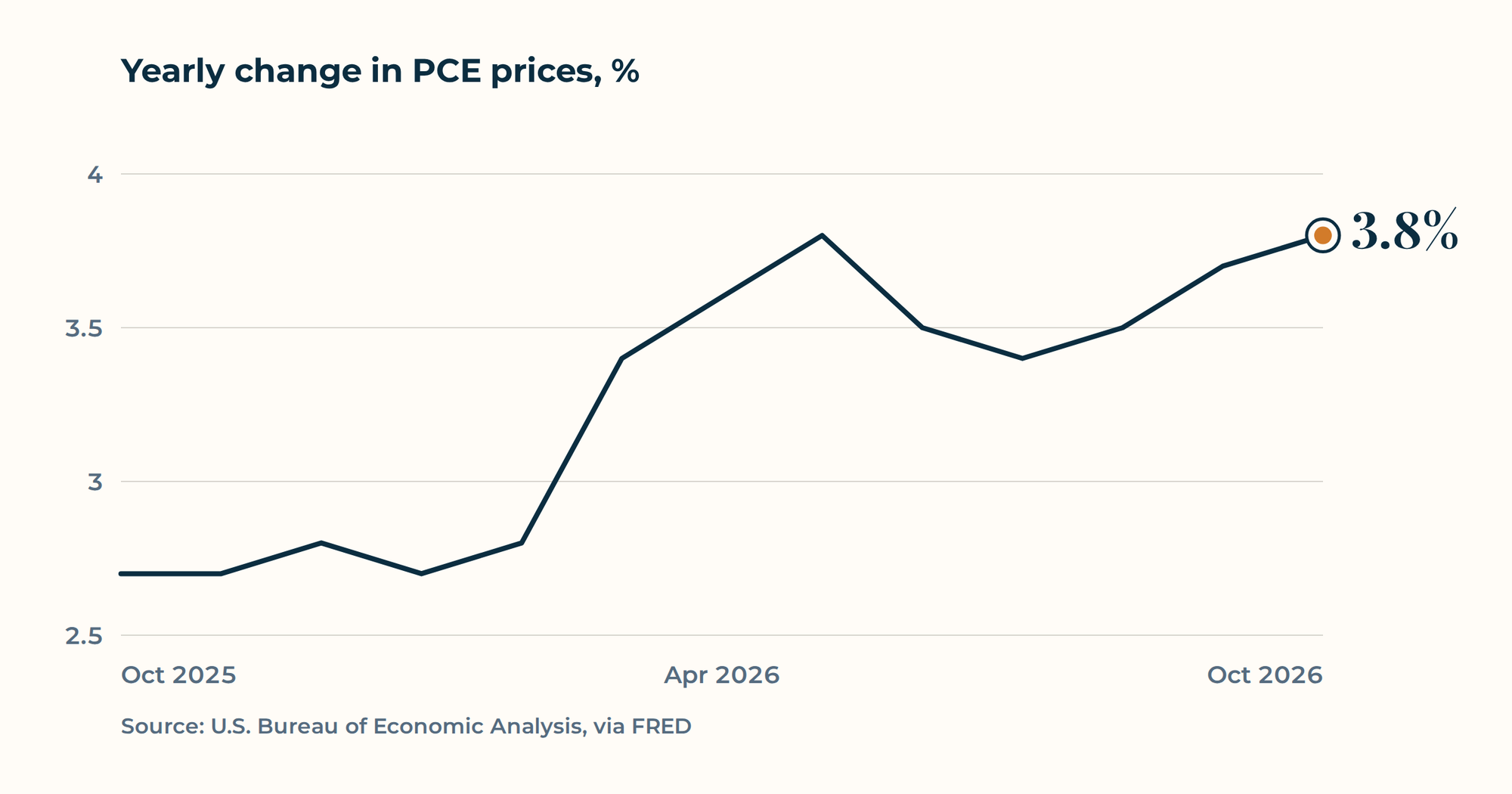
Yearly PCE inflation, October 2025 to October 2026, climbed a full point from 2.8% in February to 3.8% in October. Chart: Fair Witness; data: U.S. Bureau of Economic Analysis, via FRED
Who covered this
On this page · sections
The short version
- The Federal Reserve's preferred inflation gauge rose 3.8% over the year to October, and core prices rose 3.3%, the most since 2023.
- Markets now fully expect a Fed rate increase on Dec. 9, which would make card balances and many loans cost more.
- The next reading on these prices comes Dec. 23, two weeks after the Fed decides.
Documents in this story · 7
- RecordPersonal Income and Outlays, October 2026Bureau of Economic Analysis · Web page · Nov. 25Open Archived
- RecordGDP (second estimate) and corporate profits, third quarter 2026Bureau of Economic Analysis · Web page · Nov. 25Open Archived
- RecordPCE price index, BEA dataFederal Reserve Bank of St. Louis (FRED) · Web pageOpen Archived
- RecordPCE price index excluding food and energy, BEA dataFederal Reserve Bank of St. Louis (FRED) · Web pageOpen Archived
- RecordMinutes of the FOMC meeting, Oct. 27–28, 2026Federal Reserve · Web pageOpen Archived
- RecordGovernor Christopher Waller, The Economic Outlook and Some Thoughts on Labor Market DynamismFederal Reserve · Web page · Nov. 10Open Archived
- ReleaseSenator Warren Statement on October 2026 PCESenate Banking Committee minority · Press release · Nov. 25Open Archived
PCE inflation, the Federal Reserve's preferred price gauge, rose to 3.8% in the year through October, the government said Wednesday. Markets now fully expect the Fed to raise interest rates again when it decides on Dec. 9.
The bigger signal sat under the headline. Leave out food and energy, which swing from month to month, and core prices were up 3.3%, the highest yearly rate since late 2023. A separate report showed the economy grew at a 4.3% yearly rate in the summer, much faster than first thought. To CNBC, that growth was a sign the Fed's rates aren't holding the economy back.
Why it matters to you
The Fed's key rate sets the floor for what you pay to borrow. Traders have fully priced in a quarter-point increase at the Dec. 8–9 meeting, meaning they treat it as all but settled. They also expect another in January. Credit card rates, home equity lines and other variable-rate loans usually follow the Fed's moves.
Higher prices are eating up households' extra spending. Spending rose 0.3% in October, the same as prices, so once inflation is taken out, households bought slightly less than in September. Prices are still rising almost twice as fast as the Fed's 2% goal, which it has missed for about five and a half years.
What drove PCE inflation in October
Energy prices cooled in October, but core prices kept their pace. Gasoline and other energy goods rose 0.8% in the month, after a 9.2% jump in September. That pulled the overall monthly rise down to 0.3%, from 0.5%. Core prices rose 0.3% for a third straight month, a pace of roughly 3.7% a year if it lasts. Food prices rose 0.4% after two flat months.
So how can inflation slow and speed up at once? The monthly rise eased, but the yearly rate climbed because October's gain replaced a smaller one from October 2025. Forecasters had expected the overall figure, which matched them, but the yearly core figure came in a tenth of a point higher.
Incomes jumped 0.7%, far more than expected, and the government's release explains part of the jump: growth in benefits was led by one-time Medicare premium rebate payments, which won't repeat. The saving rate rose to 4.1%.
The summer's growth figure, first reported at 3.4%, was revised up mostly because of business investment in software and consumer spending. Strong demand like that tends to keep prices rising.
How inflation climbed a full point this year
In February, yearly inflation by this gauge was 2.8%. Then the U.S. and Israel went to war with Iran at the end of that month, and energy prices jumped. The government's index shows the yearly rate rose to 3.4% in March and 3.8% in May, eased over the summer, and is now back at May's level, the highest since 2023. September's rate now stands at 3.7% after revisions, a tenth higher than first reported.
The Fed responded in September with its first rate increase since 2023. It then held its key rate between 3.75% and 4% in October, but two officials, Lisa Cook and Beth Hammack, voted for another increase. Fair Witness reported this month on October's jobs report and on wholesale prices, which pointed the same way.
The White House had said what it expected. Kevin Hassett, director of the National Economic Council, said last month that if October's inflation came in high, "the Fed would probably appropriately act." We found no public response from the White House to Wednesday's report as of 11:40 a.m. ET Wednesday. Sen. Elizabeth Warren, the top Democrat on the Senate Banking Committee, said in a statement that Thanksgiving shows "the pain is showing up at the holiday table." She faulted President Donald Trump's promise to lower costs, but she did not dispute the figures.
What we don't know yet
No one outside the Fed knows yet whether the Dec. 9 increase will be a quarter point or half a point. A quarter point is priced in, but some officials have floated the larger step, and the November consumer price report arrives Dec. 10, a day after the Fed decides. The Fed will act without it.
It's also unclear how far into 2027 the increases run. The next PCE report, on Dec. 23, will show whether core prices kept their 0.3% monthly pace in November.
Where experts disagree
Where experts agree
Economists quoted Wednesday expect the Fed to raise rates in December. Chris Rupkey, chief economist at Fwdbonds, said the Fed should speed up its increases, because "the inflation fires look to be stoked by old-fashioned economic demand pressures." Heather Long, chief economist at Navy Federal Credit Union, called October "another hot inflation reading" and said the Fed has to act in December and likely in January.
Fed officials have said much the same. In October, almost all of them judged that further action to raise rates would likely be appropriate, according to the meeting's minutes, released last week. Most said the price pressures were broad based.
What's still debated
The split is over size, and over whether this is a short fix or a longer fight. Fed Governor Christopher Waller said on Nov. 10 that a half-point increase should be considered if October's consumer price data showed core prices rising about 0.3% a month or more. In Fed terms, a quarter point is 25 basis points. "Hiking only 25 basis points would put our credibility at risk," he said. Two officials made a similar point in the October minutes.
Others expect smaller steps. Before Wednesday's report, Oxford Economics forecast this 3.8% reading and said markets were overpricing the odds of a half-point hike, expecting energy's push on other prices to fade through 2027. Tiffany Wilding, an economist at PIMCO, wrote on Nov. 10 that the Fed's moves look like a recalibration, not the start of a long cycle of increases. Wages, she wrote, have not sped up the way they did in 2021 and 2022.
The inflation fires look to be stoked by old-fashioned economic demand pressures.
How coverage differs
Inflation slowed in Breitbart's headline and accelerated in CNBC's, and both matched the record: the monthly pace eased while the yearly rate rose. Which number an outlet put first set the story its readers got.
If you read the left 3 of 20 outlets
Your story was the yearly climb.
If you read the center 2 of 11 outlets
The rate path came first for you.
If you read the right 3 of 20 outlets
You saw the slowdown first.
Sources
Left
3 of 20 left-leaning outlets we track reported this
Center
2 of 11 center outlets we track reported this
Right
3 of 20 right-leaning outlets we track reported this
- Fox Business: Fed's favored inflation gauge rose in October ahead of expected Fed rate hike next month, Nov. 25
- Breitbart: U.S. Inflation Slowed in October, but Core Prices Kept Rising, Nov. 25
- Just The News: Fed's Personal Consumption Expenditures Prices Index indicates price up 3.8% compared to last year, Nov. 25
Other reporting
- American Banker (Bloomberg News): Hassett sees Fed acting if October inflation data come in high, Oct. 29 (banking trade publication, running a Bloomberg report)
- Oxford Economics: US PCE nowcast – Broadening pressures lock in December rate hike, Nov. 16 (economic research firm)
- PIMCO: Inflation Is Sticky, But This Isn't 2022 All Over Again, Nov. 10 (investment firm's research note)
Primary
- Bureau of Economic Analysis: Personal Income and Outlays, October 2026, Nov. 25 · Archived copy
- Bureau of Economic Analysis: GDP (second estimate) and corporate profits, third quarter 2026, Nov. 25 · Archived copy
- Federal Reserve Bank of St. Louis (FRED): PCE price index, BEA data · Archived copy
- Federal Reserve Bank of St. Louis (FRED): PCE price index excluding food and energy, BEA data · Archived copy
- Federal Reserve: Minutes of the FOMC meeting, Oct. 27–28, 2026 · Archived copy
- Federal Reserve: Governor Christopher Waller, The Economic Outlook and Some Thoughts on Labor Market Dynamism, Nov. 10 · Archived copy
- Senate Banking Committee minority: Senator Warren Statement on October 2026 PCE, Nov. 25 · Archived copy
This article was produced by AI under our Editorial Standards. Corrections are reviewed before they go live.
How coverage differs
Keep reading
The newest Economy stories.
The Fair Witness Daily
Every morning around 7 a.m. Eastern, seven days a week.
Wednesday’s editionFree
In Wednesday’s Daily
Then the Spin Meter: one divided story, set side by side as the left, center and right told it.
Free. One email a day.
Unsubscribe in one click. Already a member? Sign in