


New Zealand election final results leave Luxon's coalition one seat short
A centrist newcomer with seven seats now decides whether Luxon keeps power or New Zealand votes again.

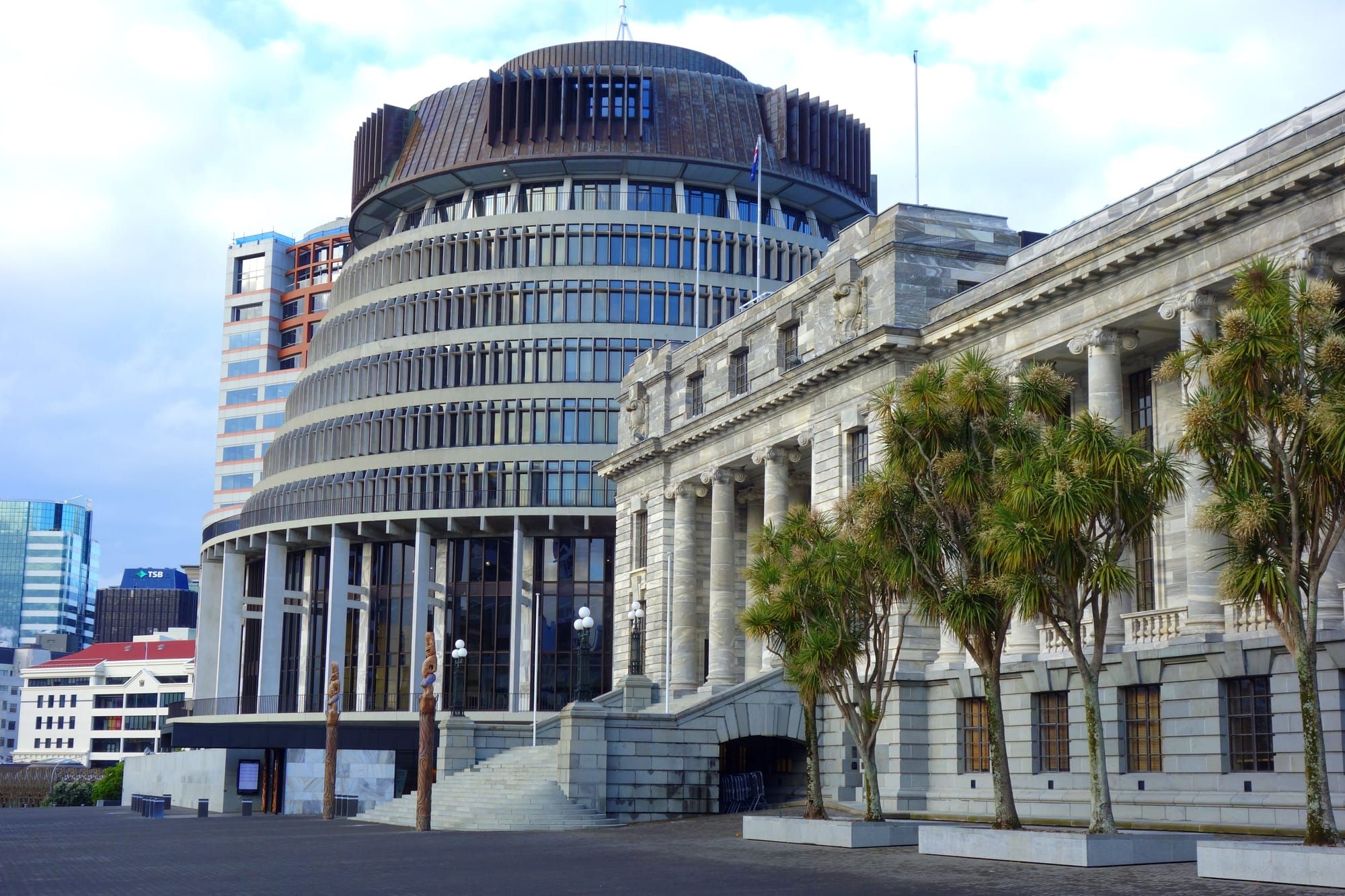
The seat of New Zealand's government, where the next one will need 66 of Parliament's 130 seats to take office. Photo, October 2024: Daderot / Wikimedia Commons / CC0
Who covered this
On this page · sections
The short version
- New Zealand's final election count left Prime Minister Christopher Luxon's three-party coalition with 65 of 130 seats, one short of a majority.
- The centrist Opportunity party's seven seats now decide whether Luxon can govern, and a failed deal could mean another election.
- Recount applications are due by Dec. 3, and Parliament must meet by Jan. 14.
Final results in New Zealand's election, released Friday, left Prime Minister Christopher Luxon's coalition one seat short of a majority, with 65 of 130 seats. Special votes, counted last, cost his National Party two seats.
That hands the choice to the Opportunity party, a centrist newcomer with seven seats. Luxon ruled it out as a partner before the Nov. 7 vote and now needs it to stay in power. If no deal is reached, New Zealand will likely need another election.
Why it matters to you
Until a deal is signed, Luxon's ministers stay on as a caretaker government, which can't make major decisions on its own except in an emergency. Whatever deal ends that could give New Zealand its first four-party coalition. No majority has needed more than three parties since the country adopted proportional voting in 1996.
Two dates frame the talks. Applications for a recount are due by Dec. 3, and one seat changing back could hand National a majority without Opportunity. Parliament must meet on or before Jan. 14, deal or no deal. Money is moving too. The New Zealand dollar, at a 17-year low against the U.S. dollar this week, rose slightly after the results came out.
How the final election results erased the majority
On election night, Luxon's National, the libertarian ACT party and the populist New Zealand First led the left 67 seats to 64. Then came the special votes, cast by people overseas or outside their home district, which usually lean left. The Electoral Commission counted about 2.93 million votes in all, including about 485,000 special votes, Reuters reported. AP put the totals lower, at 2.8 million and 400,000.
Three local races flipped. Labour took Wairarapa from National by 81 votes, and the Greens took Wellington Bays from Labour. Labour also took Hamilton East, by 173 votes in the Guardian's count and 172 in RNZ's. The final seats: National 40, Labour 36, Greens 17, ACT 13, NZ First 12, Opportunity 7 and Te Pāti Māori 5.
That leaves Labour, the Greens and Te Pāti Māori, the Indigenous rights party, with 58. Even with Opportunity, the left can't form a government, the BBC reported.
Why the 'tie' only runs one way
One rule shapes the talks. Add Opportunity's seven seats to the left's 58 and you get 65, the same as Luxon's bloc. But a government has to win votes of confidence, and "a tied vote in the House of Representatives is a lost vote," said Andrew Geddis, a law professor at the University of Otago.
So Opportunity can't make Labour's Chris Hipkins prime minister. It can back a National-led government, or abstain on confidence votes, which would leave Luxon's 65 seats against 58. Or it can do neither, and keep the deadlock. Geddis said an abstention deal would be fragile, because Opportunity could switch its votes at any time and bring the government down.
One other path exists on paper. NZ First could join Labour and its partners, as it did after the 2017 election that made Jacinda Ardern prime minister.
How National won more seats with fewer votes
Labour won 29.88% of the party vote to National's 28.35%. Yet National has four more seats. New Zealanders cast two votes, one for a party and one for a local member. National won more of the local races, and a party keeps every local seat it wins, even past its share of the party vote.
There are 10 of those extra seats this time, called overhang: six for National and four for Te Pāti Māori. That is why this Parliament has 130 seats instead of the usual 120. It is also why a majority takes 66.
What Opportunity wants
Opportunity is led by Qiulae Wong, a 38-year-old business consultant new to politics. Its five bottom lines are action on the supermarket duopoly, a cap on political donations, a 10-year cross-party health plan, an end to bottom trawling and stronger climate commitments, the Guardian reported. Wong has also said Opportunity won't strike a deal if NZ First leader Winston Peters is foreign minister.
Wong said Friday she would sit down with National first, as the largest party, though she had not yet spoken with Peters, RNZ reported. Nor would she rule out a new election. "I don't think anybody can rule anything out at this stage," she told reporters.
The other leaders set out their own positions. Hipkins said Labour was again "the most popular political party in New Zealand" but could not form a government, and he ruled out a grand coalition with National. We found no public response from Peters to Friday's count as of 8:45 a.m. ET Friday. Luxon said formal talks with ACT, NZ First and Opportunity would now begin.
What we don't know yet
Opportunity has not said whether it will join a National-led government, support it from outside or only abstain. Short of a four-party coalition, it could sign a looser confidence-and-supply agreement that supports the government on key votes. Wong said an abstention deal was possible even if her bottom lines weren't met. Whether Peters would accept a deal with Opportunity, or step aside from foreign affairs, is also unknown.
Recounts could change the math. National is likely to seek one in Wairarapa, RNZ reported, though three recounts after the 2023 count took 12 days and changed no winners. Talks after that election took 40 days, and this time four parties are at the table.
The case each side makes
Luxon and his partners
Luxon said voters had told him they want leaders to find common ground. He promised to negotiate in good faith but not to rush. "Kiwis won't thank us for rushing to an agreement that falls apart," he said. His aim, he said, is a stable government that lasts the full three years. Peters hasn't responded to the count.
ACT's David Seymour said a government could be formed if the coalition worked with Opportunity at some level. He said a deal could come in days but more likely weeks. "I hope it doesn't take months," he said. ACT also wants New Zealand out of the Paris climate agreement unless its targets change, the opposite of one of Opportunity's bottom lines, RNZ reported.
Opportunity
Wong's case is that her party's terms are the price of stability. She said the five bottom lines are minimum terms for any coalition or support deal, RNZ reported. Her party ran on evidence-based centrism and an end to partisan bickering, AP reported.
I don't think anybody can rule anything out at this stage.
Before the count, Wong said she could work with either bloc, and on Friday she said her team was ready to start talks at once. Her party would do everything it could to make sure New Zealand has a stable government, she said.
How coverage differs
Every side's readers got the 65-seat math. The rest varied: the Guardian listed Opportunity's bottom lines and its condition on Peters, Reuters showed a second path through NZ First, and the BBC framed the result around voters' frustration with the economy.
If you read the left 3 of 21 outlets
You got the price of a deal.
If you read the center 3 of 12 outlets
You saw a second way out.
If you read the right 3 of 21 outlets
You got wire copy and a cast list.
Sources
Left
3 of 21 left-leaning outlets we track reported this
- AP: Deadlocked final result in New Zealand's election leaves a new centrist party the decider, Nov. 27
- The Independent (AP copy): New Zealand election results: Ruling coalition falls short of majority by just one seat after knife-edge vote, Nov. 27
- The Guardian: New Zealand election: final results show ruling coalition needs minor party to govern, Nov. 27
Center
3 of 12 center outlets we track reported this
- Reuters: New Zealand's ruling coalition falls just short of majority, needs centrist Opportunity to govern, Nov. 27; also Reuters: Explainer: Parties to negotiate after no one wins majority in New Zealand election, Nov. 27
- BBC News: New Zealand's ruling coalition falls short of parliamentary majority by one seat, Nov. 27
- The Hill (AP copy): Deadlocked final result in New Zealand's election leaves a new centrist party the decider, Nov. 27 (headline only)
Right
3 of 21 right-leaning outlets we track reported this
- The Washington Times (AP copy): Deadlocked final result in New Zealand's election leaves a centrist newcomer as the decider, Nov. 27
- Daily Mail (AP copy): Deadlocked final result in New Zealand's election leaves a centrist newcomer as the decider, Nov. 27; also Daily Mail (AFP copy): The key players as New Zealand heads for weeks of political wrangling, Nov. 27
- Newsmax (AP copy): Final Count in New Zealand's Election Gives Neither Right Nor Left Bloc Enough Seats for a Majority, Nov. 27 (headline only)
Other reporting
- RNZ: Election 2026 final results: Coalition loses majority, another election possible, Nov. 27 (New Zealand's public broadcaster)
- RNZ: Wong won't rule out sending voters back to polls, Luxon says challenging talks coming, Nov. 27 (New Zealand's public broadcaster)
- RNZ: Hipkins will decide on leadership after government formed, Nov. 27 (New Zealand's public broadcaster)
- 1News: Hung parliament: Why Opportunity is essential to break the tie, Nov. 27 (news service of TVNZ, New Zealand's public TV network)
- 1News: 'Unprecedented' election delivers a tough deal for Luxon to seal, Nov. 27 (news service of TVNZ, New Zealand's public TV network)
This article was produced by AI under our Editorial Standards. Corrections are reviewed before they go live.
How coverage differs
Keep reading
The newest World stories.
The Fair Witness Daily
Every morning around 7 a.m. Eastern, seven days a week.
Friday’s editionFree
In Friday’s Daily
Then the Spin Meter: one divided story, set side by side as the left, center and right told it.
Free. One email a day.
Unsubscribe in one click. Already a member? Sign in












Discussion
Any free account can join the discussion.