


EU leaders pick Spain's Pablo Hernández de Cos as next ECB president
The former Bank of Spain chief would take over a central bank facing inflation at twice its target and strain over France's debt.

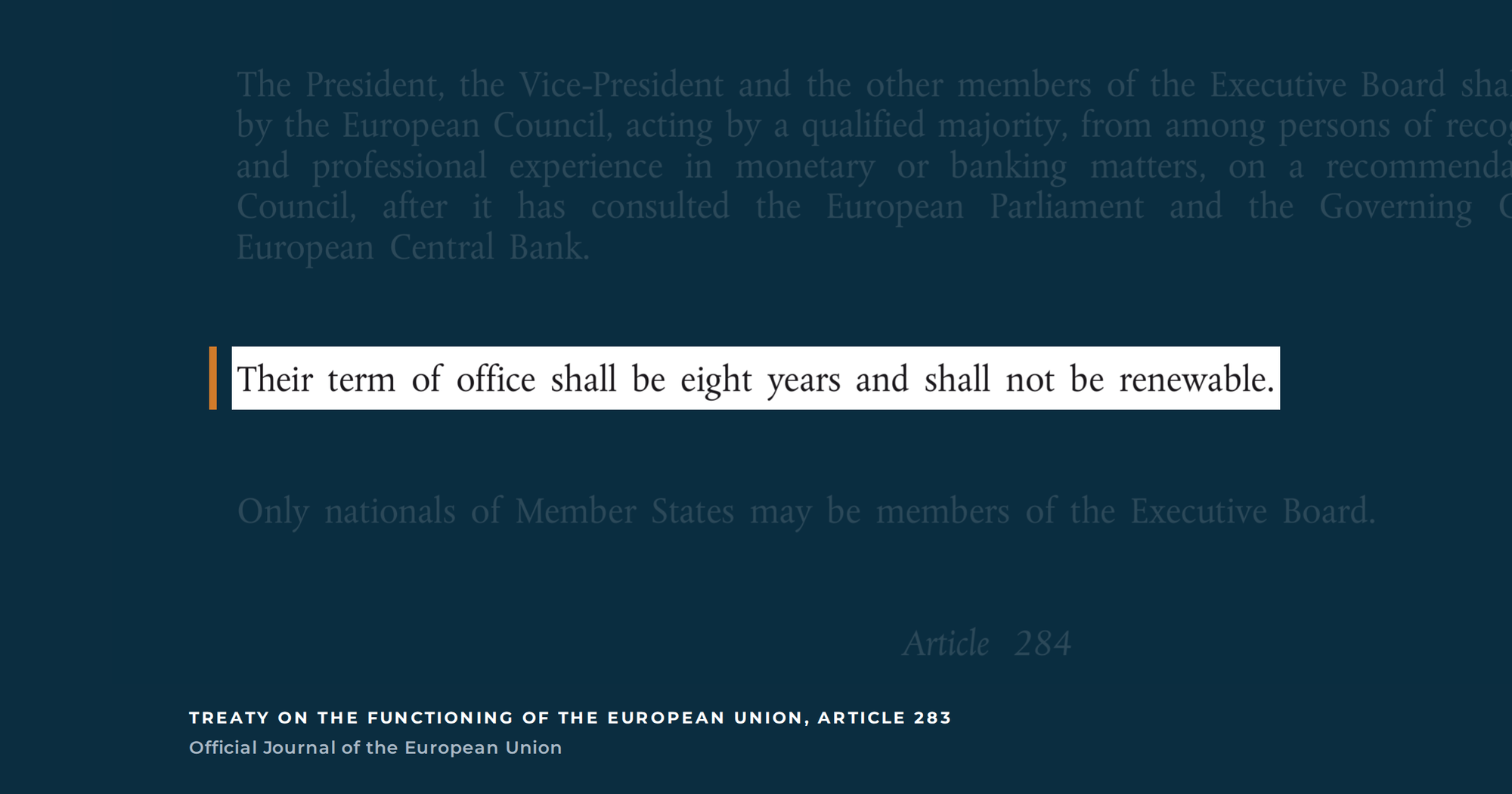
Article 283 of the EU treaty sets how the ECB president is chosen and limits the job to one eight-year term. Document: Official Journal of the European Union; graphic: Fair Witness
Who covered this
On this page · sections
The short version
- Euro-area leaders chose Spain's Pablo Hernández de Cos to succeed Christine Lagarde as European Central Bank president.
- The bank sets borrowing costs for about 359 million people, and inflation there is running at twice its target.
- EU leaders are expected to appoint him formally in December, and he would take over after Lagarde leaves on Feb. 7.
Leaders of the 21 countries that use the euro chose Pablo Hernández de Cos, Spain's former central bank governor, on Thursday to succeed Christine Lagarde as European Central Bank (ECB) president. He won out over the Netherlands' Klaas Knot, and EU leaders are expected to make the appointment formal at their December meeting.
The choice matters well beyond Frankfurt, where the bank sits. The ECB sets borrowing costs for about 359 million people, and its new leader inherits inflation of 4%, twice the bank's target, along with worries over France's debt.
Why it matters to you
The ECB's interest rates flow into almost every loan in the euro area. They shape what banks charge one another overnight, and from there credit cards, home mortgages and government bonds. If you borrow, save or own a business in one of the 21 countries, the person running those meetings matters to you.
Americans feel it too, through the exchange rate. The euro has fallen about 6% against the dollar this year, which makes European trips and goods cheaper for people paid in dollars. Higher ECB rates tend to support the euro, and lower ones tend to weaken it.
The next date comes before he arrives. Lagarde still chairs the bank's Dec. 17 meeting, where the AP said a rate increase is possible. Markets have already priced in a quarter-point rise in December, NTD reported.
How Hernández de Cos won the ECB president race
The race opened on Oct. 29, when Lagarde told the bank's Governing Council and European Council President António Costa that she would step down on Feb. 7, 2027. That is eight to nine months before her term ends, by the AP's and CNN's counts. She has said she wants to speak more freely on matters beyond monetary policy.
The contest came down to two career central bankers. Knot, who led the Dutch central bank, was seen as a hawk, someone who favors higher rates to hold down inflation. Hernández de Cos had the backing of France and Germany, the Guardian reported, and the Netherlands made a final push for Knot at this week's summit, according to CNBC. The push ended on Thursday, when Dutch Prime Minister Rob Jetten dropped his support for Knot and agreed to back the Spaniard instead, EU officials told Reuters.
The presidency came as part of a package. Euro-area ambassadors recommended three names at once. Germany's Markus Brunnermeier, a Princeton University economist, would replace Philip Lane as chief economist. France's Laurence Boone, who heads corporate and investment banking in France for Spain's Santander, would take the seat Isabel Schnabel leaves in January. French President Emmanuel Macron welcomed a "balanced trio of individuals serving the stability and prosperity of the euro area" in a post on X. Spain's prime minister, Pedro Sánchez, who faces a national election on Sunday, celebrated the pick as a sign of Spain's weight in Europe.
Who Hernández de Cos is, and how long he would serve
Hernández de Cos, 55, rose through the Bank of Spain from researcher to governor, a post he held from 2018 to June 2024. That seat put him on the ECB's rate-setting council. He also chaired the Basel Committee on Banking Supervision, which writes global rules for banks. Since July 2025 he has run the Bank for International Settlements, a Basel-based bank for the world's central banks. He would be the first Spaniard to lead the ECB and its fifth president since 1998.
His record is the reason analysts argue over his leanings. In 2020 he backed the bank's pandemic stimulus and said in a speech that it had been "clearly successful in curbing financial market deterioration" across the euro area, the AP reported. But he also supported steep rate increases after the 2022 energy shock, CNBC reported. "Some people try to label him as dovish but I don't see that," Carsten Brzeski, an economist at ING, told Reuters.
The rules for the job explain why Thursday's choice reaches so far ahead. Under Article 283 of the EU treaty, the European Council appoints the president by a qualified majority, on a recommendation from EU ministers. The ministers must first consult the European Parliament and the ECB's Governing Council, but neither can block the choice, CNBC reported. The treaty also sets one term of eight years that can't be renewed. If he takes office in February as expected, he would serve into 2035.
What we don't know yet
We don't know how Hernández de Cos would respond if markets turned on France's debt. French debt is forecast to reach 122% of GDP next year, and France votes for a new president in April. The ECB can buy a country's bonds when it judges market moves unwarranted or disorderly, but it has never used its tool built for that, the Transmission Protection Instrument. Whether he would, and on what conditions, may not be clear until a crisis tests him.
We also haven't heard from him. We found no public statement from Hernández de Cos on his selection as of 5:45 p.m. ET Thursday, and none of the reports we read quoted him on it. Next, the European Parliament and the ECB's Governing Council are to be consulted, a step Costa said will pave the way for the formal appointment in December. Whether he speaks publicly before then is still open.
Where experts disagree
Analysts agree on one point. "We do not expect his appointment to alter the near-term rate path," Matthew Ryan of the financial services firm Ebury told the Guardian. Where they split is over how he will lean once he is in charge.
He leans toward lower rates
Analysts at Germany's Commerzbank reviewed his speeches and put him among the monetary policy doves, policymakers who favor lower rates to support growth, the AP reported. Commerzbank's Marco Wagner said many governments with rising debt would likely prefer a dovish president. Arne Petimezas of AFS Group Amsterdam called him the continuity candidate and said he leans dovish, though he said France should expect no free pass on its debt.
Ryan, too, expects him to put more weight on growth and financial stability than Knot would have. On this reading, a softer hand on rates is likelier under him when the economy weakens.
He follows the data, not a camp
Others say the dove label misreads him. Brzeski called his record that of a moderate, and former colleagues described him to Reuters as flexible and pragmatic, willing to change his position. Christian Kopf of Union Investment said his support for easy money came when inflation was too low, and that his views may depend on conditions.
Kopf also said choosing a career technocrat would send a signal at a time when the world is seeing an "assault on central bank independence," including in the United States. That argument echoes the fight over the Federal Reserve that we covered when Fed Governor Lisa Cook said she won't attend a White House hearing on her firing without changes.
Some people try to label him as dovish but I don't see that.
How coverage differs
Whether you were told the next ECB president favors cheaper money depended on where you read. AP's story, which ran on sites across the spectrum, cited analysts calling him a dove, while Reuters described a pragmatist and NTD a centrist with no fixed lean.
If you read the left 6 of 21 outlets
France's debt came with the news.
If you read the center 2 of 12 outlets
You learned how the deadlock broke.
If you read the right 5 of 21 outlets
NTD put inflation first.
Sources
Left
6 of 21 left-leaning outlets we track reported this
- The Guardian: Spain's Pablo Hernández de Cos wins race to be next ECB president, Nov. 26
- CNN: European Central Bank set to appoint its first Spanish leader, Nov. 26
- CNBC: Spain's Pablo Hernández de Cos set to lead European Central Bank, Nov. 26
- Associated Press: Leaders choose Spain's former central bank head as next European Central Bank president, Nov. 26 (AP's article page blocks agents; linked to its world news section, text read through the copies below)
- ABC News (AP copy): Spain's former central bank head chosen as next European Central Bank president, Nov. 26
- The Independent (AP copy): Leaders choose Spain's former central bank head as next European Central Bank president, Nov. 26
Center
2 of 12 center outlets we track reported this
Right
5 of 21 right-leaning outlets we track reported this
- NTD: Spain's Pablo Hernández de Cos Set to Lead the European Central Bank, Nov. 26
- Just The News: European leaders name Spain's former central bank head as next European Central Bank president, Nov. 26
- The Washington Times (AP copy): Leaders choose Spain's former central bank head as next European Central Bank president, Nov. 26
- Daily Mail (AP copy): Leaders choose Spain's former central bank head as next European Central Bank president, Nov. 26
- Newsmax (AP copy): Leaders Choose Spain's Former Central Bank Head as Next European Central Bank President, Nov. 26 (headline only)
This article was produced by AI under our Editorial Standards. Corrections are reviewed before they go live.
How coverage differs
Keep reading
The newest Economy stories.
The Fair Witness Daily
Every morning around 7 a.m. Eastern, seven days a week.
Friday’s editionFree
In Friday’s Daily
Then the Spin Meter: one divided story, set side by side as the left, center and right told it.
Free. One email a day.
Unsubscribe in one click. Already a member? Sign in















Discussion
Any free account can join the discussion.