


Black Friday shoppers stock up on essentials as inflation lifts holiday sales forecasts
Forecasters expect the first $1 trillion holiday season, but higher prices drive much of it, so bigger totals overstate what people actually buy.

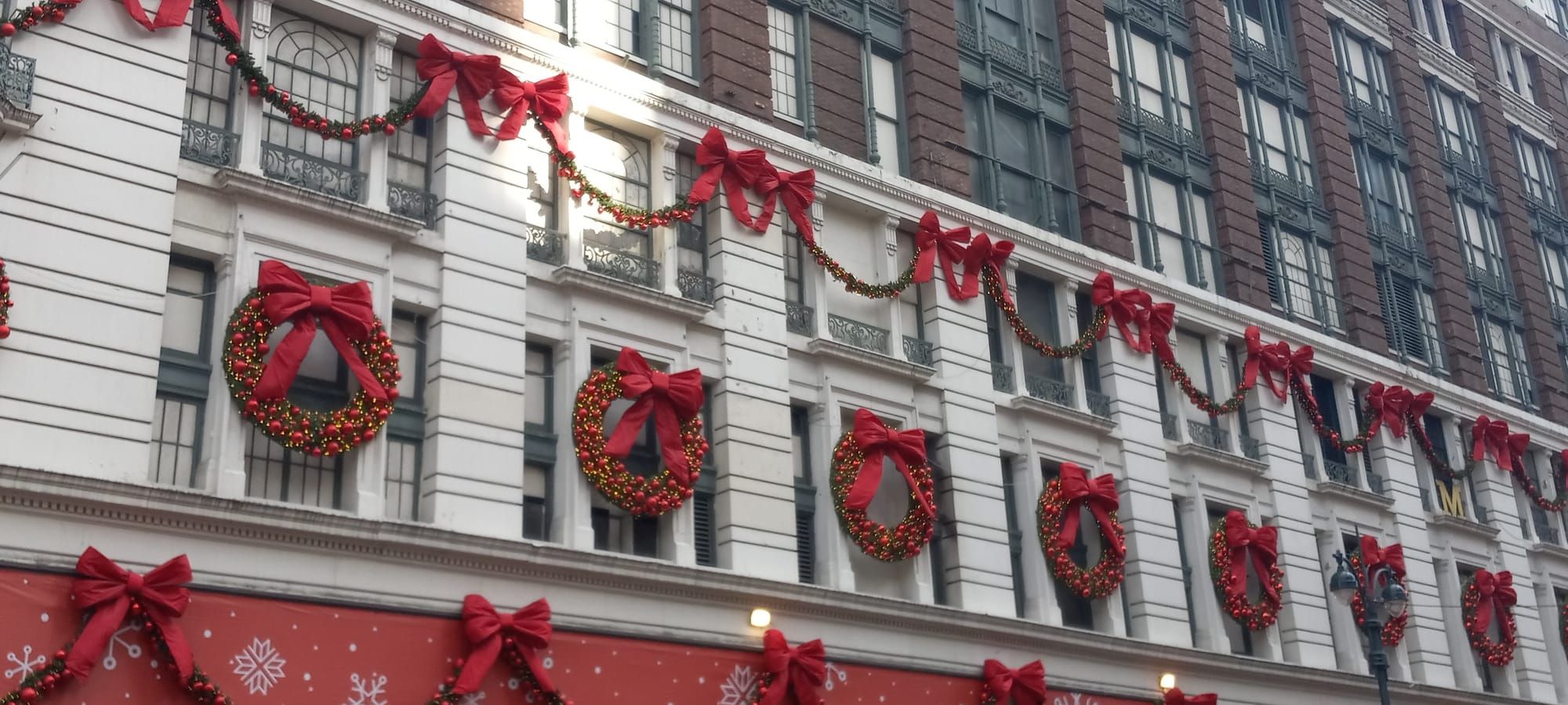
Macy's Herald Square, dressed for the 2024 holidays, where shoppers lined up before sunrise again this Black Friday. Photo, November 2024: Kidfly182 / Wikimedia Commons / CC BY 4.0
Who covered this
On this page · sections
The short version
- Black Friday arrived in a holiday season forecast to top $1 trillion, with online spending up about 9% in early November.
- Much of that growth is higher prices, and shoppers are buying more household basics, so bigger totals don't mean fuller bags.
- Adobe's Black Friday tally comes after the weekend, and the Federal Reserve meets on interest rates Dec. 9.
Documents in this story · 5
- NRF forecasts 2026 holiday sales growth as consumers remain resilientNational Retail Federation · Press release · Oct. 15Open Archived
- 183 million consumers expected to shop during Thanksgiving weekendNational Retail Federation · Press release · Nov. 19Open Archived
- Thanksgiving holiday weekend draws a record 203 million shoppersNational Retail Federation · Press release · Dec. 2, 2025Open Archived
- U.S. holiday shopping season to hit record $275.1 billion onlineAdobe · Web page · Sept. 28Open Archived
- Personal Income and Outlays, October 2026Bureau of Economic Analysis · Web page · Nov. 25Open Archived
Inflation is doing much of the work behind a holiday season forecast to top $1 trillion for the first time. Black Friday shoppers are spending more online, and many are stocking up on household basics, not just gifts.
The National Retail Federation, the industry's main trade group, forecast in October that November and December sales would grow 4.2% to $1.013 trillion. But prices are rising too. The Federal Reserve's preferred inflation gauge was up 3.8% in the year to October, and Reuters reported that most of the season's gains will come from higher prices. A record in dollars is not a record in things bought.
Why it matters to you
Discounts may be near their peak this weekend. Adobe, which tracks online sales, expected TV discounts to average 23% on Friday, against 11% in the first three weeks of November. Salesforce said discounts before Black Friday were about 8% bigger than last year's. Cyber Monday, on Nov. 30, is forecast to be the biggest online day of the year, at about $15 billion.
Many shoppers will pay later. Adobe expects $21.3 billion in online holiday purchases to go on buy now, pay later plans, which split a purchase into installments. The Daily Caller, citing a NerdWallet survey, reported that 38% of people planning to use them already expected trouble paying on time. A typical four-part plan started Friday would end on Jan. 8.
Borrowing on cards may soon cost more. The Fed meets Dec. 9, and Scripps News reported that the October inflation report made a rate increase much more likely, which would push up credit card and loan rates.
Why inflation is changing what Black Friday shoppers buy
Online spending started early and strong. Shoppers spent $82.5 billion online from Nov. 1 to 22, up 9.1% from the same weeks last year, according to Adobe. Thanksgiving Day itself brought in $7.1 billion online, beating Adobe's own forecast, the Daily Mail reported, citing Adobe.
What people bought is the telling part. Adobe found that online sales of personal hygiene products in those weeks ran 40% above October's average. Cleaning products were up 33% and basic clothing 27%. "It's not just a moment where shoppers are buying gifts," Caila Schwartz, a retail and consumer insights leader at Salesforce, told AP. Shoppers are using the long sale season to stock up.
The federation's own survey shows the strain behind that shift. Of the adults it surveyed, 82% said they were taking steps to manage holiday costs, such as buying cheaper gifts or cutting back elsewhere. And once inflation is taken out, households bought slightly less in October than in September, even though they spent more.
Visa's forecast separates prices from purchases. It expects prices of holiday goods to rise 3.4% and holiday spending, after inflation, to grow 1.1%, The Center Square reported. AP, citing the federation, put its growth estimate at 4.1% and said higher prices would account for about half of it. The federation's published forecast says 4.2%.
How far holiday forecasts have missed before
Forecasts like these can miss by a lot. This year the federation expects 182.7 million people to shop from Thanksgiving through Cyber Monday, down from 186.9 million last year. Axios reported that dip as a drop of more than 2%, largely because people started shopping sooner.
But 186.9 million was last year's forecast, not last year's count. Afterward, the federation counted a record 202.9 million shoppers, about 16 million more than it had expected. So this year's estimate is lower than the last forecast, and far lower than what actually happened.
Final results often beat pre-holiday estimates, Reuters reported, though most forecasts were made before this month's stock market drop, which UBS analysts said could cool spending by wealthier shoppers.
It's not just a moment where shoppers are buying gifts.
What we don't know yet
How much shoppers actually spent on Black Friday is still unknown. Adobe forecast $12.9 billion in online sales for the day, up 9.2%, and its tally, due after the weekend, will show whether the early surge held.
The federation will count actual weekend shoppers, too; last year's count came Dec. 2. It will show which way this year's estimate missed. It is unclear how much of the season's spending will end up on installment plans that come due in January, and whether the White House will comment.
The case each side makes
The case that shoppers are holding up
Retailers say demand is steady. Walmart's chief financial officer, John David Rainey, said the holiday quarter was "off to a pretty good start," citing healthy payrolls and markets. Target's executives said they were encouraged by early sales, and Deloitte found 87% of shoppers planned to buy during the Black Friday-Cyber Monday sales, the highest share since 2016.
Matthew Shay, the federation's president, said shoppers "will prioritize the holiday season even as they remain mindful of their budgets." To Orphan Divounguy, senior economist at The Center Square, that strength points toward higher rates. "Resilient consumer spending despite stubborn price pressures point to a Fed rate hike in December," he said.
We found no public response from the White House on this season's prices or spending as of 11:55 a.m. ET Friday. After last year's Black Friday, Kevin Hassett, director of the National Economic Council, said on Fox News that "we just had the best Black Friday that we've ever seen."
The case that the squeeze is real
Others read the same numbers as stress. Katie Thomas, who leads the Kearney Consumer Institute, said "People like to spend during the holidays," even with an undercurrent of stress. But Kearney's survey found middle- and lower-income shoppers more likely to spend less. Kohl's chief executive, Michael Bender, described customers trying to stretch every dollar, and Dollar Tree and Target have also pointed to belt-tightening, Reuters reported.
Some question whether the deals are deals at all. Groundwork Collaborative, an economic policy group, found in a 2026 analysis that nearly 1 in 3 Amazon products advertised as Black Friday and Cyber Monday deals offered no savings. Reuters linked the mood to this month's midterms, in which, it reported, voters angry over war-driven living costs handed Democrats wins.
How coverage differs
Whether shoppers looked strong or strained depended on the outlet more than the side. CNBC and The Center Square told readers spending would hold up, while Reuters led with strain and The Daily Caller with holiday debt.
If you read the left 8 of 21 outlets
You heard about the long season.
If you read the center 3 of 12 outlets
Your outlets led with the strain.
If you read the right 10 of 21 outlets
You got a spree and a debt warning.
Sources
Left
8 of 21 left-leaning outlets we track reported this
- Associated Press: Black Friday's new playbook: Early deals, essentials in carts and AI nudging clicks, Nov. 27
- ABC News (AP copy): Necessities join gifts in Black Friday shopping carts as AI and higher costs steer spending, Nov. 25
- PBS NewsHour (AP copy): Before sunrise at Macy's, a familiar Black Friday ritual returns despite weeks of online deals, Nov. 27
- The Independent (AP copy): Why Black Friday 2026 looks completely different this year, Nov. 27
- NBC News (Reuters copy): Cautious consumers gear up for Black Friday as inflation woes bite, Nov. 27
- CNBC: Inflation has shoppers hunting for value. That bodes well for Black Friday, Nov. 27
- NPR: From Thanksgiving blackouts to Black Friday, a holiday hit by wild weather and economic woes, Nov. 27
- Axios: Black Friday's frenzy gives way to "Black November", Nov. 27
Center
3 of 12 center outlets we track reported this
Right
10 of 21 right-leaning outlets we track reported this
- Daily Mail: Black Friday frenzy hits as cash-strapped shoppers hunt for deals, Nov. 27
- The New York Sun: Black Friday Spending Expected To Hit 10-Year High Despite Economic Jitters, Nov. 27
- The Center Square: Consumer spending remains strong heading into Black Friday, Nov. 25
- Just The News (Center Square copy): Black Friday consumer spending is strong, exceeding last year's, Nov. 25
- The Daily Caller: Americans Set To Go Into Major Debt For Holiday Shopping. Some Already Doubt They Can Pay On Time, Nov. 25
- The National Desk: Looking for holiday deals? Adobe forecasts peak discounts on electronics, toys and more, Nov. 25
- New York Post (AP copy): Black Friday isn't just about gifts anymore -- many shoppers are stocking up on everyday essentials, Nov. 27
- The Washington Times (AP copy): Necessities join gifts in Black Friday shopping carts as AI and higher costs steer spending, Nov. 27
- NTD (AP copy): Black Friday Isn't Just About Gifts Anymore: Shoppers Are Stocking Up on Everyday Essentials, Nov. 27
- Breitbart (AP copy): Necessities join gifts in Black Friday shopping carts as AI and higher costs steer spending, Nov. 26
Other reporting
- Fox Business: Trump economic advisor Kevin Hassett touts 'best Black Friday that we've ever seen' as holiday spending surges, Dec. 1, 2025 (Fox News's business site, on the 2025 Black Friday; cited for the White House's earlier position, not counted for this story)
Primary
- National Retail Federation: NRF forecasts 2026 holiday sales growth as consumers remain resilient, Oct. 15 · Archived copy
- National Retail Federation: 183 million consumers expected to shop during Thanksgiving weekend, Nov. 19 · Archived copy
- National Retail Federation: Thanksgiving holiday weekend draws a record 203 million shoppers, Dec. 2, 2025 · Archived copy
- Adobe: U.S. holiday shopping season to hit record $275.1 billion online, Sept. 28 · Archived copy
- Bureau of Economic Analysis: Personal Income and Outlays, October 2026, Nov. 25 · Archived copy
This article was produced by AI under our Editorial Standards. Corrections are reviewed before they go live.
How coverage differs
Keep reading
The newest Economy stories.
The Fair Witness Daily
Every morning around 7 a.m. Eastern, seven days a week.
Friday’s editionFree
In Friday’s Daily
Then the Spin Meter: one divided story, set side by side as the left, center and right told it.
Free. One email a day.
Unsubscribe in one click. Already a member? Sign in











Discussion
Any free account can join the discussion.