


Regulators close United Fidelity Bank in the largest U.S. bank failure since 2024
Most customers keep their money, but the $1.83 billion loss to the insurance fund banks pay for is nearly triple that of the last comparable failure.

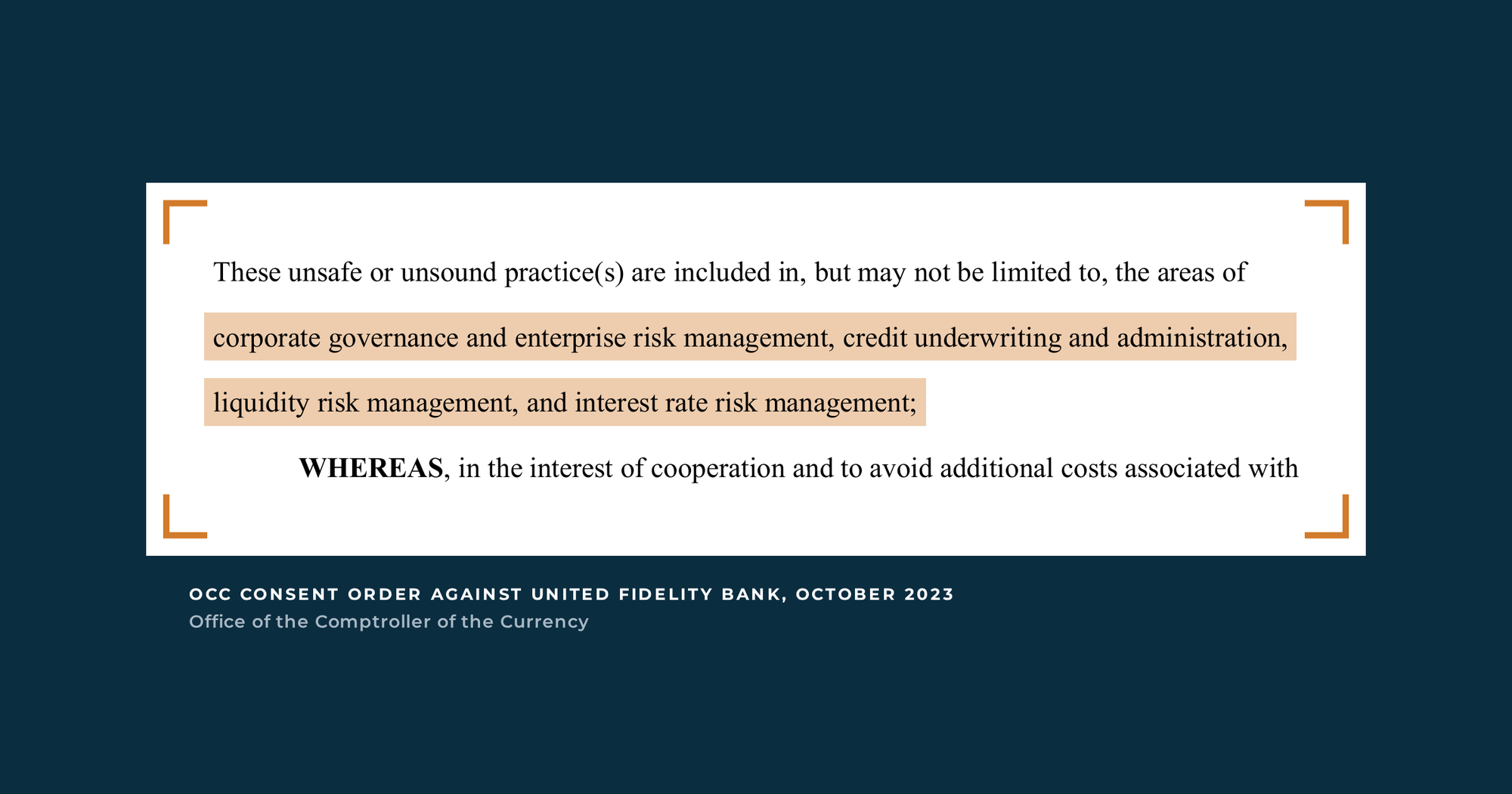
In 2023, the OCC's consent order cited United Fidelity for unsafe or unsound practices in these areas, three years before regulators closed it. Document: Office of the Comptroller of the Currency; graphic: Fair Witness
Who covered this
On this page · sections
The short version
- Federal regulators closed United Fidelity Bank of Evansville, Indiana, on Friday and sold most of it to First Citizens Bank.
- Most customers keep their money, but the FDIC estimates the failure will cost its insurance fund $1.83 billion, about 31% of the bank's assets.
- Branches reopen as First Citizens on Saturday or Monday, and federal law requires an inspector general's review of the loss.
Documents in this story · 9
- First-Citizens Bank & Trust Company, Raleigh, North Carolina, Assumes Substantially All Deposits of United Fidelity Bank, fsbFDIC · Press release · Nov. 27Open Archived
- First Citizens Bank Enters into Whole Bank Purchase of United Fidelity Bank, fsbFirst Citizens BancShares · Press release · Nov. 27Open Archived
- Consent Order, United Fidelity Bank, FSB (AA-CE-2023-40)OCC · PDF · Oct. 31, 2023Original Archived
- Enforcement action with Pedcor Financial, LLC, Pedcor Financial Bancorp and Fidelity Federal BancorpFederal Reserve Board · Press release · June 25, 2024Open Archived
- Closure notice on its website, Nov. 27, checked Nov. 28United Fidelity Bank · Web pageOpen Archived
- Failed Bank List, checked Nov. 28FDIC · Web pageOpen Archived
- Fulton Bank, N.A., Lancaster, Pennsylvania, Assumes Substantially All Deposits of Republic First Bank, April 26, 2024FDIC · Press releaseOpen Archived
- United Fidelity Bank, fsb, Evansville, Indiana, Assumes All of the Deposits of First City Bank of FloridaFDIC · Press release · Oct. 16, 2020Open Archived
- Material Loss Review of Washington Federal Bank for Savings (OIG-19-009)Treasury Office of Inspector General · PDF · Nov. 6, 2018Original Archived
Federal regulators shut United Fidelity Bank of Evansville, Indiana, on Friday night in the largest U.S. bank failure since April 2024. The lender had about $5.9 billion in assets, and First Citizens Bank is taking over most of it.
The failure matters beyond its 22 branches because of its price. The Federal Deposit Insurance Corp., which insures bank deposits, estimates the failure will cost its insurance fund $1.83 billion. That is nearly three times what a bank of about the same size cost the fund in 2024, and regulators have not said what went wrong.
Why it matters to you
Your account moves to First Citizens automatically if you bank at United Fidelity, and the FDIC says you keep all of your funds and deposit insurance. You can keep writing checks and using ATMs and debit cards through the weekend, and loan payments should go on as usual. Branches that normally open Saturday reopen as First Citizens branches that day, and the rest reopen Monday. The FDIC has set up a help line at 1-866-431-1725.
One group of customers is left out of the handover. First Citizens is taking on customer deposits other than certain brokered deposits, which are funds placed at a bank through a middleman, such as a brokerage selling certificates of deposit. Newsweek told customers with brokered deposits to seek confirmation of their funds' status.
Even if you never banked there, the loss touches the system that protects your own account. The insurance fund is financed by banks, AP reported, and it pays depositors when a bank fails.
How the United Fidelity Bank failure unfolded
The Office of the Comptroller of the Currency, which AP described as the Treasury division that regulates banks, closed United Fidelity and named the FDIC as receiver. The OCC said it found the bank in an "unsafe or unsound condition to transact business" and likely unable to meet depositors' demands.
The FDIC arranged the sale the same night. At the end of September, United Fidelity held $5.4 billion in deposits. First Citizens agreed to assume about $4.5 billion of them, along with $3.1 billion in loans, and won the bidding with an asset discount of about $2.6 billion and no deposit premium. In plain terms, it paid far less than the bank's books said the assets were worth. The deal includes Pedcor Homes, a real estate development and management subsidiary, and two branches in the U.S. Virgin Islands that operate as Bank of St. Croix.
"We believe this transaction is both financially and strategically compelling," said Frank Holding Jr., First Citizens' chairman and chief executive. The Raleigh, North Carolina, bank has done this before: it took over much of Silicon Valley Bank after that bank collapsed in 2023.
Why the cost stands out
The $1.83 billion estimate equals about 31% of United Fidelity's assets, a loss rate CNN called unusually high. The FDIC's own record gives a comparison. When Republic First Bank of Philadelphia failed in April 2024 with about $6 billion in assets, the FDIC put the cost at $667 million.
Fox Business reported that this is the most expensive failure for the fund since First Republic Bank in 2023. It is also the seventh U.S. bank failure this year, by the FDIC's failed bank list.
Regulators flagged United Fidelity in 2023
The closing statement doesn't explain the failure, but the public record shows regulators had raised alarms three years earlier. In October 2023, the OCC said it intended to bring cease-and-desist charges, and United Fidelity's board consented to a binding order instead. It cited unsafe or unsound practices in corporate governance, credit underwriting, liquidity risk management and interest rate risk. It also named practices in stress testing, contingency funding planning and concentration risk management.
The order set higher capital minimums for the bank, including a leverage ratio of at least 9%. It also meant the bank could not count as "well capitalized," a status that matters for brokered deposits. Federal law restricts them at banks below that line, and the order cited those limits.
Then, in June 2024, the Federal Reserve announced a written agreement with the bank's parent companies, Pedcor Financial and Fidelity Federal Bancorp. The record shows the warnings; it doesn't show whether they explain Friday's closing.
We believe this transaction is both financially and strategically compelling
United Fidelity was once on the other side of these deals. In 2020, it took over the deposits of the failed First City Bank of Florida.
What we don't know yet
The cause of United Fidelity's failure is still unexplained. Neither the bank nor the OCC had detailed it, Newsweek reported. Reuters, in a story the New York Post ran, said it could not reach United Fidelity for comment outside business hours. Beyond a closure notice on its website saying deposits moved to First Citizens, we found no public response from United Fidelity as of 3 p.m. ET Saturday.
It is also unclear how much money sits in the excluded brokered deposits, or what happens to it. The FDIC did not say how many or why they were left out, CNN reported, and First Citizens' release doesn't say either. That gap matters most to anyone who bought a CD through a broker.
A fuller answer has a deadline. Federal law requires a review by the Treasury Department's inspector general when a failure costs the fund more than $50 million, as this one does many times over. That review covers the OCC's supervision too, and the law sets a six-month deadline from when the loss becomes apparent.
How coverage differs
Only CNN told readers the numbers were signs of a bank in distress; most other outlets, on every side, told it as an orderly handover with customers protected. Fox Business also put the gap since the last such failure at three years, not two.
If you read the left 4 of 21 outlets
You saw the warning signs.
If you read the center 3 of 12 outlets
You read the regulators' own words.
If you read the right 6 of 21 outlets
Your outlets split on the timeline.
Sources
Left
4 of 21 left-leaning outlets we track reported this
- CNN: Federal regulators shut $6 billion Indiana lender in biggest bank failure in over two years, Nov. 27
- ABC News (AP copy): United Fidelity Bank seized in biggest US bank failure since 2024, Nov. 28
- The Independent (AP copy): United Fidelity Bank seized in biggest US bank failure since 2024, Nov. 28
- AP: United Fidelity Bank seized in biggest US bank failure since 2024, Nov. 28 (headline only)
Center
3 of 12 center outlets we track reported this
- The Hill: OCC shutters United Fidelity Bank, marking biggest US bank failure in 2 years, Nov. 28
- Newsweek: United Fidelity shut in biggest bank failure in years: Is your money safe?, Nov. 28
- Reuters: United Fidelity Bank shut in biggest US bank failure in 2 years, First Citizens buys assets, Nov. 28 (headline only)
Right
6 of 21 right-leaning outlets we track reported this
- Fox News (Fox Business): Feds shut down $6B bank in largest financial shuttering in 3 years, Nov. 28
- The Washington Times: Feds shut down bank in biggest closure in two years, Nov. 28
- Just The News: Federal regulators shut down United Fidelity Bank, Nov. 28
- Daily Mail: Federal regulators shut down $6 billion bank, Nov. 28
- New York Post (Reuters copy): Feds shut down United Fidelity Bank in $6B failure, largest in 2 years, First Citizens buys assets, Nov. 28
- Breitbart (AP copy): United Fidelity Bank seized in biggest US bank failure since 2024, Nov. 28
Primary
- FDIC: First-Citizens Bank & Trust Company, Raleigh, North Carolina, Assumes Substantially All Deposits of United Fidelity Bank, fsb, Nov. 27 · Archived copy
- First Citizens BancShares: First Citizens Bank Enters into Whole Bank Purchase of United Fidelity Bank, fsb, Nov. 27 · Archived copy
- OCC: Consent Order, United Fidelity Bank, FSB (AA-CE-2023-40), Oct. 31, 2023 · Archived copy
- Federal Reserve Board: Enforcement action with Pedcor Financial, LLC, Pedcor Financial Bancorp and Fidelity Federal Bancorp, June 25, 2024 · Archived copy
- United Fidelity Bank: closure notice on its website, Nov. 27, checked Nov. 28 · Archived copy
- FDIC: Failed Bank List, checked Nov. 28 · Archived copy
- FDIC: Fulton Bank, N.A., Lancaster, Pennsylvania, Assumes Substantially All Deposits of Republic First Bank, April 26, 2024 · Archived copy
- FDIC: United Fidelity Bank, fsb, Evansville, Indiana, Assumes All of the Deposits of First City Bank of Florida, Oct. 16, 2020 · Archived copy
- Treasury Office of Inspector General: Material Loss Review of Washington Federal Bank for Savings (OIG-19-009), Nov. 6, 2018 · Archived copy
This article was produced by AI under our Editorial Standards. Corrections are reviewed before they go live.
How coverage differs
Keep reading
The newest Economy stories.
The Fair Witness Daily
Every morning around 7 a.m. Eastern, seven days a week.
Saturday’s editionFree
In Saturday’s Daily
Then the Spin Meter: one divided story, set side by side as the left, center and right told it.
Free. One email a day.
Unsubscribe in one click. Already a member? Sign in













Discussion
Any free account can join the discussion.