


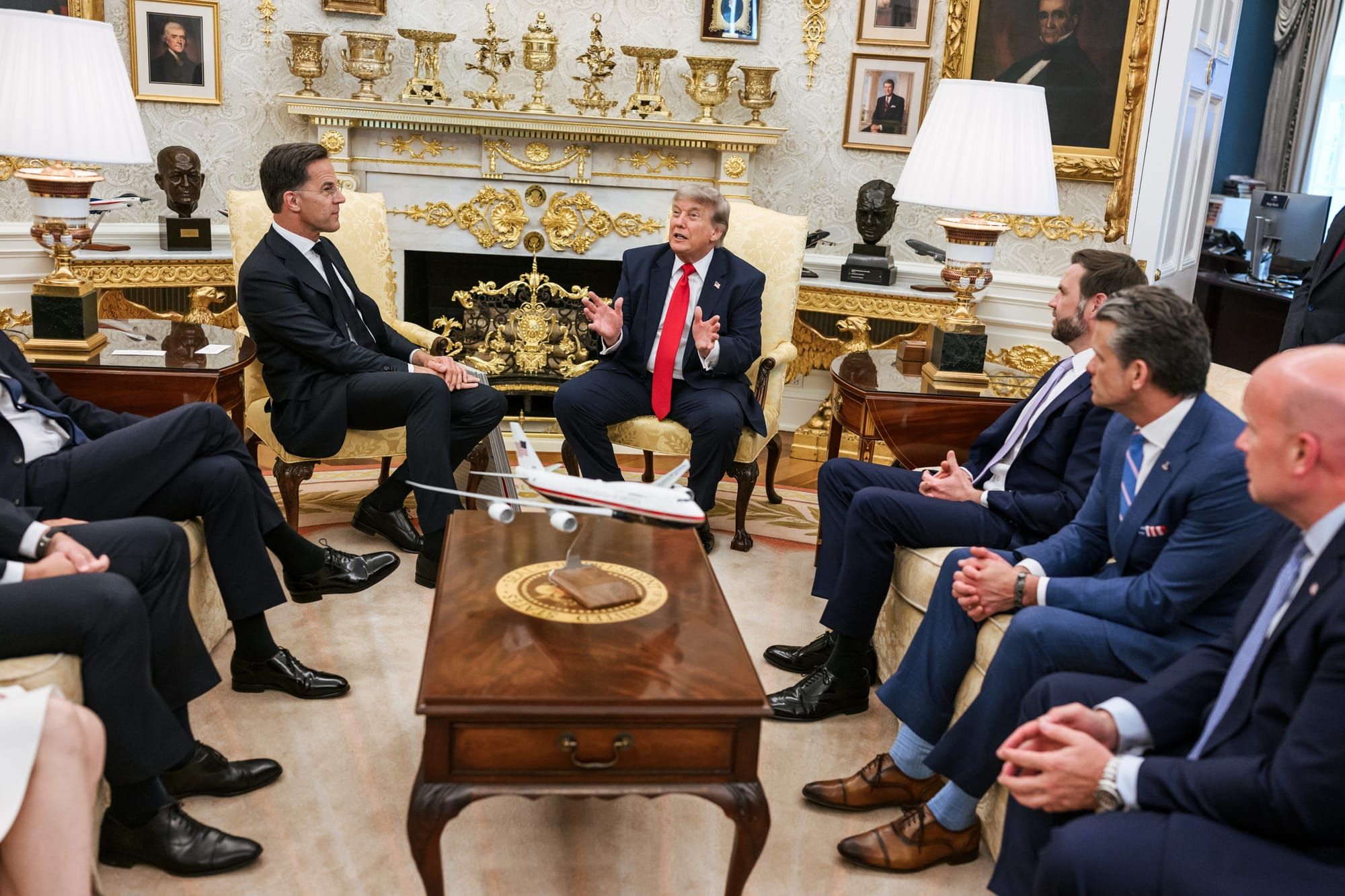
Trump and NATO's Rutte urge Russia not to widen the Ukraine war
NATO's text names only Russia; Trump's version adds Ukraine, a gap that matters because each side says the other is spreading the war.

Trump and Rutte in the Oval Office in June, five months before their Mar-a-Lago meeting on the Ukraine war. Photo, June 2026: Daniel Torok / The White House / Wikimedia Commons / Public domain
Who covered this
The story so far
Russia-Ukraine peace talks
On this page · sections
The short version
- Trump and NATO chief Mark Rutte said Russia should avoid actions that widen the Ukraine war, after meeting Wednesday at Mar-a-Lago.
- NATO's statement named only Russia, Trump's version added Ukraine, and the Kremlin said Kyiv is the one spreading the war.
- Ukraine is waiting for Washington to set a date for the next round of peace talks.
Documents in this story · 4
- Joint statement by President Donald J. Trump and NATO Secretary General Mark RutteNATO · Web page · Nov. 26, 2026Open Archived
- The Hague Summit DeclarationNATO · Web page · June 25, 2025Open Archived
- Address by Secretary General Mark Rutte to the NATO Parliamentary Assembly, BerlinNATO · Web page · Nov. 23, 2026Open Archived
- The North Atlantic Treaty, 1949NATO · Web pageOpen Archived
President Donald Trump and NATO chief Mark Rutte urged Russia to avoid actions that "intentionally, or unintentionally, expand the war" in Ukraine, in a joint statement after meeting Wednesday at Mar-a-Lago.
That statement exists in two versions. The one NATO published names only Russia. The version Trump posted on Truth Social speaks of "the importance of Russia and Ukraine avoiding any actions" that widen the war, USA Today reported. It also adds a paragraph on U.S. weapons production that NATO's text leaves out.
The difference matters because each side in the war says the other is the one spreading it. On Thursday the Kremlin said the danger comes from Kyiv, pointing to Ukrainian attacks on Russian ships far from the front, Fox News reported. Trump said the same morning that he had asked Russian President Vladimir Putin, at their summit in China last week, to "pull back all Military aggression against territories throughout Europe."
Why it matters to you
A wider war is the kind that could reach Americans directly. Under Article 5 of NATO's treaty, an armed attack on one ally is treated as an attack on all of them, the United States included.
Two allies have had run-ins with Russia lately. Poland accused Russia of violating its airspace last week after two missiles and a drone crashed on its territory, and Russia denied it, Time reported. Estonia accused Russian security services of ordering an attempted arson attack on a defense company, which Moscow called unfounded. This week Russia accused Estonia of letting Ukrainian drones cross its airspace to strike Russia, and Estonia denied it.
Two versions of the Trump-Rutte statement on Russia
Rutte met Trump at Mar-a-Lago on the evening of Nov. 25, NATO said. Their statement called it an outstanding meeting and named the Russia-Ukraine war and the conflict in Iran as the main subjects. It also credited what the two had achieved at NATO's summits in The Hague and Ankara. NATO's text runs four paragraphs.
Trump's version is longer. Besides naming Ukraine, it says he briefed Rutte on U.S. production of Patriot and THAAD air-defense systems and Tomahawk cruise missiles, UPI reported. Trump wrote that the country has never produced more military equipment, and that allies will benefit once its stockpile is full. We found no public explanation of the difference from the White House or NATO as of 3 p.m. ET Thursday.
After the meeting, Rutte said on X that American leadership is still essential as Europe and NATO grow stronger, Fox News reported. Before it, he told Fox & Friends that Trump was gauging how serious Putin is about peace. "What President Trump is doing, also in the meeting in Shenzhen, is testing Putin," Rutte said.
What Trump said he told Putin
Trump's Thursday post went further than the statement. He said he spent a lot of time on that request in China, hoping for a quick deal between Russia and Ukraine. He called a deal a strong possibility, Newsweek reported, and wrote that thousands of people are being killed every month. He did not say which territories he meant.
The post referred to Shenzhen, where Trump, Putin and Chinese President Xi Jinping held their first three-way talks last week. There, Trump called both Putin and Xi his friend, Reuters reported in a story NTD ran. His meeting with Putin drew criticism from European allies and from Democrats at home, The National Desk reported. The three leaders' declaration did not mention the war in Ukraine.
European leaders have been saying the threat goes beyond Ukraine. German Chancellor Friedrich Merz said Wednesday that the Kremlin was escalating threats in the Baltic region, Poland and the Black Sea. "Russia wants more than Ukraine," he said.
How the Ukraine war and its peace talks got here
Russia invaded Ukraine in February 2022, and the war is now nearing five years. U.S.-led talks between Russian and Ukrainian negotiators resumed in Abu Dhabi this month after a nine-month pause. They produced a prisoner exchange but no progress on ending the war, The Hill reported. U.S. envoys Jared Kushner and Steve Witkoff then met Putin in Moscow and Ukrainian President Volodymyr Zelenskyy in Dublin, Newsweek reported. In the same report, Kushner said Wednesday that disagreements over territory remain an obstacle.
The fighting did not pause for the diplomacy. Russian missiles hit Kyiv overnight into Thursday, wounding at least seven people there, Mayor Vitali Klitschko said, according to Fox News. Counting other regions, Ukrainian authorities said the strikes killed at least 10 people and wounded 58, The Washington Times reported. Ukraine struck an oil pipeline in Bashkortostan and a refinery in Samara, inside Russia, the same report said.
The spending pledge behind the statement
The statement's nod to achievements at The Hague points to a specific commitment. In the Hague Summit Declaration of June 2025, allies pledged to spend 5% of their economic output each year on defense and security by 2035. At least 3.5% goes to core military needs. Up to 1.5% can cover things like protecting infrastructure and building up the defense industry.
That declaration also helps explain the statement's closing line on industry. It names Russia as a long-term threat to Europe and North America, and it counts direct help to Ukraine's defense and its arms industry toward each ally's total. So in NATO's own rules, the money and the war in this statement are tied together.
What we don't know yet
Which version did both men sign off on, and why do the two texts differ? The answer matters because the version naming Ukraine puts a demand on Kyiv that NATO's own text does not make.
We also don't know what Putin told Trump in China, or how Moscow will answer the request to pull back. We found no public response from the Kremlin to Trump's Thursday post as of 3 p.m. ET Thursday. The Kremlin's spokesman spoke Thursday about the joint statement, not the post.
The next round of talks has no date. Zelenskyy said Ukraine is "waiting for the American side to set a date for the next meeting," and he warned that Ukrainian intelligence expects another major Russian attack on the power grid.
The case each side makes
Trump and Rutte
Trump's case is that pressure and personal contact with Putin can end the war quickly. He said his talks in China could lead to a deal soon. "I really believe this is a strong possibility," he wrote, according to Breitbart. His version of the statement asks both countries to avoid widening the war, and it adds a paragraph on U.S. arms production that he says allies will benefit from.
Rutte's case is that this approach is working and that Europe still needs America. He said Trump is testing whether Putin is serious about peace and that the pressure on Putin should continue, Scripps News reported. Speaking in Berlin on Monday, he warned that "Russia's war machine, at the moment, is running at full speed."
What President Trump is doing, also in the meeting in Shenzhen, is testing Putin.
The Kremlin
Moscow's case is that Ukraine, not Russia, is widening the war. Kremlin spokesman Dmitry Peskov said Thursday that the statement's warning appeared to refer to Kyiv's attempts to spread the fighting to the Mediterranean and the Baltic. He pointed to a Ukrainian drone attack that sank a Russian warship in Libya and an attack on a cargo ship in the Gulf of Finland, Fox News reported, citing Reuters.
Peskov said such attacks should worry coastal states and NATO as a whole. "Of course, nobody would want the conflict to spread geographically," he added, according to the same report. The Kremlin has repeatedly denied seeking a military clash with NATO countries, CNBC reported, and Russia denied the Polish airspace charge.
Ukraine
We found no public response from Ukraine's government to the version of the statement that names Ukraine as of 3 p.m. ET Thursday. Its earlier position is on the record. When Putin complained this week about Ukrainian attacks on Russian energy sites, Foreign Minister Andrii Sybiha answered on X: "Stop complaining. End the war."
Kyiv's wider argument is that Russia is still the one attacking. Zelenskyy said Thursday that Russia plans to hit energy sites again and that air-defense interceptors are Ukraine's top request to partners, Time reported. Ukraine has also pushed for Europe to have seats at the next round of talks.
How coverage differs
Only USA Today and Newsweek told readers the joint statement came in two versions; every right-leaning report we read that quoted it gave one version and never mentioned the other.
If you read the left 5 of 21 outlets
USA Today showed you the gap.
If you read the center 6 of 12 outlets
Five outlets, five angles.
If you read the right 8 of 21 outlets
Trump's version, mostly.
Sources
Left
5 of 21 left-leaning outlets we track reported this
- USA Today: Trump urges Putin to stop 'military aggression' as he meets with NATO
- CNBC: Trump, NATO chief caution Russia as attacks on Ukraine's energy infrastructure intensify
- Time: Trump Urges Putin to 'Pull Back' Military Aggression in Europe
- The Guardian: Ukraine war briefing: Kyiv launched more long-range strikes in 2026 than rest of war combined, data shows
- The Independent: Zelensky compares Trump cosying up to Putin to being friends with Hitler in WW2
Center
6 of 12 center outlets we track reported this
- Reuters: Trump and NATO chief urge Russia to avoid actions that widen Ukraine war
- Newsweek: Trump says he told Putin to back off Europe, calls Ukraine "bloodbath"
- The Hill: Trump, NATO chief urge Russia not to expand war in Ukraine
- UPI: Trump, NATO chief urge Putin not to expand war in Ukraine
- Scripps News: NATO chief says Trump is 'testing Putin' ahead of Mar-a-Lago meeting
- BBC News: Zelensky tells BBC US too focused on Middle East and not pushing Russia hard enough
Right
8 of 21 right-leaning outlets we track reported this
- Fox News: Trump, NATO chief push Russia to avoid any actions that would 'expand the war' with Ukraine
- The Washington Times: Trump and NATO's Rutte talk Ukraine and Iran at Mar-a-Lago
- The Washington Times: Trump tells Putin to 'pull back' military aggression in Europe to negotiate deal with Ukraine
- New York Post: Trump tells Putin to 'pull back all military aggression' as he tries for peace deal to end 'complete bloodbath' in Ukraine
- Daily Mail: Trump says he urged Putin to pull back aggression 'throughout Europe'
- Breitbart: Trump Urged Vladimir Putin to End Military Aggression Against European Territories
- The National Desk: Trump to meet NATO chief Mark Rutte at Mar-a-Lago after Putin and Xi talks
- NTD (Reuters copy): Trump and NATO Chief Urge Russia to Avoid Actions That Widen Ukraine War
- Newsmax: Trump Wants Russia to Ease Aggression Against Europe (headline only)
Primary
- NATO: Joint statement by President Donald J. Trump and NATO Secretary General Mark Rutte, Nov. 26, 2026 · Archived copy
- NATO: The Hague Summit Declaration, June 25, 2025 · Archived copy
- NATO: Address by Secretary General Mark Rutte to the NATO Parliamentary Assembly, Berlin, Nov. 23, 2026 · Archived copy
- NATO: The North Atlantic Treaty, 1949 · Archived copy
This article was produced by AI under our Editorial Standards. Corrections are reviewed before they go live.
How coverage differs
Keep reading
The newest World stories.
The Fair Witness Daily
Every morning around 7 a.m. Eastern, seven days a week.
Friday’s editionFree
In Friday’s Daily
Then the Spin Meter: one divided story, set side by side as the left, center and right told it.
Free. One email a day.
Unsubscribe in one click. Already a member? Sign in














Discussion
Any free account can join the discussion.