


Spain election: polls favor Feijóo's People's Party, with Vox in reach of power
Polls point to a right-wing majority in Sunday's vote, and Vox, polling third, could decide whether Feijóo takes office.

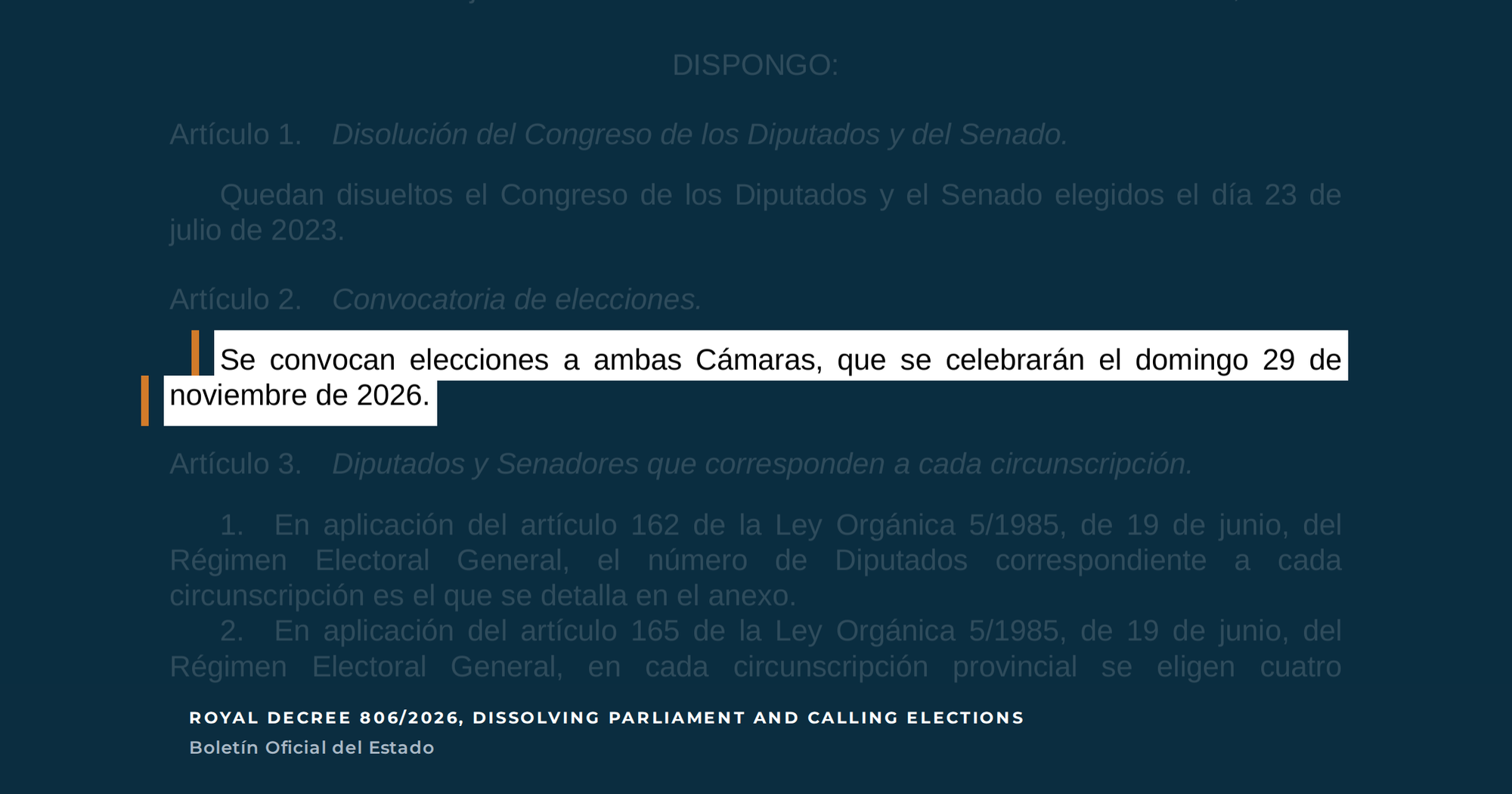
Spain's royal decree of Oct. 5 dissolved Parliament and set the general election for Sunday, Nov. 29. Document: Boletín Oficial del Estado; graphic: Fair Witness
Who covered this
On this page · sections
The short version
- Spain votes Sunday in a snap election, and most polls put Feijóo's People's Party ahead of Sánchez's Socialists.
- If Feijóo needs Vox to govern, a party most outlets call far right would hold national power for the first time since Franco.
- The new Parliament meets Dec. 23, and a candidate then needs a confidence vote in Congress to become prime minister.
Documents in this story · 3
- Royal Decree 806/2026 of Oct. 5, dissolving the Congress and Senate and calling electionsBoletín Oficial del Estado, Oct. 6 · Web pageOpen Archived
- Spanish Constitution, Article 99Boletín Oficial del Estado · Web pageOpen Archived
- Organic Law 5/1985 on the General Electoral Regime, Article 53Boletín Oficial del Estado · Web pageOpen Archived
Spain votes Sunday in a snap election that could end Pedro Sánchez's eight years as prime minister. Most polls put Alberto Núñez Feijóo's People's Party first and Vox third.
The order matters. Feijóo would most likely need Vox to govern, the BBC reported, and that would bring a party most outlets we read call far right, a label its leader rejects, into Spain's national government. The BBC said it would be the first time the far right has held national power in Spain's 50 years of democracy since the Franco dictatorship.
Why it matters to you
If you live in Spain, or plan to, the next government's rules will reach you. The People's Party has promised to add Spanish language tests and questions on the constitution to residency renewals. The Guardian reported that the plan has raised questions for British and American retirees and remote workers living there. Vox would give Spaniards priority for housing and end public benefits for immigrants without papers, Reuters reported.
The result also travels. Spain is the first of four big European Union countries to vote in the next year, followed by France, Poland and Italy, which The Christian Science Monitor called an early test for Europe's right.
Why Sánchez called the Spain election early
Housing set this election in motion. In September, the eviction of an elderly tenant set off protests nationwide. Sánchez called the early vote after Congress rejected his emergency housing reforms.
The formal call came on Oct. 5, when a royal decree signed by King Felipe VI and Sánchez dissolved both houses, elected in July 2023, and set the vote for Sunday, Nov. 29. The same decree ends the campaign at midnight Friday. Spain's election law bars campaigning after that, so Saturday is a quiet day before the vote.
Housing has topped voters' worries for more than a year, according to the CIS, Spain's state pollster. The AP reported that two fatal crashes on the high-speed rail network this year also shaped the race. So did corruption cases touching Sánchez's party, his brother and his wife, who denies wrongdoing. Sánchez calls the cases against his family a smear campaign.
Immigration runs through all of it. In July, more than 70,000 migrants crossed into Ceuta, Spain's territory in North Africa, in two days. Vox's leader, Santiago Abascal, called it an invasion. The outlets we read disagree on one key number. The BBC said Sánchez announced plans in April to give legal status to half a million immigrants without papers. The AP reported that Spain legalized nearly 1.2 million this year, and a separate AP story put the figure at 1 million. We could not check either figure against a government record before publishing.
What the final polls and the debate showed
The private polls and the state pollster describe different races. Monday was the last day Spanish law allowed new polls to be published. All but one of the final surveys put the People's Party and Vox together above 176 seats, a majority of the 350-seat Congress, Reuters reported in a story HuffPost ran. The 40dB poll for El País had the People's Party at about 32%, just ahead of the Socialists at about 31%. Vox was third, at about 17%.
The CIS was the exception. Its survey put the Socialists at about 34%, well ahead of the People's Party at about 25%. It had Vox at about 16%, and Reuters called the survey a major outlier.
The leaders' final TV debate on Thursday night focused heavily on housing. Feijóo pressed his housing pledge while Sánchez defended his emergency measures for tenants. Ada Colau, who leads Broad Front, a coalition of four small left-wing parties, said rich landlords should be taxed.
How Spain picks a prime minister after the vote
Winning the most seats does not make anyone prime minister. The new Parliament meets on Dec. 23, the decree says. Then, under Article 99 of Spain's Constitution, the king consults the parties and proposes a candidate, who must win a vote of confidence in Congress.
That rule gives smaller parties leverage. On the first vote, the candidate needs an absolute majority, 176 of the 350 seats. If that fails, a second vote 48 hours later needs only more yes votes than no votes, so parties that abstain can decide it. If no candidate wins within two months of the first vote, the king dissolves Parliament and Spain votes again.
So Vox's seat count may matter as much as who finishes first. Vox would likely join the People's Party in a coalition, the AP reported. Sánchez has made that prospect his main warning. "A government of the PP that includes Vox would not be just another government," he said in an interview with El País, the AP reported.
What we don't know yet
We don't know whether the People's Party would want Vox inside the government or only its votes. Neither Feijóo nor Abascal had set out terms for a deal in the reports we read. Any bargaining would start after the count and run up to the confidence votes that follow Dec. 23.
We also don't know how close the final polls will come to the result. With no new polls allowed this week, a late swing can't be measured. Turnout may decide which picture holds, including whether the young voters who favor Vox in recent surveys actually vote.
The case each side makes
Sánchez and the Socialists
Sánchez argues that his government has delivered growth and should finish the job on housing. He points to Europe's fastest-growing economy and a higher minimum wage, and his party promises 100,000 public affordable homes, interest-free loans of up to €50,000 for first-time buyers and a pause on evicting vulnerable tenants. He defends immigration by citing the benefits that legal newcomers bring to the economy.
His second argument is about who his rivals would govern with. He has warned that a People's Party government with Vox in it would turn the clock back 40 or 50 years, and that Vox would target abortion and euthanasia laws and green energy policies.
A government of the PP that includes Vox would not be just another government.
Feijóo and the People's Party
Feijóo argues that eight years have been enough and that he would run the state better. He has called access to housing a "vital emergency" and promises to build 1 million homes, back mortgages for first-time buyers and repeal the housing law that regulates rents. His party would also cut corporate taxes, cut income taxes for low- and middle-income earners and keep nuclear plants open longer.
His pitch centers on competence. He has vowed to "return quality to public services" and to audit the rail network within months. On immigration, he promises tougher controls on immigration and the border and a ban on mass legalization programs.
Abascal and Vox
Abascal argues that only Vox will put Spaniards first. Beyond those housing and benefit pledges, his party would deport foreigners convicted of crimes and cut taxes, and it would cancel the planned nuclear shutdown and build new reactors.
He rejects the far-right label and calls his positions common sense, the AP reported. At a rally in Ávila, he told supporters that Spaniards are "part of one of the oldest nations in history."
How coverage differs
What a Vox role in government would mean depended on who told it: the Guardian took readers to migrants in a Murcia farm town who fear it, while The New York Sun cast Sánchez's warnings as a campaign gambit.
If you read the left 9 of 21 outlets
You heard from the people Vox targets.
If you read the center 4 of 12 outlets
Housing and young voters led.
If you read the right 5 of 21 outlets
You got one report of your own.
Sources
Left
9 of 21 left-leaning outlets we track reported this
- The Independent (Reuters copy): Spain election 2026: The main proposals from the three largest parties, Nov. 27
- HuffPost (Reuters copy): Spain's Far Right Could Be On Brink Of Power: Polls, Nov. 24
- Associated Press: Here are the main issues driving Spain's national election and why they matter for Europe, Nov. 27
- ABC News (AP copy): Here are the main issues driving Spain's national election, Nov. 26
- NBC News (AP copy): Spain's far right hasn't governed since Franco. Immigration fears could change that, Nov. 26
- The Guardian: Race hate exploded in this Spanish town last year. Now its residents are bracing for more, Nov. 27
- CNN: Spain's Sánchez stood up against Trump. His own voters may be about to bring him down, Nov. 27
- CNBC: Spain Votes: Will Sanchez's big gamble pay off?, Nov. 27 (headline only; article link not found, linked to CNBC's world section)
- NPR: Spain's national election is Sunday. What to know about the polarized race, Nov. 27 (headline only; article link not found, linked to NPR's Europe section)
Center
4 of 12 center outlets we track reported this
- Reuters: Spain election: what the main parties are proposing, Nov. 27
- BBC News: Leaders clash in final Spain election debate as housing dominates run-in, Nov. 27
- The Christian Science Monitor: Will young voters make Spain's far-right Vox party into kingmakers?, Nov. 25
- The Hill (AP copy): Spain's far right hasn't governed since Franco. Immigration fears could change that, Nov. 26 (headline only; article link not found, linked to The Hill's international section)
Right
5 of 21 right-leaning outlets we track reported this
- Daily Mail (AP copy): Here are the main issues driving Spain's national election and why they matter for Europe, Nov. 26
- The Washington Times (AP copy): Spain's far right hasn't governed since Franco. Immigration fears could change that, Nov. 26
- Breitbart (AP copy): Spain's far right hasn't governed since Franco. Immigration fears could change that, Nov. 26
- Newsmax (AP copy): Spain's far right hasn't governed since Franco, Nov. 26 (headline only; article link not found, linked to Newsmax's world section)
- The New York Sun: Conservatives Eye a Chance in Spain, Nov. 25
Primary
- Royal Decree 806/2026 of Oct. 5, dissolving the Congress and Senate and calling elections (Boletín Oficial del Estado, Oct. 6) · Archived copy
- Spanish Constitution, Article 99 (Boletín Oficial del Estado) · Archived copy
- Organic Law 5/1985 on the General Electoral Regime, Article 53 (Boletín Oficial del Estado) · Archived copy
This article was produced by AI under our Editorial Standards. Corrections are reviewed before they go live.
How coverage differs
Keep reading
The newest World stories.
The Fair Witness Daily
Every morning around 7 a.m. Eastern, seven days a week.
Friday’s editionFree
In Friday’s Daily
Then the Spin Meter: one divided story, set side by side as the left, center and right told it.
Free. One email a day.
Unsubscribe in one click. Already a member? Sign in


















Discussion
Any free account can join the discussion.