


Israeli strikes in Gaza kill Hamas official Khaled Abu Nada and his wife
Israel killed the third senior Hamas figure since Tuesday as Washington presses it to carry out a ceasefire plan each side says the other breaks.

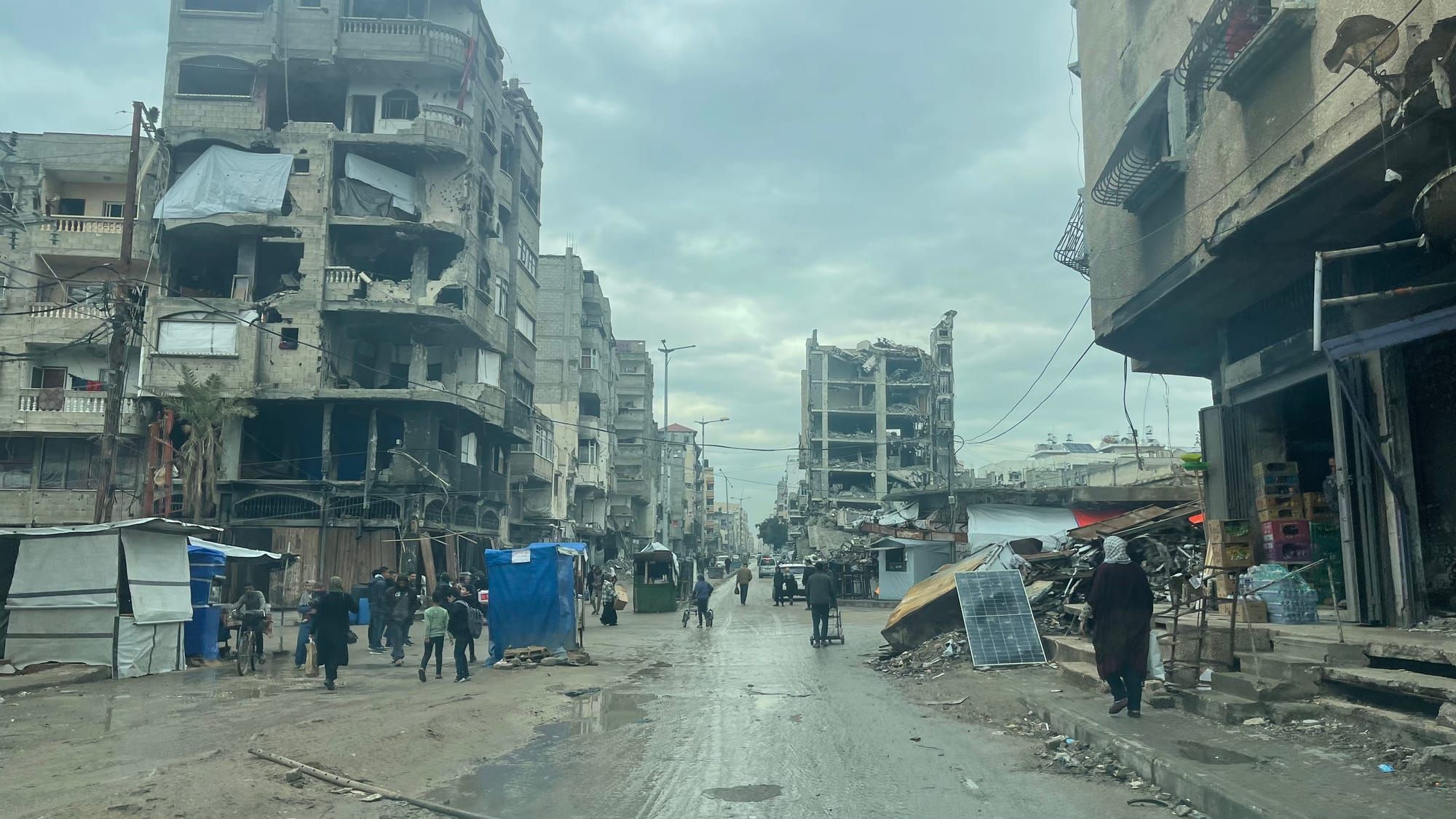
Several of Thursday's strikes hit Gaza City, shown here in February 2025, while the one that killed Abu Nada hit an apartment in Deir al-Balah. Photo, February 2025: Jaber Jehad Badwan / Wikimedia Commons / CC BY-SA 4.0
Who covered this
On this page · sections
The short version
- An Israeli strike in central Gaza killed Hamas official Khaled Abu Nada and his wife, and Thursday's toll in Gaza reached at least 10.
- He was the third senior Hamas figure killed since Tuesday, more than a year into a U.S.-brokered ceasefire.
- Hamas said it would discuss a response with other Palestinian groups, while Washington presses Israel to carry out the plan.
An Israeli strike on an apartment in central Gaza killed Hamas official Khaled Abu Nada and his wife at dawn Thursday. By evening, Israeli strikes and gunfire had killed at least 10 people across Gaza, medics told Reuters.
Abu Nada was the third senior Hamas figure Israel has killed since Tuesday, after two heads of the group's internal security service. The strikes landed more than a year into a U.S.-brokered ceasefire, and just as Washington is pressing Israel to move ahead with the plan.
Who Khaled Abu Nada was, in each side's telling
Israel and Hamas agree that Abu Nada is dead, but not on who he was. Prime Minister Benjamin Netanyahu and Defense Minister Israel Katz said in a joint statement that he oversaw Hamas's economic and education affairs in Gaza. The military said he ran Hamas's banking and investment network and steered money to its fighters.
Hamas described a political figure. It confirmed his death and that he sat on its political office, Reuters reported, but did not answer Israel's other claims about his role. CNN called him a senior member of Hamas's political bureau and its deputy education minister, the title the BBC also used.
Netanyahu said Israel has killed about 80 Hamas members in the past month. "No terrorist is immune, and no one in the Hamas leadership will manage to evade us," he said. The joint statement called the strike "part of a series of targeted killings" against Hamas officials.
How many died in Thursday's Israeli strikes on Gaza
The death toll rose during the day. Hospital officials first counted eight dead in three strikes, the AP reported: the couple in Deir al-Balah and three people in each of two strikes on Gaza City. The BBC said three of those killed in the Shati refugee camp worked for Hamas's security services. Medics also told Reuters that Israeli gunfire killed a 62-year-old man in the Bureij camp, bringing its count to at least nine.
Reuters' later count of at least 10 added a strike in Gaza City's Sheikh Radwan district, and the AP's updated roundup also counted 10. The Israeli military said one strike targeted three militants and gave no details on the others.
Gaza's Hamas-run health ministry says at least 1,705 people have been killed there in the 13 months since the ceasefire, the BBC reported, noting that the United Nations considers its figures reliable. Israel says six of its soldiers have been killed there in the same period. Reuters, citing Palestinian and Israeli tallies, put those figures at at least 1,600 and five.
What the ceasefire plan says, and why both sides cite it
Hamas called the killing part of a policy of assassinations by Israel. It said that targeting civilian homes is "a continuous breach of the ceasefire agreement", and it blamed the U.S.-backed Board of Peace, which oversees the plan, for not stopping the attacks. Hamas leader Khalil al-Hayya said the group would talk with other Palestinian groups about how to respond, but gave no details.
Israel's case turns on Hamas's weapons. Its military has said each recent target was planning attacks and rebuilding armed groups in violation of the ceasefire. Katz wrote on X that Hamas could disarm on its own under President Donald Trump's plan or Israel would disarm it in an offensive that would again move Gaza residents south, Ireland's RTÉ reported.
No terrorist is immune, and no one in the Hamas leadership will manage to evade us.
The plan's own text shows why both sides can cite it. Its third point says that once both sides accept, "all military operations, including aerial and artillery bombardment, will be suspended". Its 16th ties Israel's pullback to steps in disarming Gaza, and its sixth offers amnesty to Hamas members who give up their weapons. Hamas reads the bombing promise as broken. Israel reads the disarmament steps as never met: Netanyahu has refused to move ahead until Hamas is fully disarmed, and Hamas says it will disarm only alongside a staged Israeli withdrawal.
Washington is now pressing on that knot. Jared Kushner, Trump's son-in-law, who helped craft the deal, urged Netanyahu in a call Tuesday to carry out Israel's side of it, CNN reported, citing Axios. Israeli troops now hold about two-thirds of Gaza, up from more than half when the ceasefire began, according to Reuters.
What we don't know yet
We don't know how Hamas will respond. Al-Hayya said the group was not prepared to keep enduring the attacks, but he named no step and gave no date for the talks with other groups. What Hamas chooses will shape whether the ceasefire holds.
The Israeli military said it would give more details on the Abu Nada strike later, and it had not commented on several of the other deaths. We also found no public response from the White House or the Board of Peace to Thursday's strikes as of 5:45 p.m. ET. Katz's threat of a new offensive sets up the next test: whether Washington's push moves either side first.
How coverage differs
The same man was a Hamas political official killed during a ceasefire in CNN's and Reuters' telling, and an official who helped fund a terror group in the New York Post's.
If you read the left 5 of 21 outlets
You got the ceasefire and the pressure.
If you read the center 4 of 12 outlets
You got the toll first.
If you read the right 3 of 21 outlets
Your outlets named him two ways.
Sources
Left
5 of 21 left-leaning outlets we track reported this
- CNN: Israel intensifies assassinations in Gaza as US urges Netanyahu to proceed with ceasefire plan
- The Guardian: Israeli strikes kill 16 schoolchildren so far this month, Gaza ministry says
- Associated Press: Israeli strikes kill 8 in Gaza, and other Mideast news
- The Independent (AP copy): Israeli strikes kill 8 in Gaza, and other Mideast news
- NBC News (Reuters copy): Israel kills nine in Gaza, including Hamas-appointed deputy education minister
Center
4 of 12 center outlets we track reported this
- BBC News: Hamas political official and wife among eight Palestinians killed in Israeli strikes on Gaza
- Reuters: Israel kills nine in Gaza, including Hamas-appointed deputy education minister, officials say
- The Hill (AP copy): Israeli strikes kill 8 in Gaza, and other Mideast news (headline only; text unavailable)
- NewsNation (AP copy): Israeli strikes kill 8 in Gaza, and other Mideast news (headline only; text unavailable; link not resolvable from its feed)
Right
3 of 21 right-leaning outlets we track reported this
- New York Post: Israel takes out 3 senior Hamas leaders in Gaza — including official who helped fund terror group
- Daily Mail (AP copy): Israeli strikes kill 10 in Gaza as Iranian drones kill 2 Italians in Kuwait, and other Mideast news
- Newsmax: Israel Kills 9 in Gaza, Including Hamas-Appointed Deputy Education Minister (headline only; text unavailable; the same headline as Reuters'; link not resolvable from its feed)
Other reporting
- Arab News (Reuters copy): Hamas weighs response after Israel kills 10 people in Gaza (Saudi daily, running Reuters' updated story)
- RTÉ News: Katz threatens to displace 1m in Gaza unless Hamas disarm (Ireland's public broadcaster)
Primary
- The White House: President Donald J. Trump's Comprehensive Plan to End the Gaza Conflict, Sept. 29, 2025 (full text as republished by PBS NewsHour) · Archived copy
This article was produced by AI under our Editorial Standards. Corrections are reviewed before they go live.
How coverage differs
Keep reading
The newest World stories.
The Fair Witness Daily
Every morning around 7 a.m. Eastern, seven days a week.
Friday’s editionFree
In Friday’s Daily
Then the Spin Meter: one divided story, set side by side as the left, center and right told it.
Free. One email a day.
Unsubscribe in one click. Already a member? Sign in


















Discussion
Any free account can join the discussion.