


Israeli strike kills 2 MSF guards at Gaza clinic; Israel says they were Hamas members
MSF says Israel hit a marked clinic it knew about; Israel says it struck two fighters there, not the facility itself.

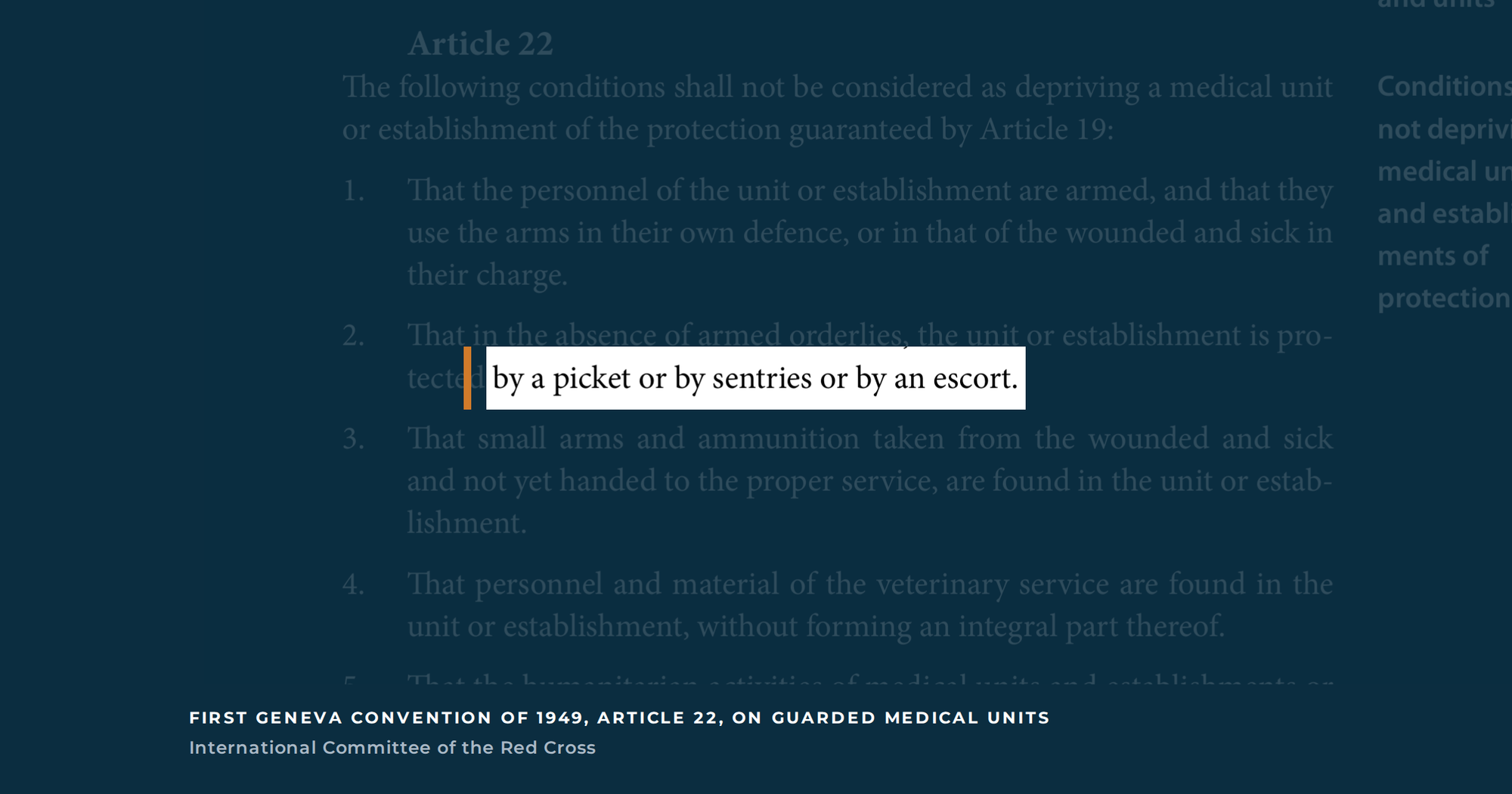
The First Geneva Convention says a medical unit guarded by sentries keeps its protection; whether the two MSF guards were fighters is in dispute. Document: International Committee of the Red Cross; graphic: Fair Witness
Who covered this
The story so far
Israeli strikes in Gaza during the ceasefire
On this page · sections
The short version
- An Israeli strike late Friday killed two watchmen at a Doctors Without Borders clinic in Gaza City, the medical charity said.
- Israel said the men were Hamas fighters working as guards, and the charity said its clinic was marked and known to Israel's military.
- What comes next depends on whether Israel releases evidence about the men and how the charity answers its claims.
An Israeli strike in Gaza City late Friday killed two staff of Doctors Without Borders, or MSF, who worked as watchmen at one of the charity's clinics, the group said in a statement. The Israeli military confirmed the strike but said the two men were members of Hamas's military wing working as guards there.
MSF, the initials of the charity's French name, said the deaths bring to 17 the number of its staff killed in Gaza during the war. The strike came hours after another Israeli strike hit the apartment of the son of Hamas leader Khalil al-Hayya, who survived, Hamas said. Both came a day after Israel killed Hamas official Khaled Abu Nada, as Fair Witness reported Thursday. He was the third senior Hamas figure Israel had killed since Tuesday, more than a year into a U.S.-brokered ceasefire.
MSF says the Israeli strike was a direct hit on its Gaza clinic
MSF called it a direct hit on the organization. It said the clinic was marked with MSF logos and that its location had been shared with and was known by the Israeli military. "We call for accountability," the group said in its statement, posted overnight.
A relative of one man told CBS News the two were unarmed and wore MSF uniforms. A local MSF worker said they were making their rounds of the clinic when a missile struck.
The head of the World Health Organization, Tedros Adhanom Ghebreyesus, condemned the strike on X. "Those risking their lives to save others must be protected, not attacked," he wrote, The Guardian reported.
Israel says it targeted two Hamas fighters, not the facility
The Israeli military tells a different story about the men. In a post on X, it named them and said they were Hamas fighters who had advanced plans to attack Israeli civilians and troops. It called the case another example of Hamas embedding itself in international groups, and said the men were posing as humanitarian workers.
It also said it had not hit a medical site. The strike was "not directed at a hospital," the military said, and did no damage to medical infrastructure. It said it used precise weapons and aerial surveillance to limit harm to civilians.
MSF did not immediately respond when Reuters asked about Israel's claims, but it has disputed such a charge before. In June 2024, after Israel called a staff member it killed near MSF's Gaza City clinic an Islamic Jihad operative, MSF said it had "no indication that this is true." Earlier this year, MSF itself paused some Gaza hospital work because gunmen were present. Rights groups say Israel has often not shown enough evidence to justify its strikes on medical sites.
What the Geneva Convention says about guarded medical units
The two statements talk past each other: MSF's is about the site, its marked clinic, and Israel's is about the two men at it. The First Geneva Convention of 1949, written for armies' medical units, says a unit keeps its protection when it is guarded "by a picket or by sentries or by an escort". It loses that protection only if it is used to harm the enemy, and only after a warning is ignored.
So under the treaty, having guards does not cost a medical unit its protection, but the treaty cannot say whether these two guards were also fighters. That is the fact in dispute. Hospitals are protected sites under international law, Reuters reported, and using them for military ends is also seen as a breach.
We call for accountability.
The strike on al-Hayya's son, the same day
At dawn Friday, an Israeli strike hit a residential apartment in Gaza, Hamas said. Senior Hamas official Basem Naim told Reuters that Izzeldeen al-Hayya, the son of Hamas's overall leader, and his family survived, though Hamas sources said several people, including the leader's daughter-in-law, were hurt. Naim said Israeli forces have killed four of the leader's other sons.
Hamas tied the strike to threats Defense Minister Israel Katz had made against al-Hayya and said Israel was trying to wreck the ceasefire. The Israeli military offered no immediate comment, Reuters reported, and we found no public response from it on the al-Hayya strike as of 8:30 a.m. ET Saturday.
What we don't know yet
Israel has not said whether it will release evidence tying the two watchmen to Hamas's military wing. MSF has not yet answered Israel's claims about the men. Its reply could turn a clash of statements into a dispute over records.
It is also unclear where the missile landed. MSF called it a direct hit, but Reuters said the men were killed outside the clinic and the AP near it.
Al-Hayya had warned Thursday of possible retaliation for that day's strikes, and Hamas has not said what it will do after the attack on his son. That choice is the next test of the ceasefire.
How coverage differs
Where the missile hit depended on which headline you read: on the clinic for BBC News and The Independent, outside it for Reuters and NBC News, near it for the AP. Readers of right-leaning outlets saw the story only in an AP roundup.
If you read the left 6 of 21 outlets
You got both accounts, in different order.
If you read the center 2 of 12 outlets
You got the dispute, then the record.
If you read the right 1 of 21 outlets
You had one wire roundup.
Sources
Left
6 of 21 left-leaning outlets we track reported this
- CBS News: Israeli strike kills 2 Doctors Without Borders guards whom Israel claims were Hamas fighters
- The Guardian: Two Médecins Sans Frontières staff killed by Israeli strike in Gaza, charity says
- CNN: MSF 'outraged' as two workers killed in Israeli strike on Gaza
- The Independent: Israeli strike on Doctors Without Borders clinic in Gaza kills two staffers
- Associated Press: Houthis report airstrikes in Yemen, Israeli strike kills 2 near Gaza clinic, and other Mideast news
- NBC News (Reuters copy): Israeli strike killed two staff outside Gaza clinic, MSF says
Center
2 of 12 center outlets we track reported this
Right
1 of 21 right-leaning outlets we track reported this
Other reporting
- The Independent (Reuters copy): Hamas say chief's son survived assassination attempt by Israeli military (Reuters' report on the al-Hayya strike, on the British daily's site; The Independent is counted once, above)
This article was produced by AI under our Editorial Standards. Corrections are reviewed before they go live.
How coverage differs
Keep reading
The newest World stories.
The Fair Witness Daily
Every morning around 7 a.m. Eastern, seven days a week.
Saturday’s editionFree
In Saturday’s Daily
Then the Spin Meter: one divided story, set side by side as the left, center and right told it.
Free. One email a day.
Unsubscribe in one click. Already a member? Sign in















Discussion
Any free account can join the discussion.