


Tribunal rejects Argentina's bid to halt Falklands oil drilling
The ruling lets the Sea Lion project keep moving toward drilling in 2027 while a separate panel takes up the full dispute.

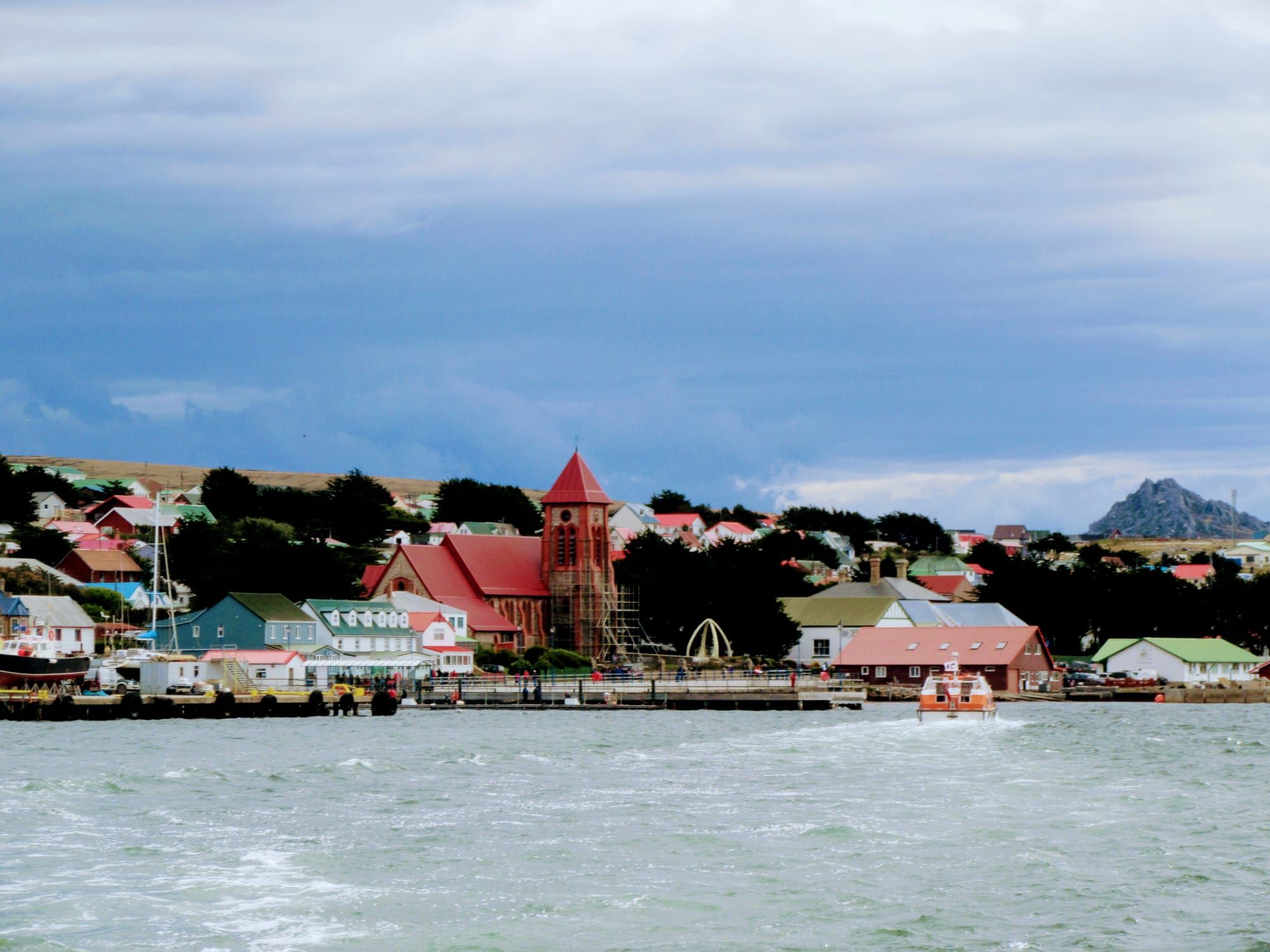
The islands' capital from the water; the islands' government licensed the Sea Lion oil project that the tribunal let go ahead. Photo, December 2019: amanderson2 / Wikimedia Commons / CC BY 2.0
Who covered this
On this page · sections
The short version
- An international sea-law tribunal voted 18-3 to reject Argentina's request to halt the Sea Lion oil project off the Falkland Islands.
- The judges said Argentina's claims turn on who owns the islands, a question the sea treaty doesn't cover, so the project can go ahead.
- Argentina will ask an arbitration panel for new measures, and Britain has promised no drilling before March 21, 2027.
Documents in this story · 8
- Order of Nov. 28, 2026, Case No. 37, Argentina v. United Kingdom, provisional measuresInternational Tribunal for the Law of the Sea · PDFOriginal Archived
- Press release ITLOS/Press 406International Tribunal for the Law of the Sea · PDF · Nov. 28Original Archived
- Dissenting opinion of Judge Patelitlos.org · PDF · Nov. 28Original Archived
- Joint dissenting opinion of Judge Horinouchi and Judge ad hoc Vinuesaitlos.org · PDF · Nov. 28Original Archived
- Hearing transcript ITLOS/PV.26/C37/1, Nov. 10morning · PDFOriginal Archived
- Joint statement on the Falkland Islands from the Foreign Secretary and Attorney GeneralUK government · Web page · Nov. 28Open Archived
- Attorney General's introductory remarks to the International Tribunal for the Law of the SeaUK government · Web page · Nov. 10Open Archived
- Businesses set to be protected from Argentinian economic coercionUK government · Web page · Oct. 13Open Archived
An international tribunal on Saturday rejected Argentina's bid to halt Falklands oil drilling, ruling 18-3 that the case turns on who owns the British-held islands, a question the sea treaty doesn't cover.
The International Tribunal for the Law of the Sea, based in Hamburg, Germany, cleared the way for the $2.1 billion Sea Lion project. Work can go ahead while a separate panel hears the full case. It is the latest round in a fight over islands that Britain and Argentina went to war over in 1982. Argentina's president, Javier Milei, has pressed his country's claim harder in recent months.
Why it matters to you
For the roughly 3,500 people of the Falkland Islands, the ruling keeps alive an oil project that could bring huge revenues to an economy that has long depended on fishing. The field holds an estimated 1.7 billion barrels of oil. Britain says drilling won't start until March 2027, with extraction a year later.
The dispute also reaches Washington. President Donald Trump has said the U.S. position on the islands is under review, and Milei, a close Trump ally, has appeared encouraged by that, AP reported. A shift away from U.S. neutrality would put Washington on one side of a fight between Britain and Argentina.
Companies feel the pressure too. Argentina says it has sent warning letters to 180 companies and people tied to oil work around the islands. Navitas, the project's operator, said last month it was replacing two contractors that pulled out over Argentina's threats.
How the tribunal ruled on Argentina's Falklands oil drilling bid
Argentina asked for four orders, the tribunal's summary shows. It wanted no new drilling or production equipment at Sea Lion, no use of survey data against Argentina, no British steps that keep it from protecting the sea there, and no new licenses. Britain asked the judges to reject all four.
The judges never reached the question of harm. The tribunal works under the U.N. Convention on the Law of the Sea, the treaty that governs the oceans. It can order emergency steps before a panel is formed to hear a case. But it can do so only if that panel would appear, at first look, to have jurisdiction over the case. The tribunal found that each of Argentina's four claims would first require deciding which country owns the islands. That is a question about land, not the sea, so the panel would seem to have no power over it.
Even Argentina's claim about protecting the sea fell on that point. Deciding who must protect those waters, the tribunal said, means deciding who owns the coast they lie off. Once it found that, it said it didn't need to weigh urgency or harm at all.
The vote shows how the bench split. When a country has no judge of its own on the tribunal, it may choose one for the case, called a judge ad hoc. Britain's choice, Vaughan Lowe, voted with the majority of 18. Argentina's choice, Raúl Vinuesa, joined Judges Horinouchi and Patel in dissent.
What the order puts on record
The order also holds Britain to its word. The tribunal said it "places these assurances on record": drilling won't begin before March 21, 2027, extraction won't begin before March 2028, and no new licenses will be granted while licensing is suspended, as Britain told the judges. Britain said it expects the arbitration panel to be formed by January 2027 at the latest, and the tribunal urged both countries to set it up quickly.
The decision is also a first, according to one of the dissenters. Judge Patel wrote that it is the first time the tribunal has refused emergency measures because the first-look test of the panel's power wasn't met. Patel agreed that who owns the islands is beyond the panel's reach. But the dissent argued that duties to protect the sea bind a country whatever its title, so the tribunal could have ordered narrower steps for both sides.
Horinouchi and Vinuesa went further. In a joint dissent, they wrote that the majority ignored Argentina's promises that it wasn't asking for a ruling on sovereignty. The order itself says it doesn't decide whether the panel will have power over the full case.
How the Falklands fight reached Hamburg
Britain has ruled the islands since 1833, and Argentina, which calls them the Malvinas, has never dropped its claim. Argentina's military government invaded in 1982, starting a 74-day war. The war killed 649 Argentine and 255 British troops, and three islanders died. In a 2013 referendum, 99.8% of voters chose to remain a British overseas territory. Argentina rejects the result, arguing that the right to decide doesn't apply to a population it considers planted by Britain.
Sea Lion became a firm plan in December 2025, when its two owners made a final decision to invest, the tribunal's summary says. Israel's Navitas Petroleum holds 65%, and Britain's Rockhopper Exploration holds the rest. Argentina started arbitration on Sept. 28 and asked the tribunal for emergency measures on Oct. 13. The same day, Britain said it would shield companies from Argentine measures aimed at business tied to the islands. The judges heard both sides on Nov. 10 and 11.
Milei's hard line is a turnabout. He took office in 2023 seeking warmer ties with Britain, but his tone sharpened as his popularity slipped a year before his reelection bid, AP reported. On Friday his government opened new sanctions proceedings against five people or companies involved in the project.
What we don't know yet
The arbitration panel that will hear the full case hasn't been formed, and no one knows how fast it will rule. Argentina told the tribunal it would be happy to move quickly. After the ruling, Milei's office said, "This decision is not the last word," and that Argentina will ask the panel for measures to protect its rights. Saturday's finding doesn't bind that panel, which will decide its own jurisdiction.
It is also unclear whether Argentina's sanctions and criminal complaints will slow the project before drilling starts. Nor is it known where the U.S. review of its stance on the islands will land, or when.
The case each side makes
Argentina
Argentina says it never asked anyone to rule on who owns the islands. Its agent at the hearing, Mario Oyarzábal, a foreign ministry legal adviser, told the judges the case was about rights to the seabed while the dispute goes on. The measures, he said, would only preserve the situation until the panel rules. "Once extracted, oil cannot be put back," he said. He cited a licensee's own spill plan, which put at 30% the chance that oil from a blowout would reach undisputed Argentine waters within a month.
After the ruling, Milei's office said Argentina respects the decision but disagrees with it. It argued that by tying the case to who owns the islands, the tribunal had in effect accepted that a dispute exists. Britain has long refused to hold talks on it, AP reported. In October, Milei warned that letting the project go ahead could encourage Britain to "deepen its occupation," CNN reported.
This decision is not the last word.
Britain
Britain says Argentina's case is really a dispute over who owns the islands, which a sea-law panel can't decide, and that the islanders' own choices come first. Attorney General Ellie Reeves told the judges that Britain "has no doubt about its sovereignty over the Falkland Islands." She also argued there was no urgency, since the panel would be in place before any drilling, and drilling has gone on in the area since 1998.
After the ruling, Reeves and Foreign Secretary Ed Miliband called the outcome "a vindication of the UK's robust legal defence and strategy." In their joint statement, they urged Argentina to respect the islanders' right to decide their future and to end its wider economic pressure on the islands. The Falkland Islands government granted the Sea Lion licenses with Britain's backing.
How coverage differs
Readers on every side heard Argentina answer, but not the same answer. AP's copies gave its argument that the ruling showed a dispute exists, the BBC its word that it never sought a sovereignty ruling, and PA's copy Milei's claim to them.
If you read the left 6 of 21 outlets
You heard Argentina's fullest reply.
If you read the center 2 of 12 outlets
The BBC had the reply; Reuters didn't.
If you read the right 4 of 21 outlets
You saw AP's version or London's demand.
Sources
Left
6 of 21 left-leaning outlets we track reported this
- AP: Argentina loses bid to halt oil drilling off nearby UK-held Falkland Islands, Nov. 28
- NBC News (AP copy): Argentina loses bid to halt oil drilling off nearby U.K.-held Falkland Islands, Nov. 28
- CBS News: Argentina's bid to halt oil drilling off U.K.-held Falkland Islands rejected by international court, Nov. 28
- CNN: Argentina loses bid to halt UK-backed oil exploration near contested Falkland Islands, Nov. 28
- The Independent: Argentina fails in bid to block UK-led oil drilling off Falkland Islands, Nov. 28
- The Guardian: Argentina fails to block UK-led oil drilling off Falkland Islands, Nov. 28
Center
2 of 12 center outlets we track reported this
Right
4 of 21 right-leaning outlets we track reported this
- The Washington Times (AP copy): Argentina loses bid to halt oil drilling off nearby U.K.-held Falkland Islands, Nov. 28
- Breitbart (AP copy): Argentina Loses Bid to Halt Oil Drilling Off Nearby British Falkland Islands, Nov. 28
- Newsmax (AP copy): Argentina Loses Bid to Halt Oil Drilling off Nearby UK-held Falkland Islands, Nov. 28 (headline only; link not resolvable from its feed)
- Daily Mail (PA copy): UK demands Argentina ends 'economic pressure' on Falklands after court ruling, Nov. 28
Primary
- International Tribunal for the Law of the Sea: Order of Nov. 28, 2026, Case No. 37, Argentina v. United Kingdom, provisional measures · Archived copy
- International Tribunal for the Law of the Sea: press release ITLOS/Press 406, Nov. 28 · Archived copy
- Dissenting opinion of Judge Patel, Nov. 28 · Archived copy
- Joint dissenting opinion of Judge Horinouchi and Judge ad hoc Vinuesa, Nov. 28 · Archived copy
- Hearing transcript ITLOS/PV.26/C37/1, Nov. 10 (morning) · Archived copy
- UK government: Joint statement on the Falkland Islands from the Foreign Secretary and Attorney General, Nov. 28 · Archived copy
- UK government: Attorney General's introductory remarks to the International Tribunal for the Law of the Sea, Nov. 10 · Archived copy
- UK government: Businesses set to be protected from Argentinian economic coercion, Oct. 13 · Archived copy
This article was produced by AI under our Editorial Standards. Corrections are reviewed before they go live.
How coverage differs
Keep reading
The newest World stories.
The Fair Witness Daily
Every morning around 7 a.m. Eastern, seven days a week.
Saturday’s editionFree
In Saturday’s Daily
Then the Spin Meter: one divided story, set side by side as the left, center and right told it.
Free. One email a day.
Unsubscribe in one click. Already a member? Sign in














Discussion
Any free account can join the discussion.