


Supreme Court to hear challenges to AR-15 assault weapons bans Wednesday
The justices will decide whether governments may ban AR-15-style rifles, a ruling that could settle the fate of similar laws in about a dozen states.

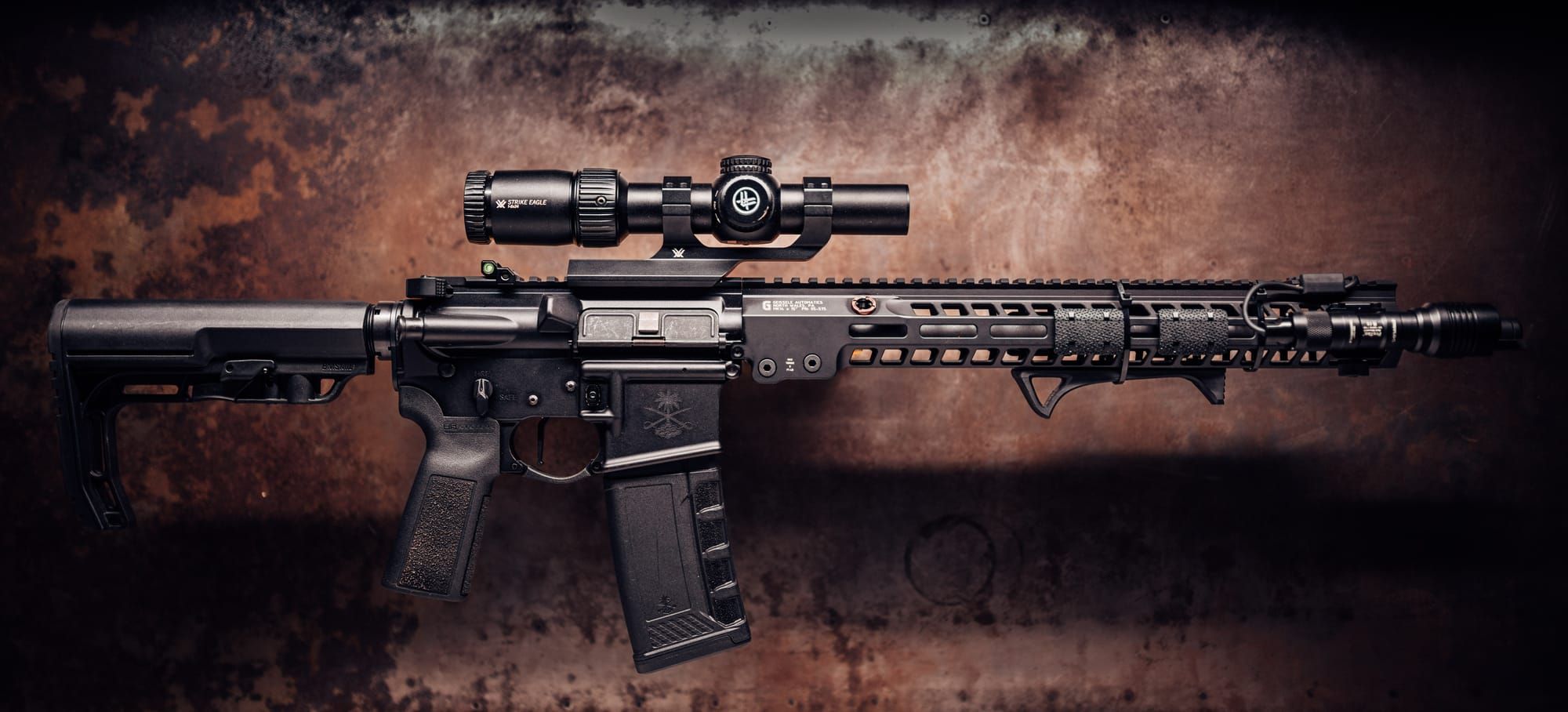
An AR-15-style rifle, the class of semiautomatic rifle at the center of the Supreme Court's Dec. 2 arguments. Photo, March 2026: Bradley Lanphear for CAT Outdoors / Wikimedia Commons / CC BY-SA 4.0
Who covered this
On this page · sections
The short version
- The Supreme Court hears arguments Wednesday on whether Connecticut and Cook County, Illinois, may ban AR-15-style rifles.
- About a dozen states and Washington, D.C., have similar bans, so the ruling could decide whether those laws survive.
- The justices may also drop the Cook County case over standing, and a decision is expected by the end of June.
Documents in this story · 8
- Supreme Court docket, No. 25-238, Khaya v. Cook Countyformerly Viramontes v. Cook County · Court rulingOpen Archived
- Supreme Court docket, No. 25-566, Grant v. Higginssupremecourt.gov · Court rulingOpen Archived
- Question presented, No. 25-238Supreme Court · PDFOriginal Archived
- Brief of the petitionerssupremecourt.gov · PDF · Aug. 28Original Archived
- Brief of the United States as amicus curiae supporting the petitionerssupremecourt.gov · PDF · Sept. 4Original Archived
- Connecticut respondents' briefcorrected · PDF · Oct. 21Original Archived
- Cook County respondents' briefcorrected · PDF · Oct. 21Original Archived
- Cook County's suggestion of mootnesssupremecourt.gov · PDF · Nov. 5Original Archived
The Supreme Court will hear arguments Wednesday on whether states and local governments may ban AR-15-style rifles, in challenges to Connecticut's assault weapons ban and a Cook County, Illinois, ordinance that covers Chicago.
The stakes reach well past those two places. About a dozen states have similar laws, and a ruling for the challengers could strike down Connecticut's ban and declare a constitutional right to own rifles like the AR-15, Reuters reported. The Trump administration backs the gun owners, while families of children killed at Sandy Hook Elementary School have urged the court to uphold the law Connecticut expanded after the 2012 shooting.
Why it matters to you
If you live in a state with one of these bans, the ruling decides whether it survives. By Reuters' count, 11 states and Washington, D.C. prohibit the AR-15 and similar weapons, and the places they cover include New York, Los Angeles and Chicago. Nothing changes before the decision, which is expected by the end of June. Until then, Connecticut's and Cook County's bans remain in force.
The answer also matters if you live somewhere the rifles are legal. A federal law limiting their sale and manufacture expired in 2004, and Congress has not passed another. The ruling could also affect many other gun laws, well beyond these rifles, AP reported.
What the Supreme Court will decide on AR-15 bans
The justices agreed on June 30 to take up two cases together and gave them one hour of argument. One challenges Cook County's ordinance. The other, Grant v. Higgins, challenges Connecticut's law and names Ronnell Higgins, the state's commissioner of emergency services and public protection. The court agreed to answer one question: whether the Constitution guarantees the right to possess "AR-15 platform and similar semiautomatic rifles."
That question is narrower than the lawsuits. Cook County's ordinance also covers AK-47-style rifles, but the court didn't agree to hear the broader claim that the whole ordinance is invalid.
The federal government will argue too. On Nov. 9, the court let the solicitor general, who argues for the United States at the Supreme Court, take part on the challengers' side. "The AR-15 rifle is unquestionably in common use among law-abiding citizens for lawful purposes," its brief says. Connecticut and Cook County answer that the Second Amendment has never barred regulating a gun only because it is popular.
A challenger drops out, and the Cook County case is in doubt
The docket shows a turn that none of the news reports we read mentioned. On Oct. 29, Cutberto Viramontes, the Cook County resident whose name the case carried, asked to leave it. In a Nov. 5 filing, Cook County argued that without him, it is doubtful anyone left in the case has standing, the legal right to sue.
Viramontes had said he wanted an AR-15-style rifle. The other individual challenger, Christopher Khaya, wants an Israeli-made Galil rifle that his own side described as largely based on the AK-47 design, not an AR-15. So the county asked the court to dismiss the case as moot, meaning no live dispute is left to decide. The court let Viramontes go on Nov. 23, and the next day the justices put the county's request off until the argument.
Even if the Illinois case falls away, the question doesn't. The county's own filing says Connecticut's case would still let the court decide it. So some of Wednesday's hour may go to standing, while the case born of Sandy Hook carries the main fight.
How Sandy Hook and two rulings led here
In December 2012, a gunman at Sandy Hook Elementary School in Newtown, Connecticut, killed 20 first-graders and six adults, firing 154 rounds in under five minutes. Connecticut quickly extended its ban to the AR-15 and similar rifles, and widened it again in 2023. Cook County's ban dates to the 1990s.
Two Supreme Court rulings frame the fight. In 2008, District of Columbia v. Heller struck down Washington's handgun ban and said the Second Amendment protects weapons in common use. In 2022, New York State Rifle & Pistol Association v. Bruen held that gun laws must be consistent with the nation's historical tradition of firearm regulation. Bruen set off a wave of challenges, and lower court judges have said they are unsure how to apply it.
Applying those tests, the federal appeals courts in New York and Chicago upheld both bans. Some justices have signaled doubts before. Justices Clarence Thomas, Samuel Alito and Brett Kavanaugh have dissented when the court turned away earlier challenges, or, as appeals judges, from rulings upholding bans, the New York Post reported.
What we don't know yet
The court hasn't said whether it will decide the Cook County case or dismiss it over standing. The justices put that question off until Wednesday, and a dismissal would leave Connecticut's law as the test case for every ban like it.
How broad a ruling will be is also open. The justices could rule on AR-15s alone or on how the common-use test works for every weapon. How much any ruling would change gun violence is disputed too. Handguns are more common in gun violence overall, and UCLA law professor Adam Winkler told AP he expects little effect on public safety either way. Those answers come with the decision, due by the end of June.
The case each side makes
The gun owners and the Trump administration
The Second Amendment Foundation and individual gun owners say the Heller ruling settles this case. Because tens of millions of Americans own AR-15-style rifles, the guns are in common use and cannot be banned, they argue. If governments can ban the most popular guns, Bill Sack, the foundation's senior director of legal operations, told Reuters, then "the right to 'keep and bear arms' is a dead letter."
The federal government's brief makes the same point with numbers. It says AR-15s are legal under federal law and in 40 states, owned mostly for self-defense, hunting and target shooting. In a 2025 ruling, the brief notes, the court itself described the AR-15 as the most popular rifle in the country. Americans own about 40 million AR-15-type rifles, according to a 2026 survey the challengers cite. The challengers' brief says that under Heller, judges may not second-guess that choice by weighing a gun's danger against its usefulness.
The AR-15 rifle is unquestionably in common use among law-abiding citizens for lawful purposes.
Connecticut, Cook County and the Sandy Hook families
Connecticut says history is on its side. Its brief traces bans on especially lethal weapons from medieval lances to the Tommy gun and says governments have long restricted weapons "because of their unusually dangerous properties." Since Sandy Hook, AR-15s or similar rifles were used in 12 of the 17 deadliest U.S. mass shootings, the state said.
Cook County's lawyers wrote that legislatures should be able to act once a weapon poses "an unacceptable threat to human life," in the county's brief. Cook County State's Attorney Eileen O'Neill Burke told CNN the rifles are especially dangerous in a crowded place like Chicago, in a story Scripps News ran. Nicole Hockley, a co-founder of Sandy Hook Promise whose 6-year-old son Dylan was killed at the school, said the fight over the ban is "about ensuring that people are protected," AP reported.
How coverage differs
Readers of the New York Post, the one right-leaning outlet with its own report, heard only from the bans' defenders: Cook County's prosecutor and Connecticut's brief. AP and Reuters gave the Second Amendment Foundation's Bill Sack the challengers' case in his own words.
If you read the left 5 of 21 outlets
You met the families first.
If you read the center 2 of 12 outlets
You went to Newtown.
If you read the right 4 of 21 outlets
You heard the defense and the votes.
Sources
Left
5 of 21 left-leaning outlets we track reported this
- AP: The Supreme Court will decide whether assault weapons bans violate the Second Amendment, Nov. 28
- ABC News (AP copy), Nov. 28
- CNBC (AP copy), Nov. 28
- CNN: Supreme Court to tackle AR-15 bans in blockbuster Second Amendment case, Nov. 27
- The Independent (Reuters copy): Supreme Court weighs Connecticut AR-15 ban born from Sandy Hook school shooting, Nov. 28
Center
2 of 12 center outlets we track reported this
Right
4 of 21 right-leaning outlets we track reported this
- New York Post: Supreme Court to hear arguments on AR-15 bans in huge Second Amendment case, Nov. 27
- The Washington Times (AP copy), Nov. 28
- Daily Mail (AP copy), Nov. 28
- Newsmax: Supreme Court to Hear Cases on Assault Weapons Bans, Nov. 27 (headline only; link not resolvable from its feed)
Primary
- Supreme Court docket, No. 25-238, Khaya v. Cook County (formerly Viramontes v. Cook County) · Archived copy
- Supreme Court docket, No. 25-566, Grant v. Higgins · Archived copy
- Supreme Court: question presented, No. 25-238 · Archived copy
- Brief of the petitioners, Aug. 28 · Archived copy
- Brief of the United States as amicus curiae supporting the petitioners, Sept. 4 · Archived copy
- Connecticut respondents' brief (corrected), Oct. 21 · Archived copy
- Cook County respondents' brief (corrected), Oct. 21 · Archived copy
- Cook County's suggestion of mootness, Nov. 5 · Archived copy
This article was produced by AI under our Editorial Standards. Corrections are reviewed before they go live.
How coverage differs
Keep reading
The newest U.S. stories.
The Fair Witness Daily
Every morning around 7 a.m. Eastern, seven days a week.
Saturday’s editionFree
In Saturday’s Daily
Then the Spin Meter: one divided story, set side by side as the left, center and right told it.
Free. One email a day.
Unsubscribe in one click. Already a member? Sign in


















Discussion
Any free account can join the discussion.