


Edge of Frame · Center and Right
Strobe Talbott, Clinton's deputy secretary of state and Brookings chief, dies at 80
He went from covering the Soviet Union for Time to shaping U.S. policy toward Russia, and Clinton's tribute measured that work against Russia today.

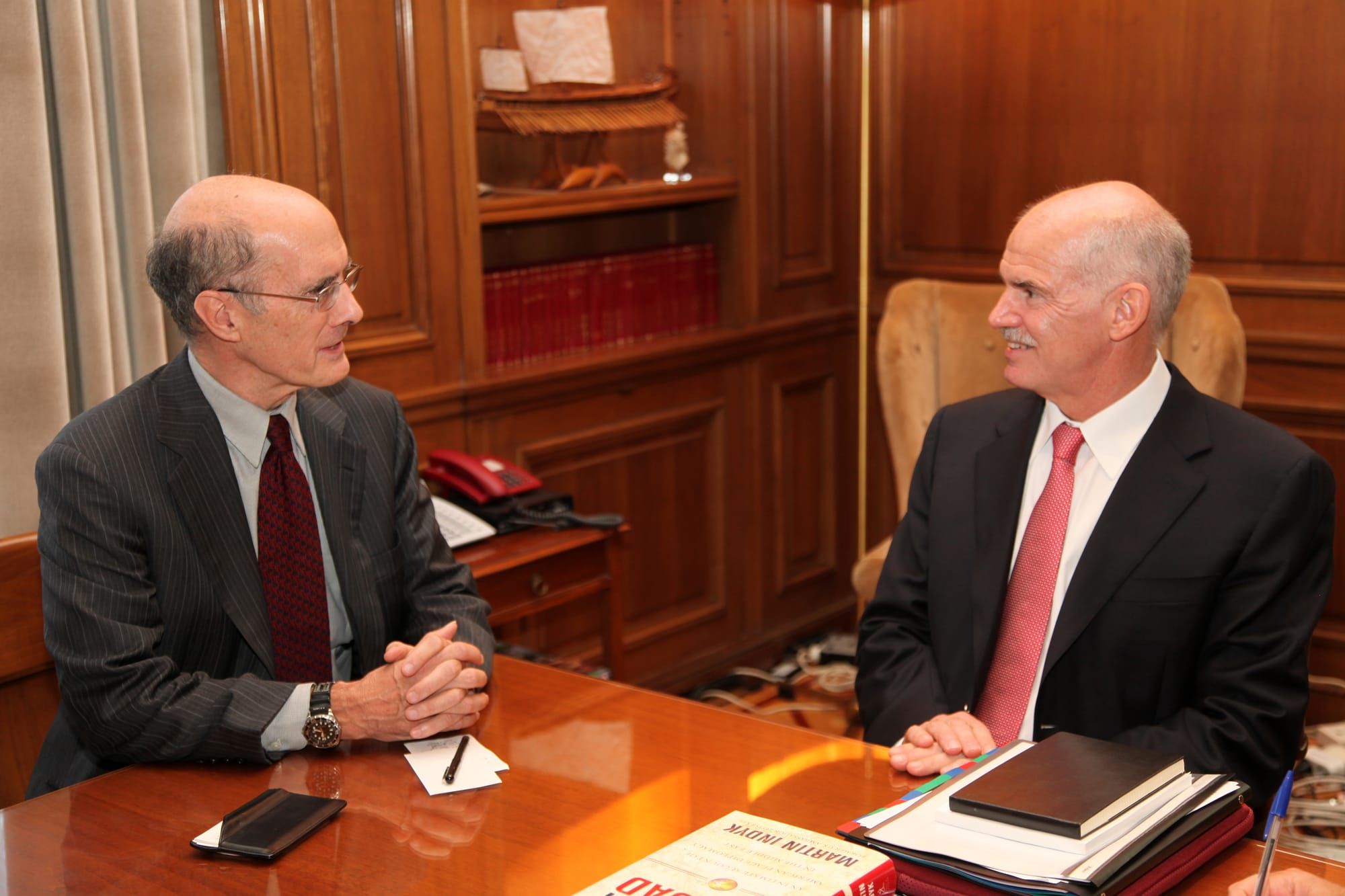
Talbott (left) in October 2009, seven years into his 15 years as president of the Brookings Institution. Photo, October 2009: Office of the Prime Minister of Greece / Wikimedia Commons / CC BY-SA 2.0
Who covered this
On this page · sections
The short version
- Strobe Talbott, a Time reporter who became deputy secretary of state under Bill Clinton, died Thursday at 80 at his New York home.
- He shaped U.S. policy toward Russia after the Soviet collapse, then led the Brookings Institution for 15 years.
- His family has not announced a funeral or memorial, and reports differ on how many grandchildren survive him.
Documents in this story · 4
- Strobe (Nelson Strobridge) Talbott IIIU.S. Department of State, Office of the Historian · Web pageOpen Archived
- Statement on the nomination of Strobe Talbott to be Deputy Secretary of StateThe American Presidency Project · Web page · Dec. 28, 1993Open Archived
- Former Brookings President Strobe Talbott has passed away (Nov. 27, 2026)Brookings Institution · Web pageOpen Archived
- Strobe Talbott profileBrookings Institution · Web pageOpen Archived
Strobe Talbott, the Time magazine reporter who became President Bill Clinton's deputy secretary of state and later led the Brookings Institution, died Thursday at his home in East Hampton, New York. He was 80. His son, Devin Talbott, said the death came peacefully after a long illness.
Talbott spent two decades writing about Moscow, then became what AP called the architect of the Clinton administration's approach to Russia and the other former Soviet states. That is why Clinton's tribute to his old friend on Thursday was about policy as much as friendship, and why it weighed their work against the Russia of today.
Clinton and Brookings mark Strobe Talbott's death
Clinton and Talbott were students together at Oxford, where they shared a home. In a statement after the death, Clinton said, "Strobe was a good and brilliant man who made our world more peaceful and secure." He recalled that while Talbott translated Soviet memoirs at Oxford, it was Clinton's job to make breakfast, and joked that he got the better end of the deal.
The fuller statement, as Fox News printed it, turned to policy. Clinton called Talbott "analytical, completely devoted to diplomacy, and on the level." He said their work cut nuclear dangers and helped build a freer Europe, naming NATO's growth and the resolution of ethnic conflicts in the Balkans. Then he added that Russia's current leader had taken the country in a different direction, a line Fox News said referred to President Vladimir Putin.
Brookings, the Washington think tank Talbott led, announced his death on Friday, calling him its sixth president and saying the institution was stronger for his years there. We did not find Clinton's statement posted on his own accounts as of 8:40 p.m. ET Friday, so the words here are as AP and Fox News printed them.
From Time's Soviet beat to the State Department
Talbott was born in Dayton, Ohio, in 1946 and studied at Yale and Oxford. After an internship in Time's Moscow bureau, the magazine asked him to help translate the leaked memoirs of Nikita Khrushchev, the Soviet leader ousted in 1964. The work got him a job at Time, where he stayed 21 years covering U.S.-Soviet ties. He rose to Washington bureau chief and wrote a column on world affairs.
The newly elected Clinton then brought him into government. AP's obituary, which most of the outlets we counted ran, says Talbott joined the State Department in 1994. The department's own record gives an earlier start. Its Office of the Historian lists him as ambassador at large from April 1993, the secretary's special adviser on the new states of the former Soviet Union. That December, Clinton welcomed his nomination as deputy secretary, calling him "a man of great ability, intellect, and vision."
He took office as deputy secretary, the department's second-ranking job, on Feb. 23, 1994, and held it until the day before Clinton left office in January 2001. That is nearly seven years, through most of Russia's first decade after the Soviet collapse and the 1998 talks with India after its nuclear tests.
Strobe was a good and brilliant man who made our world more peaceful and secure.
A second career at Brookings
After government, Talbott founded Yale's Center for the Study of Globalization, then led Brookings from July 2002 to October 2017. Hillary Clinton, as secretary of state, named him in 2011 to chair the State Department's Foreign Affairs Policy Board. His 13th and last book, published in 2020, set the founders' ideals against the age of President Donald Trump. The Independent said it contrasted Trump with the first six presidents on honesty, civic duty and empathy.
His first wife, Brooke Shearer, died in 2009, and he later married the author Barbara Lazear Ascher. He is survived by his sons, Devin and Adrian.
What we don't know yet
When and where Talbott will be mourned is still open: his family has not announced a funeral or a memorial service, and Brookings has not said whether it will hold its own event. Those plans would also show whether former colleagues from the Clinton years and from Moscow take part.
The reports also differ on his family. AP and Fox News said he leaves six grandchildren. The Guardian and The Independent, citing The New York Times, said eight, along with a stepdaughter and three siblings. We found no obituary from the family that would settle it.
How coverage differs
For readers of center outlets, and of most right-leaning ones, Talbott's death sat at the edge of the frame: they got AP's short obituary or nothing, while Fox News readers alone got Clinton's words on NATO and on Russia's current leader.
If you read the left 8 of 21 outlets
You had the most places to read it.
If you read the center 1 of 12 outlets
One outlet, one wire story.
If you read the right 3 of 21 outlets
Fox gave you Clinton's Russia tribute.
Sources
Left
8 of 21 left-leaning outlets we track reported this
- AP: Strobe Talbott, former Time magazine reporter and deputy secretary of state, has died
- NBC News (AP copy): Strobe Talbott, former deputy secretary of state, has died
- ABC News (AP copy): Strobe Talbott, former Time magazine reporter and deputy secretary of state, has died
- HuffPost (AP copy): Strobe Talbott, Former Time Magazine Reporter And Deputy Secretary Of State, Dead At 80
- NPR (AP copy): Strobe Talbott, former Time magazine reporter and deputy secretary of state, has died
- Politico (AP copy): Strobe Talbott, former Time magazine reporter and deputy secretary of state, has died
- The Guardian (AP copy): Strobe Talbott, Time magazine reporter and deputy US secretary of state, dies aged 80
- The Independent: Strobe Talbott: Clinton's deputy secretary of state dies aged 80
Center
1 of 12 center outlets we track reported this
Checked, no report found as of 8:40 p.m. ET Nov. 27: Reuters, The Hill, BBC News, The Christian Science Monitor, Newsweek, UPI, +5.
Right
3 of 21 right-leaning outlets we track reported this
- Fox News: Strobe Talbott, former deputy secretary of state and Brookings Institution president, dies at 80
- The Washington Times (AP copy): Strobe Talbott, former Time magazine reporter and deputy secretary of state, has died
- Daily Mail (AP copy): Strobe Talbott, former Time magazine reporter and deputy secretary of state, has died
Checked, no report found as of 8:40 p.m. ET Nov. 27: New York Post, The Daily Wire, The Daily Caller, Just The News, The Center Square, Washington Free Beacon, +12.
Primary
- U.S. Department of State, Office of the Historian: Strobe (Nelson Strobridge) Talbott III · Archived copy
- The American Presidency Project: Statement on the nomination of Strobe Talbott to be Deputy Secretary of State, Dec. 28, 1993 · Archived copy
- Brookings Institution: Former Brookings President Strobe Talbott has passed away (Nov. 27, 2026) · Archived copy
- Brookings Institution: Strobe Talbott profile · Archived copy
This article was produced by AI under our Editorial Standards. Corrections are reviewed before they go live.
How coverage differs
Keep reading
The newest U.S. stories.
The Fair Witness Daily
Every morning around 7 a.m. Eastern, seven days a week.
Friday’s editionFree
In Friday’s Daily
Then the Spin Meter: one divided story, set side by side as the left, center and right told it.
Free. One email a day.
Unsubscribe in one click. Already a member? Sign in

















Discussion
Any free account can join the discussion.