Kim Jong Un calls for wider deployment of tactical nuclear weapons
Kim said North Korea's nuclear status will never change, rejecting the denuclearization that Washington and Seoul named as their shared goal last year.

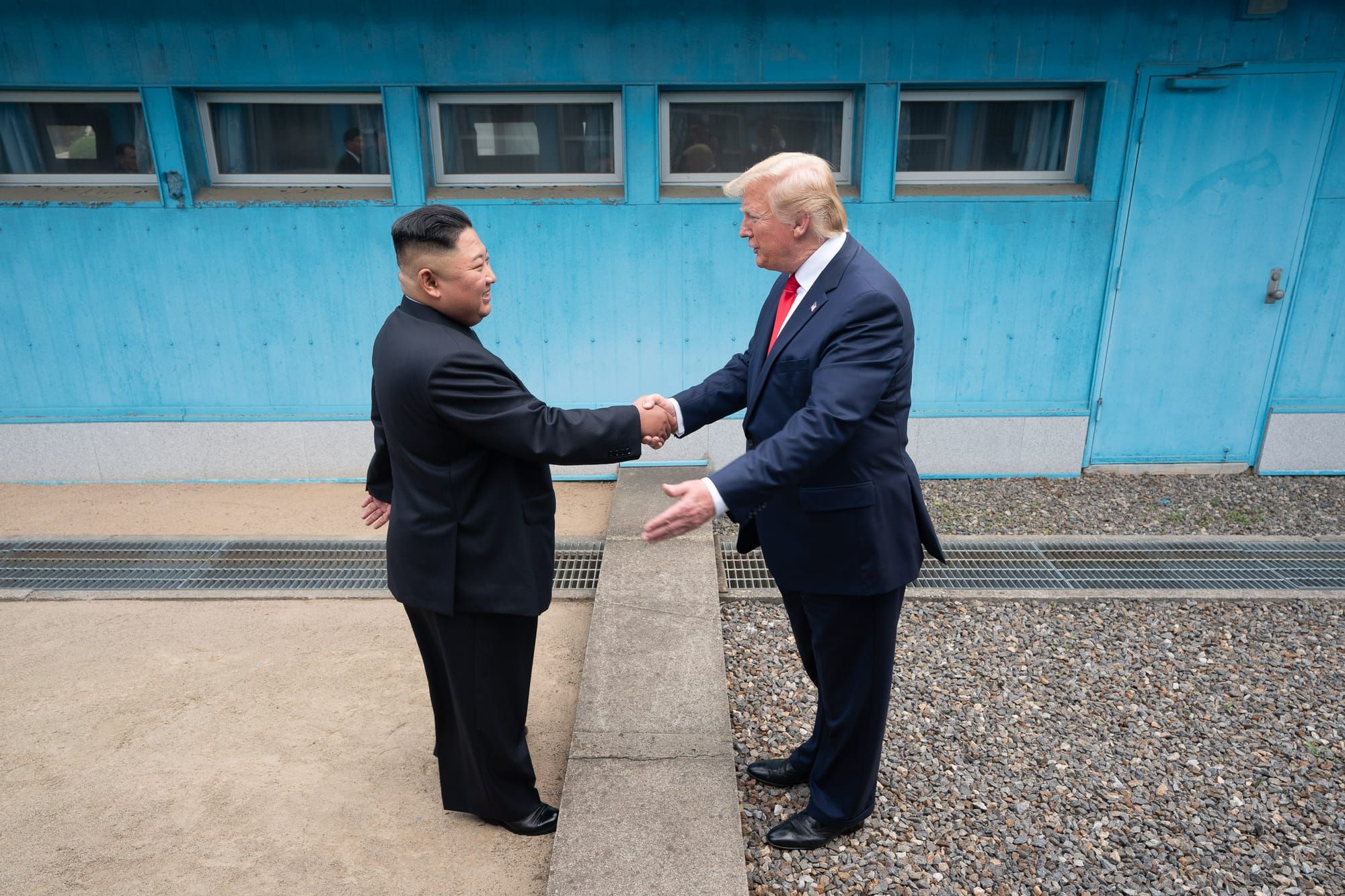
The two leaders in June 2019, the year their talks collapsed; North Korea has not publicly answered Trump's newest offer to meet. Photo, June 2019: Shealah Craighead / The White House / Wikimedia Commons / Public domain
Who covered this
On this page · sections
The short version
- North Korea's Kim Jong Un toured nuclear sites and called for wider deployment of tactical nuclear weapons and more nuclear material.
- He rejected any talk of giving up the weapons, days after North Korea left Trump's offer to meet without a public answer.
- South Korea urged the North to follow U.N. resolutions, and Trump said this week that contact with Kim could start right away.
North Korean leader Kim Jong Un toured nuclear sites and called for wider deployment of tactical nuclear weapons and more nuclear material, the state news agency KCNA reported Thursday.
The Wednesday tour took in a new nuclear-materials factory, a second one being expanded, a base that makes nuclear-powered equipment and the Nuclear Weapons Institute, UPI reported from KCNA's account. KCNA, which the North Korean government runs, did not say where any of the sites are. Its photos showed Kim walking between rows of what appeared to be centrifuges, the machines that enrich uranium, the Associated Press reported.
What made the tour more than a photo session was the timing. It came days after President Donald Trump's Asia trip ended without the meeting with Kim that Trump had said he wanted, and North Korea did not publicly answer the offer. Kim's words went straight at the goal of any such talks. He said his country's status as a nuclear-armed state "will never change," and that any attempt to deny that status would be treated as a declaration of war.
Why it matters to you
Tactical nuclear weapons are smaller warheads built for use on a battlefield, not for long-range strikes on distant cities. Kim tied them to the border with what he called the most dangerous enemy state. That meant South Korea, the AP reported. South Korea is a U.S. ally: in a joint fact sheet in November 2025, the White House pledged to defend South Korea with the full range of U.S. capabilities, including nuclear weapons.
Kim also said North Korea should field the weapons across several military domains, wording one South Korean analyst said could point past the peninsula. Shin Jong-woo of the Korea Defence and Security Forum said it could signal targets that include the U.S. mainland, in a Reuters report NBC News ran. That is one analyst's reading, not a stated North Korean plan. Whether contact resumes is the next test. Trump said this week that communications with Kim could start up right away.
What Kim showed of North Korea's tactical nuclear weapons
KCNA's pictures did much of the talking. Analysts said some objects looked like gas centrifuges and like the Hwasan-31, a small tactical warhead that KCNA pictured in 2023, Reuters reported. Analysts said the nuclear-powered equipment base may be the first public look at gear for a naval reactor. Ankit Panda of the Carnegie Endowment for International Peace called the images a very notable disclosure, and Shin said the equipment could serve a nuclear-powered submarine planned for next year, the same report said.
Kim framed the buildup as an answer to Washington. He accused the United States of urging its allies to get nuclear-powered submarines and of committing to share its nuclear weapons with them, the AP reported. He named the AUKUS pact among the United States, Britain and Australia as the precedent, according to Reuters. "Our nuclear capability is now a reality," KCNA quoted Kim as saying.
The report gave no production figures either, so outsiders have only photos and words to judge the program by.
How North Korea's nuclear program reached this point
North Korea has carried out six nuclear tests since 2006, the last and largest in 2017, and in 2023 it wrote its nuclear status into its constitution, Reuters reported. Nobody outside the country knows how many warheads it holds. South Korea's defense minister said in August that the North was believed to have 80 to 120, an estimate he said came from private researchers and could not be confirmed.
Direct diplomacy ended in 2019, when negotiations between Trump and Kim collapsed. The International Atomic Energy Agency, the United Nations' nuclear watchdog, has had no inspectors in North Korea since they were expelled in 2009. Last week its director general, Rafael Grossi, told the agency's board that an addition to the original uranium-enrichment plant at Yongbyon, the North's main nuclear complex, was outwardly finished by late October, UPI reported. He called the growth of the enrichment program a cause for serious concern.
A Washington research group, the Institute for Science and International Security, said Tuesday that the addition could raise North Korea's capacity to make weapons-grade uranium. Kim's tour came a day later.
The submarine deal behind Kim's charge
Kim's complaint about submarines points to a real decision, and the record shows both what it is and what it isn't. In the joint fact sheet from Trump's meeting with South Korean President Lee Jae Myung, published Nov. 13, 2025, the United States said it had approved South Korea building nuclear-powered attack submarines. Nuclear power runs a submarine's engine. It does not by itself mean the vessel carries nuclear weapons, as CNBC noted.
The same document holds the goal Kim rejected on Wednesday. In it, Trump and Lee restated their commitment to the "complete denuclearization of the DPRK," the initials of North Korea's formal name. So one page carries both halves of the dispute: the submarine approval North Korea cites as a threat, and the disarmament demand it says it will never accept.
What we don't know yet
We don't know where the factories Kim visited are, or whether either one is the new addition at Yongbyon that the IAEA described. The answer matters because the North may have more enrichment plants than outsiders can see: last year South Korea's unification minister said it was running four, the AP reported.
We also don't know how the Trump administration will answer. Trump has said he and Kim could restart the letters they traded in his first term, but he said they had not been in touch recently, the AP reported. Whether the White House or the State Department responds to the tour, and whether any contact follows, is the next thing to watch.
The case each side makes
North Korea
North Korea's case, as KCNA set it out, is that its weapons are a defense against a growing threat. Kim said he was answering nuclear threats approaching the Korean Peninsula. He accused Washington of promising to share its nuclear weapons with allies, the AP reported. In his telling, the AUKUS pact set a dangerous example of nuclear spread, and Washington is now bringing it to Northeast Asia, according to Reuters.
He called the weapons a choice that cannot be undone while hostile powers use nuclear arms to dominate others, Reuters reported. And he said the nuclear policy is written into the state's highest law, according to CNBC. Kim has said before that he could return to talks if the United States dropped what he calls its hostile policy and accepted North Korea as a nuclear state, the AP noted.
Our nuclear capability is now a reality.
South Korea and the United States
South Korea's Defense Ministry said it takes the North's plan to expand tactical nuclear operations seriously. "North Korea must immediately stop trying to justify its nuclear development," spokeswoman Chung Binna said Thursday, urging Pyongyang to follow U.N. Security Council resolutions, UPI reported. She said Seoul is strengthening deterrence with Washington through the two countries' Nuclear Consultative Group.
We found no public response from the White House or State Department as of 12 p.m. ET Thursday. Trump spoke about Kim earlier this week, before the KCNA report. In a New York Post interview, he brushed off the idea that Kim had ignored his outreach, saying, "No, he didn't ignore it," the AP reported. He said the busy summit days were not the right time. For the U.S. side, the record is older. The fact sheet Trump issued with Lee in November 2025 names complete denuclearization as the allies' shared goal.
How coverage differs
For readers of right-leaning outlets, this story was at the edge of the frame: the New York Post ran the only original report, and the rest was wire copy from AP and AFP.
If you read the left 8 of 20 outlets
You got the warning and the watchdog.
If you read the center 3 of 11 outlets
Trump came only in a headline.
If you read the right 3 of 20 outlets
You saw it mostly through the wires.
Sources
Left
8 of 20 left-leaning outlets we track reported this
- CNBC: North Korea's Kim calls for nuclear arsenal expansion, says status 'will never change'
- NBC News (Reuters copy): Kim Jong Un presses for wider nuclear deployment on facility tour
- Politico (AP copy): Despite Trump overture, North Korea's Kim vows to build more nuclear weapons
- CNN: North Korea's Kim Jong Un urges wider tactical nuclear deployment during inspection of weapons facilities (headline only; text unavailable)
Center
3 of 11 center outlets we track reported this
Right
3 of 20 right-leaning outlets we track reported this
- New York Post: North Korean's Kim Jong Un brazenly inspects nuclear weapons
- Daily Mail (AP copy): North Korea's Kim vows to build more nuclear weapons after ignoring Trump's overture
- Daily Mail (AFP copy): North Korea's Kim calls for more ways to fire nuclear weapons (headline only)
Checked, no report found as of 11:15 a.m. ET Nov. 26: Fox News, The Daily Wire, The Washington Times, The Daily Caller, Just The News, The Center Square, +11.
This article was produced by AI under our Editorial Standards. Corrections are reviewed before they go live.
How coverage differs
Keep reading
The newest World stories.
The Fair Witness Daily
Every morning around 7 a.m. Eastern, seven days a week.
Thursday’s editionFree
In Thursday’s Daily
Then the Spin Meter: one divided story, set side by side as the left, center and right told it.
Free. One email a day.
Unsubscribe in one click. Already a member? Sign in