Houthis say they attacked Saudi Arabia's largest refinery and Riyadh's financial district
The Houthis now threaten the Red Sea ports that Saudi Arabia uses to ship its oil around the Strait of Hormuz.

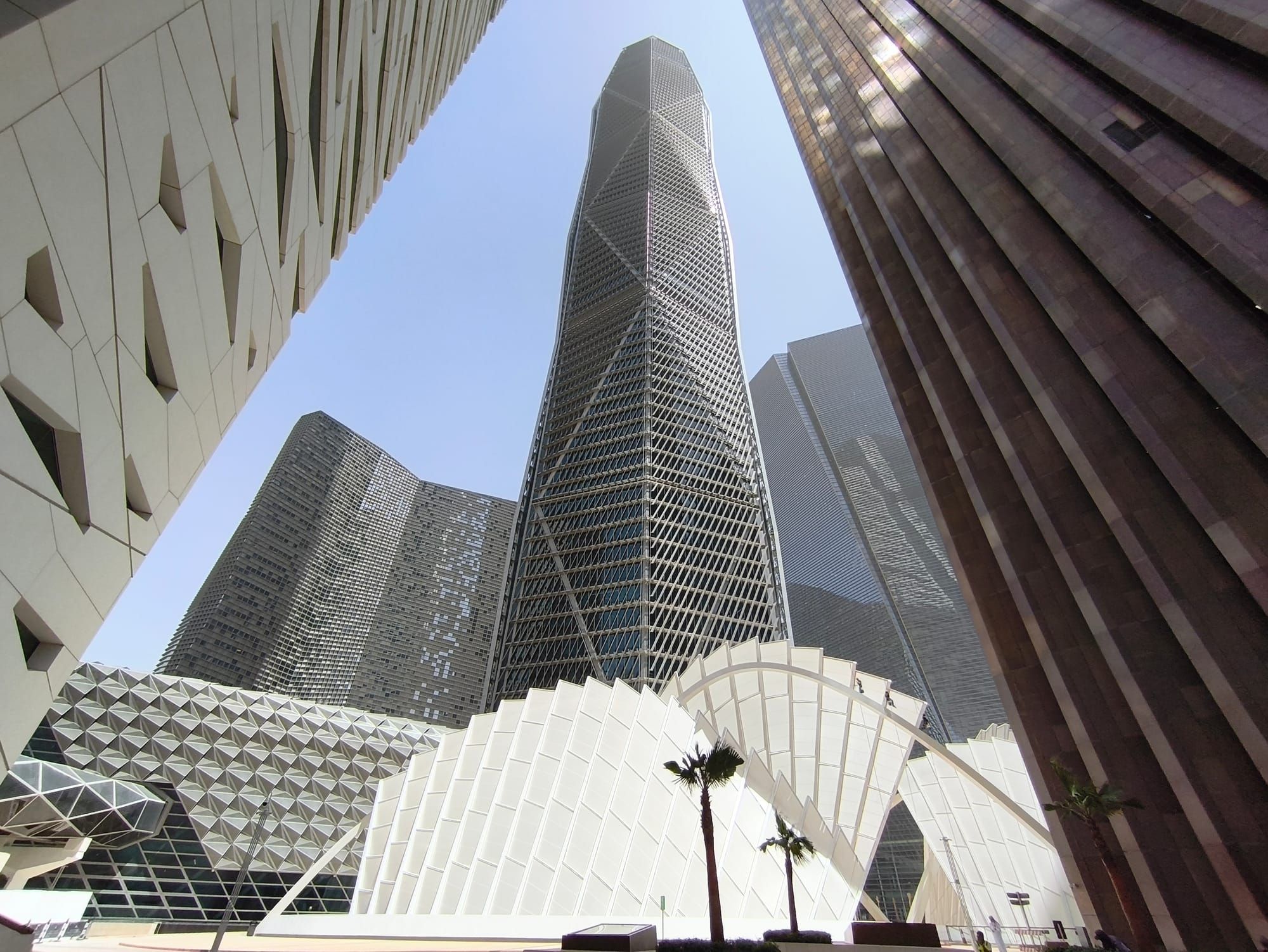
Riyadh's King Abdullah Financial District, home of the Public Investment Fund Tower, which a strike hit on Tuesday, wounding 11 people. Photo, April 2025: Kolaiel / Wikimedia Commons / CC0
Who covered this
On this page · sections
The short version
- Yemen's Houthis said they attacked Saudi Arabia's largest refinery and Riyadh's financial district, a day after a strike on a Riyadh tower wounded 11.
- The fight now reaches the Red Sea ports Saudi Arabia uses to ship oil around Hormuz, as Houthi fighters close in on Aden.
- Saudi Arabia and Aramco have not said whether the refinery was damaged, and Saudi civil defense says the coalition will respond decisively.
Yemen's Houthis said Wednesday they attacked Ras Tanura, Saudi Arabia's largest oil refinery, and Riyadh's financial district, a day after a strike on the capital's tallest tower wounded 11 people.
The Saudi-led coalition said its air defenses destroyed four drones over Ras Tanura and did not say the refinery had been hit. By evening the fight had moved west. The Houthis said they struck the Red Sea ports of Jeddah and Jazan after coalition strikes on the Yemeni port of Hodeidah. The coalition said one projectile hit Jazan and did little damage, AFP reported.
That shift is what raises the stakes. The Red Sea coast is Saudi Arabia's way around the Strait of Hormuz, the Gulf waterway the U.S.-Iran war has already slowed. And on the ground in Yemen, Houthi fighters are now within about 37 miles of Aden, the seat of the government Saudi Arabia backs, Yemen's military spokesman said.
Why it matters to you
Iran's attacks have cut traffic through Hormuz, which has made other routes, including the Red Sea, more important. On Monday, Iran's Revolutionary Guard said three oil ships hit naval mines in the strait. With that route in doubt, a Houthi threat to Saudi Red Sea ports reaches well beyond Yemen and Saudi Arabia. Oil trades on a world market, so trouble on its shipping lanes can reach fuel prices far from the Gulf.
Ras Tanura matters for the same reason. It can refine about 550,000 barrels a day, and it sits beside one of the world's largest crude export terminals. Earlier Houthi attacks briefly disrupted some of Aramco's operations and led to the cancellation of most international flights to Riyadh, Reuters reported.
What Saudi Arabia confirms about the Houthi attack on its refinery and Riyadh
The two sides tell different stories about Ras Tanura. Houthi military spokesman Yahya Saree said the attack caused fires. Reuters reported that satellite images from NASA and Planet Labs showed thick black smoke over the site, and a source who knows the matter confirmed an attack. The coalition's spokesman, Turki al-Maliki, said debris from the downed drones hurt no one, AFP reported. Saudi Arabia's government and Aramco, the state oil company, did not immediately respond to requests for comment from Reuters.
The Riyadh strike is clearer. Saudi civil defense said 11 people were wounded Tuesday at a tower in the financial district, and it posted an image of the building with damage about halfway up its face. Nine of the wounded were foreigners: four Egyptians, three Nepalis and two Indians. Civil defense did not name the tower, but the image showed the headquarters of the Public Investment Fund, the kingdom's sovereign wealth fund. It was the second strike on that tower in less than a week. The first, on Nov. 19, damaged the building but hurt no one.
The ports came next. On Wednesday Saree warned that Jeddah and every other Saudi Red Sea port would be targets if Saudi Arabia attacked Hodeidah. He told workers, residents and shipping companies to leave at once. The coalition then said it had struck "operational capabilities" at Hodeidah and hit targets in the Saada and Amran provinces. Hours later, the Houthis said they had struck Jeddah and Jazan. The coalition confirmed only the Jazan hit and did not comment on Jeddah, AFP reported.
Why the Red Sea ports matter more now
What makes the Jeddah threat different is where Saudi oil now goes. The U.S. Energy Information Administration's country analysis describes an East-West pipeline that can carry 5 million barrels a day of crude from the Gulf to the Red Sea. That pipeline is how Saudi Arabia can export without passing through Hormuz. The agency's analysis was last updated in 2024, before the war.
The war has made Yanbu, where the pipeline ends, far more important, Reuters reported. The Saudis shifted much of their exports to the Red Sea route over the summer, Breitbart reported. So a threat to every Saudi Red Sea port is a threat to the route Saudi Arabia chose to get around Hormuz.
Ships sailing south from those ports must also pass waters the Houthis now control. Yemen's military spokesman said the group holds the coast along the Bab el-Mandeb Strait, the narrow southern entrance to the Red Sea, and Mayyun Island in its middle.
How the fight for Aden got here
Yemen's civil war had been mostly frozen until it flared again in July, a spillover from the U.S.-Iran war. Since then the Houthis, who hold much of western Yemen and the capital, Sanaa, have fired at Saudi airports, oil sites and offices. Iran has hit other Gulf states too, including Bahrain and a U.S. air base in Kuwait, as Fair Witness reported.
In September, the Houthis swept aside government forces. The government and Saudi Arabia answered with an offensive, Operation Dawn of Yemen, launched Oct. 4 to retake Sanaa. This month government forces pulled back from the Bab el-Mandeb to defend Aden, and the Houthis have begun striking the city. The Guardian put the front about 50 miles from Aden, farther out than the 37 miles Yemen's military spokesman gave.
Civilians in Yemen have been hit too. Saudi airstrikes since September have killed or wounded 822 civilians, 181 of them children, by the count of the independent Yemen Data Project, The Guardian reported. "The Houthis appear to be testing how well Aden's defences will hold," Mohammed al-Basha, who runs a U.S.-based risk advisory firm, told The Guardian.
What we don't know yet
Whether the attack damaged Ras Tanura is still unknown. Neither the Saudi government nor Aramco had said by 5:45 p.m. ET Wednesday. Jeddah is a second gap: the Houthis say they hit it, and the coalition has said nothing about it. Iran hasn't answered the Yemeni claim about its advisers.
How Saudi Arabia answers is the next unknown. Saudi civil defense said the coalition would answer attacks on civilians decisively. Saree tied his Jeddah threat to Hodeidah, so more strikes there would test it.
Nor is it clear whether the Houthis will try to take Aden. They have not said they plan to, and al-Basha said they could try a siege if the defenses hold. One international aid group is issuing termination notices to its staff this week, to be renewed only if the Houthis don't reach the city, a worker told The Guardian.
The case each side makes
The Houthis
The Houthis present their strikes as answers to Saudi attacks. Houthi authorities say Saudi Arabia has carried out 5,500 air and missile attacks since July. They tied last week's threats to a Saudi operation against shipments at Hodeidah, and they told civilians to leave Riyadh's financial district first, calling it a "military target."
Saree's Jeddah warning on Wednesday followed the same order: the condition first, then the call for civilians to leave. After the coalition struck Hodeidah, he said the group had hit both ports. "Both operations resulted in damage to the targeted sites," Saree said, according to AFP.
The Houthis appear to be testing how well Aden's defences will hold.
Saudi Arabia and Yemen's government
Saudi Arabia calls the strikes terrorism, and the Yemeni government it backs says Iran is behind them. Al-Maliki said the Riyadh tower was hit in a "cowardly terrorist attack" and said investigators were at the scene. Col. Majed Abdullah Al-Nuzaily, Yemen's military spokesman, said 14 members of Iran's Revolutionary Guard and seven Hezbollah experts were working with the Houthis. Yemen's Interior Ministry had found them, he said. Hezbollah called that claim baseless on Nov. 4, Shafaq News reported. We found no public response from Iran as of 6 p.m. ET Wednesday. "Iran is the Houthis' patron, their godfather," he said.
Al-Nuzaily said government forces had suffered setbacks but that Aden would hold. The fight is "not as dire as reported," he said, and forces now stand on a fortified line north and west of the city. "Aden is a red line," he told reporters. Marwan Al Noman, a political adviser to Yemen's foreign minister, asked the U.S. and its allies for equipment, training and coast guard help, not troops.
How coverage differs
Readers of right-leaning outlets got this war mostly from Yemen's front line: Fox News and The Washington Times told it through the army's Aden briefing, while CNBC and Reuters led with the strikes on Riyadh and Ras Tanura.
If you read the left 4 of 20 outlets
You saw the wounded and the residents.
If you read the center 2 of 11 outlets
You got the claim, labeled as one.
If you read the right 3 of 20 outlets
You heard mostly from Yemen's army.
Sources
Left
4 of 20 left-leaning outlets we track reported this
Center
2 of 11 center outlets we track reported this
- Reuters: Yemen's Houthis say they attacked Saudi oil refinery and Riyadh financial district, Nov. 25
- Reuters: Yemen's Houthis threaten to target Jeddah and other Saudi Red Sea ports, Nov. 25
- Reuters, as carried by NBC News under NBC's headline: Yemen's Houthi rebels attack Saudi Arabia's largest oil refinery, Nov. 25
- NewsNation: Houthis advance toward Aden; Saudis vow response for Riyadh attack, Nov. 24
Right
3 of 20 right-leaning outlets we track reported this
Other reporting
This article was produced by AI under our Editorial Standards. Corrections are reviewed before they go live.
How coverage differs
Keep reading
The newest World stories.
The Fair Witness Daily
Every morning around 7 a.m. Eastern, seven days a week.
Wednesday’s editionFree
In Wednesday’s Daily
Then the Spin Meter: one divided story, set side by side as the left, center and right told it.
Free. One email a day.
Unsubscribe in one click. Already a member? Sign in