


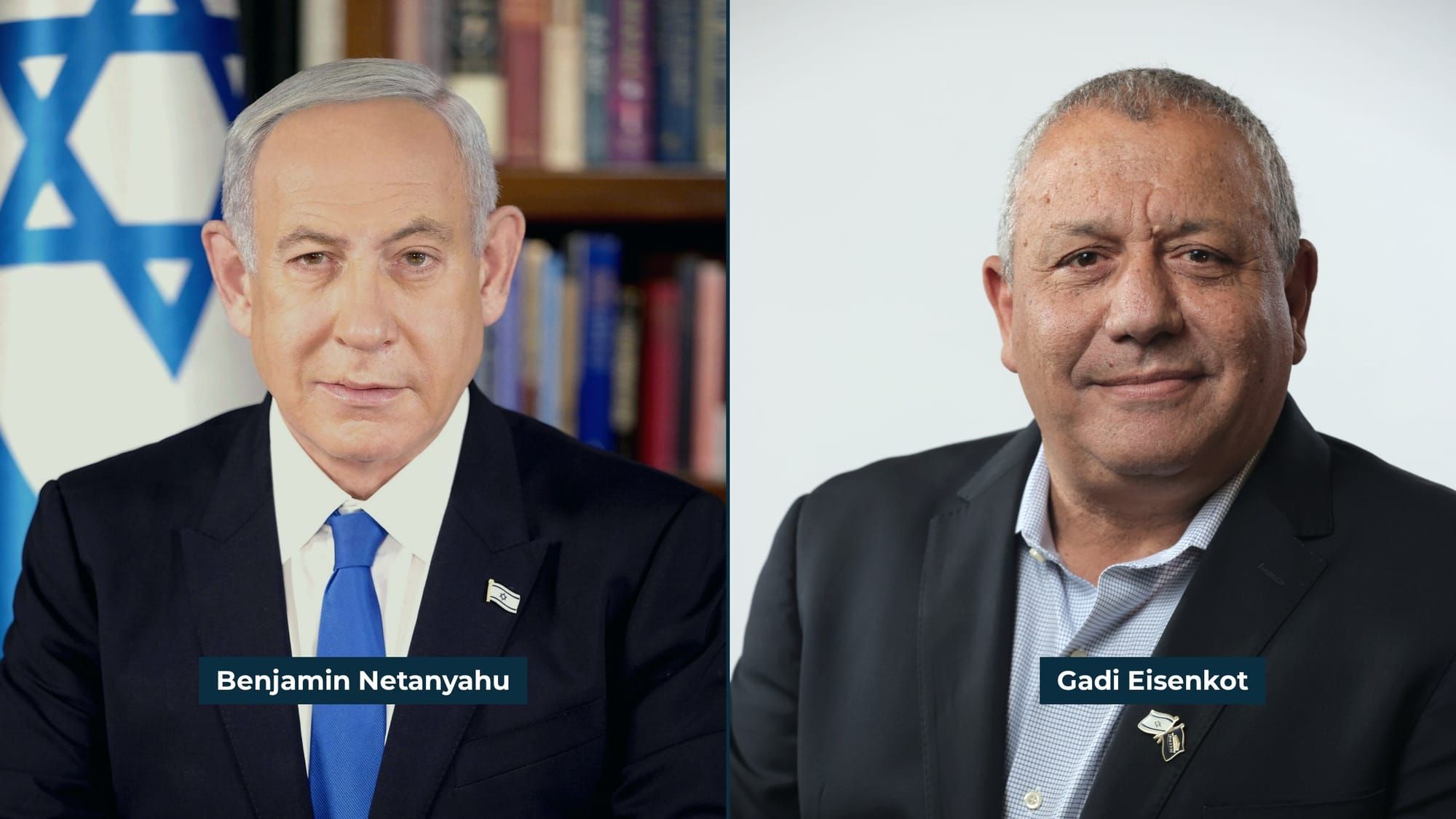
Netanyahu offers Eisenkot first turn as prime minister in a unity government
The offer could keep Netanyahu in power as his rival, Gadi Eisenkot, works toward a majority without him before a Dec. 6 deadline.

Composite of official portraits from 2023 and 2022: Benjamin Netanyahu (left), Israel's caretaker prime minister, and Gadi Eisenkot (right), Yashar party leader. Photos: Avi Ohayon, Government Press Office of Israel / Wikimedia Commons / CC BY-SA 3.0 (left); Ronen Horesh, Knesset Archives / Wikimedia Commons / CC BY-SA 4.0 (right)
Who covered this
On this page · sections
The short version
- Netanyahu offered Saturday to let his rival Gadi Eisenkot serve first as prime minister in a rotating unity government.
- Eisenkot is working toward a majority without Likud, and the offer could keep Netanyahu in power as alternate prime minister.
- The two agreed to meet Sunday morning in Herzliya, and Eisenkot's deadline to form a government is Dec. 6.
Israeli caretaker Prime Minister Benjamin Netanyahu offered Saturday to let his main rival, Gadi Eisenkot, serve first as prime minister in a rotating unity government. Netanyahu would take the post of alternate prime minister and lead later.
It is the first time Netanyahu has said he would go second, and he said it with Eisenkot edging toward a government without him. Eisenkot answered within hours. He invited Netanyahu to talks and said he would judge over the next 24 hours whether Likud was serious. The two men then spoke and agreed to meet at 10 a.m. Sunday in Herzliya (about 3 a.m. ET), Likud said. As of 6 p.m. ET Saturday, no deal had been announced.
Why it matters to you
Israel is a close U.S. ally, and its next government will set its course on the wars around it. Netanyahu warned that a government without him would pull Israeli forces back from Gaza, Syria and Lebanon, the Daily Mail reported. Eisenkot, a former military chief, would lead a coalition that runs from the right-wing Yisrael Beiteinu to the left-wing Democrats.
The offer also bears on Netanyahu's corruption trial, which we covered this week. The post he would take carries protections on criminal cases that an ordinary minister's job does not, and we explain them below. The first test comes at Sunday's meeting, and Eisenkot has until Dec. 6 to form a government.
What Netanyahu offered Eisenkot in the unity government
Netanyahu made the offer in a statement on X on Saturday evening. He argued first that he should lead, because Likud is the largest party in the Knesset. Then he gave that claim up.
"My responsibility as a leader requires me to put everything aside," Netanyahu said, according to the New York Post. He said he would set aside the principle that the largest party leads, and he cited what he called an existential threat to Israel.
Key terms were missing. Netanyahu did not say how long Eisenkot's first turn would last, CNN reported. He said he expected the other side to make similar concessions. Netanyahu also wants a security matter he did not name settled before any handover, The Jerusalem Post reported.
Why Eisenkot is close to a majority without Likud
No bloc won a majority in the Oct. 27 election. Eisenkot's centrist Yashar and three other Jewish opposition parties won 48 of the Knesset's 120 seats, the BBC reported. Netanyahu's bloc won 53, and two Arab-led alliances won 19, their best result yet.
Still, more lawmakers wanted Eisenkot to lead. Sixty-seven members recommended him to President Isaac Herzog, against 46 for Netanyahu, and Herzog gave him the mandate on Nov. 8. Israeli law gives a candidate 28 days to form a government, which puts Eisenkot's deadline at Dec. 6. The president can add up to 14 more days, but on Friday Eisenkot said he would announce a government by then without asking for more time.
He has signed deals with Yisrael Beiteinu and the Democrats, which gives him 36 lawmakers, still far short of 61. He is also in talks with United Torah Judaism, an ultra-Orthodox party that backed Netanyahu for years. The Joint List, an Arab-majority party, is expected to back an Eisenkot government from outside it. Mansour Abbas, who leads the Arab party Ra'am, on Saturday implicitly recognized Hamas as a terror group, AFP reported. That step could open the way for Ra'am to join.
A deal with Likud would change the arithmetic at once. Likud's 27 seats plus Eisenkot's 36 make 63, a majority with no ultra-Orthodox or Arab party.
What Israel's rotation law says, and how the last deal ended
Israel has tried this before. Shimon Peres and Yitzhak Shamir swapped the job in the 1980s, and Naftali Bennett handed it to Yair Lapid in 2022. The one that failed was Netanyahu's own. After the 2020 election he formed a unity government with Benny Gantz and served first. He then did not pass a state budget, which forced new elections before Gantz's turn came, CNN reported.
The rules for a rotation are in Israel's Basic Law: The Government, one of the country's constitutional laws. Read directly, the Knesset's English text shows three things that matter here. The prime minister in a rotation government "is not entitled to remove the Alternate Prime Minister from his office." A later amendment moves the handover forward if the budget is not passed on time. It also does so if at least two lawmakers from the prime minister's side vote to dissolve the Knesset. That would cover the kind of budget failure that ended the 2020 deal.
The third point bears on the trial. The law gives the alternate prime minister the same legal status as the prime minister on criminal investigations, indictments and removal after a conviction. Take a regular minister convicted of a crime the court finds shameful, which Israeli law calls moral turpitude. That minister is out the day of the verdict. A prime minister, and so an alternate, leaves only by a Knesset vote or once the verdict is final. That is why the post would let Netanyahu stay in government while his trial goes on, The Jerusalem Post reported.
What we don't know yet
How long would Eisenkot's first turn last, and what security matter does Netanyahu want settled before any handover? Those terms would decide when, or whether, the job passes back to Netanyahu, and Sunday's talks are the first chance to learn them.
It is also unclear whether Eisenkot's partners would accept Likud. Some of his allies called the offer a bluff. The other path, through ultra-Orthodox and Arab parties, has opponents of its own among those allies. Whatever he chooses has to come together by Dec. 6, or Herzog can give him more time or hand the task to someone else.
The case each side makes
Netanyahu and those backing the offer
Netanyahu argues that Israel's dangers outweigh his own claim to the job. As head of the largest party, he said, he was the natural choice to lead. He warned that "supporters of terrorism" want policies that would return militants to the edge of Israeli towns, and that only a unity government could stop them.
His allies say the offer is real. Finance Minister Bezalel Smotrich called it "genuine and sincere" and urged Eisenkot to form a broad unity government. Bennett, who co-leads Beyachad, a party in Eisenkot's own bloc, also backed it. He said Netanyahu had made the right decision in agreeing to join a government led by Eisenkot.
My responsibility as a leader requires me to put everything aside.
Eisenkot and his partners
Eisenkot argues that the question is policy, not who sits in which chair. On Friday he said Likud had "refused to put a single concrete proposal on the table" in two weeks of talks, and accused it of stalling to force new elections. On Saturday he said he had sent a detailed proposal through a private channel a week earlier and still had no reply.
He did not reject the offer. He invited Netanyahu's team to start talks that same night at a Herzliya hotel, and gave Likud a day to show it means it. Some of his partners went further. Lapid, who co-leads Beyachad with Bennett, called the offer "yet another transparent con by a serial fraudster," AFP reported. Yair Golan, who leads the Democrats, said Netanyahu had lost and called for a government of change.
How coverage differs
CNN and Reuters headlined a leader at risk of losing power, while the New York Post and the Daily Mail headlined him stepping aside. Only CNN said Gantz never got his turn in Netanyahu's last rotation deal.
If you read the left 4 of 21 outlets
You got the history and the doubters.
If you read the center 2 of 12 outlets
You got the seat math.
If you read the right 3 of 21 outlets
You read it as a step aside.
Sources
Left
4 of 21 left-leaning outlets we track reported this
- CNN: Running out of options, Israel's Netanyahu offers power sharing deal to main rival Eisenkot, Nov. 28
- The Guardian: Netanyahu offers to rotate Israeli premiership with main rival Eisenkot, Nov. 28
- CNBC (Reuters copy): At risk of losing power, Netanyahu makes long-shot unity appeal to rival Eisenkot, Nov. 28
- HuffPost (Reuters copy): At Risk Of Losing Power, Netanyahu Makes Unity Appeal To Rival Eisenkot, Nov. 28
Center
2 of 12 center outlets we track reported this
Right
3 of 21 right-leaning outlets we track reported this
- New York Post: Netanyahu offers to temporarily step aside in power sharing deal with rival Eisenkot, Nov. 28
- Daily Mail: Netanyahu offers to step down as Israel's leader in power sharing bid, Nov. 28
- Daily Mail (AFP copy): Eisenkot and Netanyahu to hold coalition talks Sunday after rotating PM offer, Nov. 28
- Newsmax: Netanyahu Offers Eisenkot First Turn as Israel PM, Nov. 28 (Newsmax's syndicated copy on Yahoo News; article link on newsmax.com not found)
Other reporting
This article was produced by AI under our Editorial Standards. Corrections are reviewed before they go live.
How coverage differs
Keep reading
The newest World stories.
The Fair Witness Daily
Every morning around 7 a.m. Eastern, seven days a week.
Saturday’s editionFree
In Saturday’s Daily
Then the Spin Meter: one divided story, set side by side as the left, center and right told it.
Free. One email a day.
Unsubscribe in one click. Already a member? Sign in

















Discussion
Any free account can join the discussion.