Shenzhou 24 brings Pakistani astronaut to China's space station, its first foreign visitor
China is opening its station to other countries' astronauts just as NASA must decide what replaces the International Space Station after 2030.

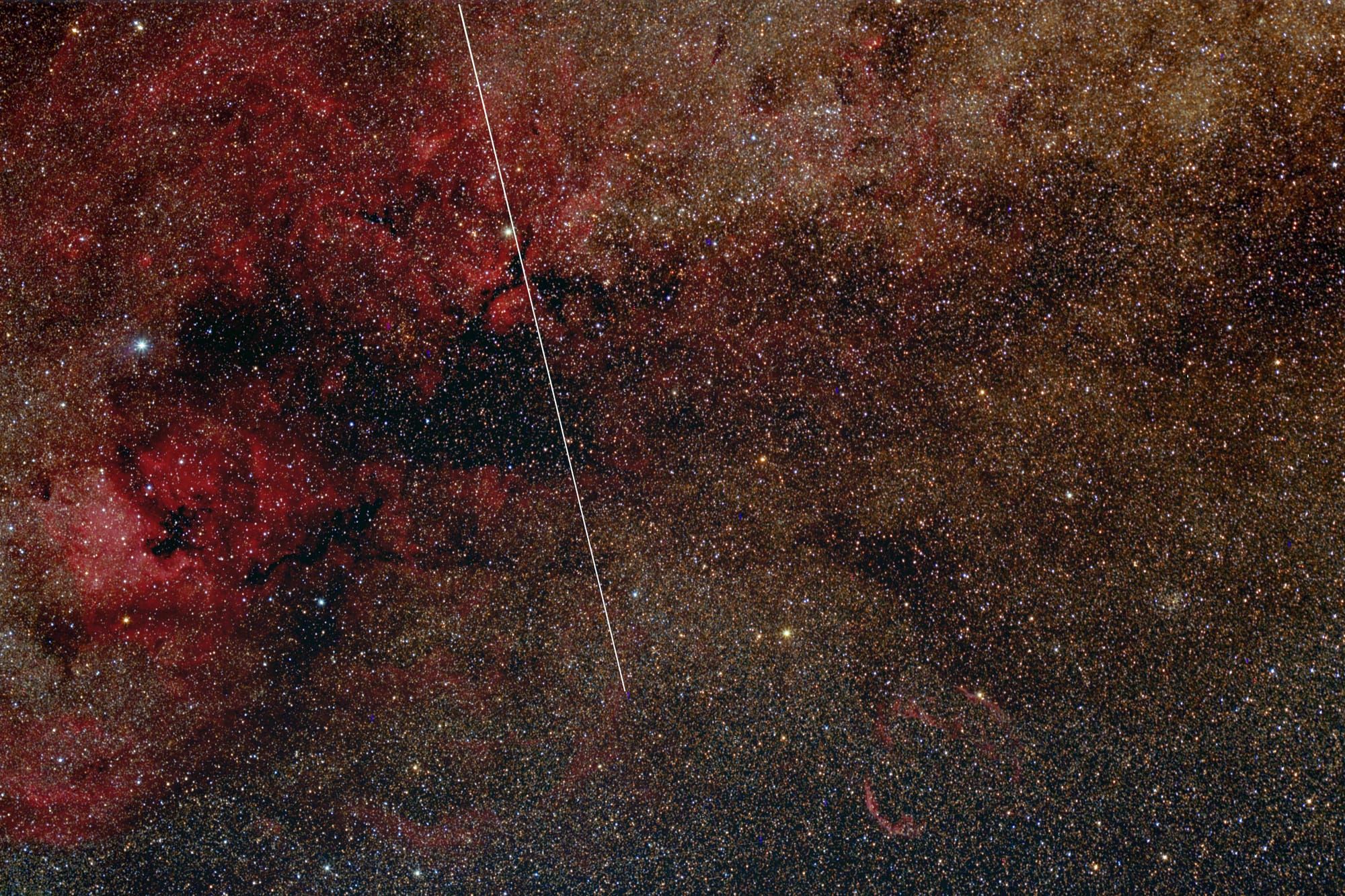
China's Tiangong space station crosses the Cygnus constellation in a 2022 long exposure, years before its first foreign visitor. Photo, August 2022: Giuseppe Donatiello / Wikimedia Commons / CC0
Who covered this
On this page · sections
The short version
- China's Shenzhou 24 carried Pakistani astronaut Muhammad Zeeshan Ali to the Tiangong space station, the first foreigner to go aboard.
- China is offering its station to other countries while NASA weighs what replaces the International Space Station after 2030.
- Ali is due home on the Shenzhou 23 capsule after a short stay, and NASA's own decision on its station comes in 2027.
Pakistani astronaut Muhammad Zeeshan Ali became the first foreigner to board China's Tiangong space station on Wednesday, after the Shenzhou 24 spacecraft carried him there with two Chinese crewmates.
Beijing wants that first foreign visit to show Tiangong can be an international research platform, not a national one. The pitch carries more weight because the NASA-led International Space Station faces possible retirement by 2030.
How Shenzhou 24 carried a Pakistani astronaut to Tiangong
A Long March 2F rocket lifted off from the Jiuquan Satellite Launch Center in northwest China at 8:18 a.m. Beijing time, which was 7:18 p.m. ET Tuesday. About 10 minutes later the spacecraft reached orbit, and the China Manned Space Agency called the launch "a complete success," Xinhua, China's state-run news agency, reported. The capsule docked automatically at the front port of the station's core module at 11:56 a.m. Beijing time. The three crew members of Shenzhou 23 opened the hatch at 2:35 p.m. and welcomed the new crew aboard.
Ali, 40, flew with commander Tang Hongbo, 51, and flight engineer Wu Yi, 39, the Associated Press reported. It was the first flight for Ali and Wu. Tang, on his third mission, is now the first astronaut to board Tiangong three times. China has now sent 31 of its own astronauts and one foreign astronaut into space.
Ali is a former fighter pilot who flies as a payload specialist, the crew member who runs experiments. His own include a test on photosynthetic cyanobacteria, bacteria that make energy from light, and a study of how radiation and weak gravity affect seeds. His stay is short. Reuters said he will spend 5 to 10 days aboard, and The Independent put it at about a week. He will then ride home on Shenzhou 23 with two of its crew. Tang and Wu will stay about six months.
How Pakistan got its seat on Shenzhou 24
The seat came from an agreement China and Pakistan signed in February 2025. Pakistan has no spacecraft of its own to send astronauts up. Ali was picked in April and trained for seven months in Beijing, including Chinese-language classes, Reuters reported. "I'm not flying for myself," Ali told reporters on Tuesday. "I carry the name of Pakistan on my shoulder."
Prime Minister Shehbaz Sharif struck the same note. "This is not just one astronaut's journey, but the journey of 240 million Pakistanis," he wrote on X. Planning Minister Ahsan Iqbal told reporters at the launch site that he hoped the flight would start wider cooperation. Asked whether Pakistan could one day send its own astronauts, he said that day would come.
Chinese President Xi Jinping and Pakistani President Asif Ali Zardari traded messages of congratulations. Xi called China's station "an ark of peace, friendship and cooperation." Zardari said the flight would lift the two countries' ties to a higher level, Xinhua reported.
China opens Tiangong as NASA plans for life after the ISS
The timing gives the launch its weight. NASA said in a 2022 report that it expects to operate the ISS safely through 2030. Its plan is for private companies to have their own stations flying before then, with no gap between the old station and the new ones.
That plan isn't settled. In June, a Government Accountability Office report from Congress's watchdog said NASA must judge in 2027 whether a commercial station is ready to take over, citing agency officials. If none is, NASA may need other options, such as keeping the ISS flying past 2030. The report said NASA faces several risks that "could lead to a gap in human presence in LEO," meaning low Earth orbit.
I'm not flying for myself. I carry the name of Pakistan on my shoulder.
While NASA weighs its options, China plans to double the size of Tiangong and fly more joint missions with other countries' crews. The race reaches past orbit, too. China aims to land astronauts on the Moon by 2030, and NASA aims for 2028, with SpaceX's Starship as one of its landers, as we reported after Starship's 15th test flight.
What we don't know yet
China hasn't said when Ali will come home, so his stay will be settled only when Shenzhou 23 lands. We also don't know whose astronaut flies next. None of the reports or records we read named a second partner country or seat.
On the U.S. side, no one yet knows whether a commercial station will pass NASA's 2027 review, and so whether the ISS can retire on time.
How coverage differs
Only Reuters told readers that the station NASA leads may retire by 2030, the backdrop for China's open door. AP's story, run on left- and right-leaning sites, ended on the race to the Moon instead, and no right-leaning outlet ran a report of its own.
If you read the left 3 of 20 outlets
You heard the cheering in Pakistan.
If you read the center 2 of 11 outlets
You got the diplomacy behind the seat.
If you read the right 0 of 20 outlets
You got wire copy, not a report.
Sources
Left
3 of 20 left-leaning outlets we track reported this
- Associated Press (via ABC News): China launches Shenzhou 24 spacecraft carrying 2 Chinese and 1 Pakistani astronaut, Nov. 25 (also run by NBC News, the Daily Mail and, in its Nov. 24 preview, The Washington Times)
- The Independent: China hails 'complete success' in historic space launch carrying Pakistani astronaut, Nov. 25
Center
2 of 11 center outlets we track reported this
Other reporting
- AFP (via the Daily Mail), wire service: 'Made history': Pakistan cheers as astronaut flies pioneering mission, Nov. 25 (headline only)
- Xinhua, China's state news agency, with the China Manned Space Agency's announcement: China launches Shenzhou-24 spaceship to Tiangong with first foreign astronaut on board, Nov. 25
- Xinhua, China's state news agency: China's Shenzhou-24 spaceship docks with Tiangong, Nov. 25
- Xinhua, China's state news agency: Shenzhou-24 astronauts, including first foreigner, enter Tiangong, Nov. 25
- Xinhua, China's state news agency: Xi says joint space exploration by Chinese, Pakistani astronauts vivid embodiment of deep-rooted friendship, Nov. 25
This article was produced by AI under our Editorial Standards. Corrections are reviewed before they go live.
How coverage differs
Keep reading
The newest Science stories.
The Fair Witness Daily
Every morning around 7 a.m. Eastern, seven days a week.
Wednesday’s editionFree
In Wednesday’s Daily
Then the Spin Meter: one divided story, set side by side as the left, center and right told it.
Free. One email a day.
Unsubscribe in one click. Already a member? Sign in