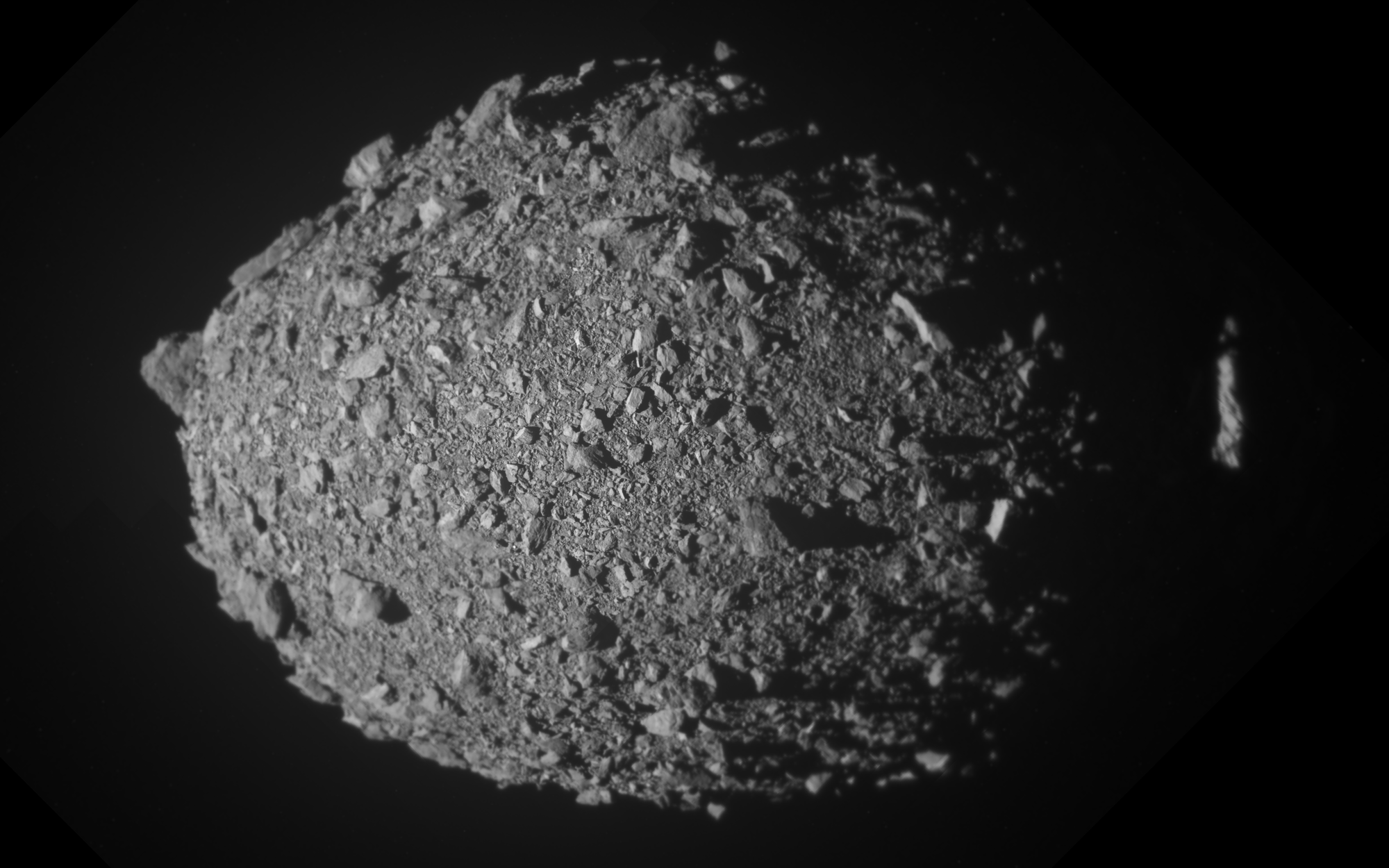
Hera's first close-ups show a stadium-size crater on Dimorphos, the asteroid DART struck
The images show what NASA's 2022 crash did to the asteroid itself, the evidence needed to know whether the same push would work again.

Dimorphos as NASA's DART saw it moments before the 2022 impact, the face that Hera now shows flattened by a crater. Photo, September 2022: NASA / Johns Hopkins APL / Public domain
Who covered this
On this page · sections
The short version
- Europe's Hera spacecraft found that NASA's 2022 DART crash left a stadium-size crater across one face of the asteroid Dimorphos.
- The crash also set the asteroid tumbling, and those changes show how a real threat might respond to the same kind of push.
- Hera moves closer in December to weigh the asteroid, which will show how well the push worked.
Documents in this story · 3
- RecordHera reveals stadium-sized asteroid crater from spacecraft impactEuropean Space Agency · Web page · Nov. 25Open Archived
- ReleaseNASA Confirms DART Mission Impact Changed Asteroid's Motion in SpaceNASA · Press release · Oct. 11, 2022Open Archived
- RecordMomentum Transfer from the DART Mission Kinetic Impact on Asteroid Dimorphos, Cheng et al., Nature (preprint on arXiv), 2023arxiv.org · Web pageOpen Archived
The first close-up images from Europe's Hera probe show that Dimorphos, the asteroid NASA struck with a spacecraft in 2022, now has a stadium-size crater across one face and is tumbling. The European Space Agency released the images from its probe on Wednesday.
DART, NASA's Double Asteroid Redirection Test, already proved that a spacecraft can change an asteroid's orbit. What no one could see from Earth was what the crash did to the asteroid itself. That answer matters because it shows how another space rock might respond to the same push, if one were ever found heading for Earth.
Why it matters to you
Neither Dimorphos nor its larger partner, Didymos, poses any danger to Earth. But Dimorphos is about the size of the asteroids that could, which makes the pair a good place to test. Rocks that size could wipe out a city. Scientists still haven't found all of them, said Carolyn Ernst of the Johns Hopkins Applied Physics Laboratory, who works on both missions.
So DART and Hera are testing what engineers call a kinetic impactor: hitting a threatening rock hard enough to nudge it off course. The first test worked. What Hera adds is the evidence needed to know whether a second one would, and how big and how early a spacecraft would have to be.
What Hera found at the Dimorphos crater
The crater covers the face DART struck and stretches across the asteroid's entire width, ESA said. Dimorphos is only about 495 feet (151 meters) wide, so the crater is almost as big as the asteroid. Michael Kueppers, ESA's Hera mission scientist, told Reuters it looks as if "a piece of the asteroid was cut off" by the impact.
Away from the crater, Dimorphos looks as it did in 2022, with boulder fields that match DART's images. Kueppers said that a huge crater with no sign of change on the far side surprised the team.
Scientists had argued over whether DART would leave a crater, reshape the asteroid or barely change it. A 2024 set of computer simulations had suggested it might reshape the whole body. Patrick Michel, Hera's principal investigator, said the images settled it: "Much to our surprise the answer turns out to be all three at once!" The face DART hit was flattened, the asteroid's shape changed, and the rest stayed as it was.
Before the crash, Dimorphos always showed the same face to Didymos, the way our Moon does to Earth. Now it tumbles. Sabina Raducan, a planetary scientist on the Hera team, said at the briefing in Berlin that it moves like a "barrel that you throw down the stairs."
Hera also found company. Hundreds of boulders, a few meters across, circle the two asteroids. Naomi Murdoch of the University of Toulouse said at the briefing that more than 100 of them are between the size of a football and a washing machine. She said the team can't yet tell whether they are debris from DART or rubble shed by Didymos.
How DART moved an asteroid in 2022
DART struck Dimorphos on Sept. 26, 2022, at about 14,000 miles per hour. The spacecraft weighed roughly half a ton and was destroyed in the crash. Its debris trail stretched about 6,200 miles, long enough for telescopes on Earth and in space to see it.
Those telescopes also timed the result. Before the crash, Dimorphos took 11 hours and 55 minutes to circle Didymos. NASA had said shortening that by 73 seconds would count as success, and the crash beat that mark more than 25 times over. ESA now puts the change at 33 minutes, more than predicted.
ESA launched Hera in October 2024 to go back and inspect the scene, and the car-size probe reached the pair three weeks ago. It now flies about 15 to 19 miles (25 to 30 kilometers) from them. The asteroids themselves are about 120 million miles from Earth.
Much to our surprise the answer turns out to be all three at once!
Why Dimorphos's mass is the missing number
The orbit changed more than DART's own weight and speed could explain on their own. The reason is the debris. When the crash threw rock off the surface, the escaping material shoved the asteroid back, the way a rifle kicks.
A 2023 study of the impact in Nature, led by Andrew Cheng, measured that boost. If Dimorphos is as dense as Didymos, the debris made the push about 3.6 times stronger than the spacecraft alone. But the study could only pin the figure between 2.2 and 4.9, because nobody knew how heavy Dimorphos is.
That gap is what Hera is built to close. The high end is more than double the low end, so a mission planned around 4.9 would deliver less than half the push it needed if the true figure were 2.2. Simon Green, a planetary scientist on the Hera team, told the BBC why that matters: knowing an asteroid's properties would let planners say how heavy a spacecraft must be and how fast and how early it must hit. Once Hera weighs Dimorphos, Murdoch said, the team will see exactly how well DART's hit worked.
What we don't know yet
How hard DART really pushed Dimorphos depends on the asteroid's mass, which Hera is set to measure after it moves closer in December. The probe is due to close to about 8 miles (13 kilometers) then, for sharper images and the measurements behind that figure.
The boulders are the other open question, and they are also a practical problem. Margherita Cardi, a Tyvak International executive who oversees the Milani satellite, said they pose a collision risk to the two shoebox-size satellites Hera plans to release in January 2027. One of them, Juventas, will use radar to look inside an asteroid for the first time and then try to land.
How coverage differs
Readers of CNN and Reuters got the crater, the tumble and the boulders; the earlier stories in The Guardian and the BBC went out before the images and offered the question instead. No right-leaning outlet we track had a report of its own.
If you read the left 2 of 20 outlets
You got the briefing room.
If you read the center 2 of 11 outlets
You got the verdict, then the stakes.
If you read the right 0 of 20 outlets
You had no report of your own.
Sources
Left
2 of 20 left-leaning outlets we track reported this
Center
2 of 11 center outlets we track reported this
Primary
- Hera reveals stadium-sized asteroid crater from spacecraft impact (European Space Agency), Nov. 25 · Archived copy
- NASA Confirms DART Mission Impact Changed Asteroid's Motion in Space (NASA), Oct. 11, 2022 · Archived copy
- Momentum Transfer from the DART Mission Kinetic Impact on Asteroid Dimorphos, Cheng et al., Nature (preprint on arXiv), 2023 · Archived copy
This article was produced by AI under our Editorial Standards. Corrections are reviewed before they go live.
How coverage differs
Keep reading
The newest Science stories.
The Fair Witness Daily
Every morning around 7 a.m. Eastern, seven days a week.
Wednesday’s editionFree
In Wednesday’s Daily
Then the Spin Meter: one divided story, set side by side as the left, center and right told it.
Free. One email a day.
Unsubscribe in one click. Already a member? Sign in