


Congo's Ebola outbreak passes 12,000 cases as fighting forces some responders out
With no vaccine or treatment approved for this strain, fighting near the response hub is pulling back the health teams who track the virus.

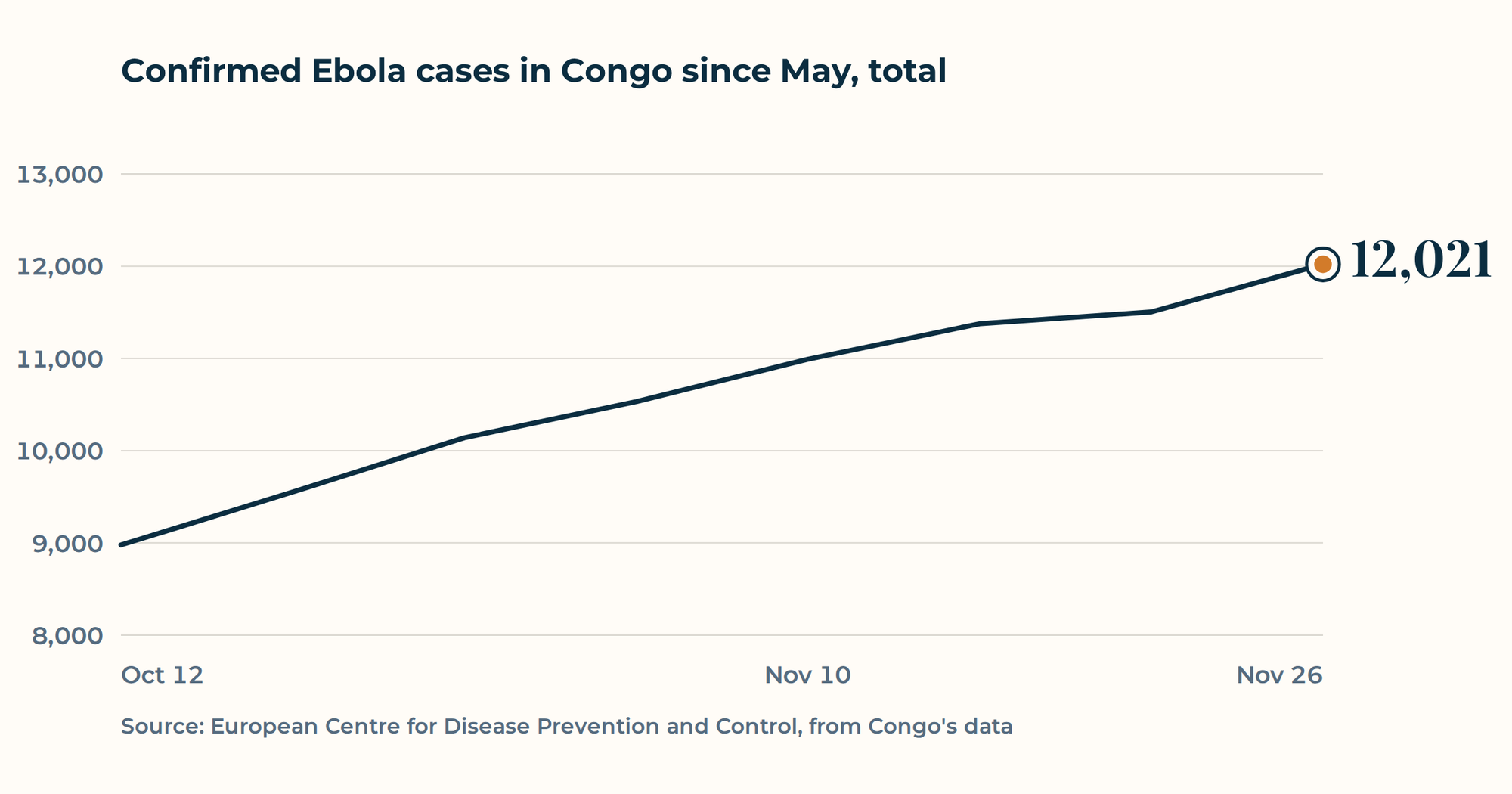
Confirmed Ebola cases in Congo rose from about 9,000 in mid-October to 12,021 in the count Europe's disease agency posted Nov. 26. Chart: Fair Witness; data: European Centre for Disease Prevention and Control, from Congo's data
Who covered this
On this page · sections
The short version
- Congo's Ebola outbreak has passed 12,000 confirmed cases, and nearly half of those people have died.
- There is no approved vaccine or treatment for this strain, and fighting near the response hub has forced some health workers out.
- Europe's disease agency posts its next weekly count on Dec. 3, and vaccine trial results are expected in early 2027.
Documents in this story · 7
- RecordEbola disease caused by Bundibugyo virus, updateEuropean Centre for Disease Prevention and Control · Web page · Nov. 26Open Archived
- RecordUpdates for Ebola disease outbreak caused by Bundibugyo virus, 2026European Centre for Disease Prevention and Control · Web pageOpen Archived
- RecordRapid risk assessment, Bundibugyo virus disease, Democratic Republic of the Congo, version 5WHO · Web page · Nov. 25Open Archived
- RecordDisease Outbreak News, Bundibugyo virus disease in Congo, Kenya and NigeriaWHO · Web page · Oct. 23Open Archived
- RecordDisease Outbreak News, Bundibugyo virus disease in CongoWHO · Web page · Oct. 8Open Archived
- RecordTwo new candidate vaccines to join Ebola trial as treatment research advancesWHO · Web page · Nov. 4Open Archived
- RecordEbola disease fact sheetWHO · Web pageOpen Archived
Congo's Ebola outbreak has passed 12,000 confirmed cases, government data showed Thursday, as fighting near Bunia, the hub of the response, forced some health workers to flee. Nearly half of the 12,021 people confirmed to have the virus have died.
The strain behind this outbreak, Bundibugyo, has no approved vaccine or treatment. AP called it the fastest-growing Ebola outbreak in history. Congo's health officials say new cases are falling, but the World Health Organization says most new infections are still turning up among people no one knew had been exposed.
Why it matters to you
Ebola has already crossed borders. Beyond Congo, Uganda has reported 20 cases, Kenya nine and Nigeria one, according to the latest update from the European Centre for Disease Prevention and Control, the European Union's disease agency. Patients and exposed health workers have been flown to Britain, Germany, the Netherlands and Switzerland for care. WHO rates the risk very high in Congo and high in Kenya and Nigeria.
For travelers outside the outbreak zone, the risk is small. The European agency rates it very low for the general public in Europe, and it says screening arriving travelers would not reliably find people who are infected. It advises people coming home from affected areas to learn the symptoms and what to do if they appear.
Why the count climbs even as daily cases fall
Congo's health officials counted 66 new confirmed cases on Tuesday, down from 109 a week earlier, UPI reported. Daily deaths fell to 18, from 34 on Nov. 17. The officials said the response is "showing encouraging progress," and no new areas had been hit outside the core outbreak zone in four eastern provinces.
The total still grows by hundreds each week because the outbreak is so large. The European agency's count puts deaths at 5,904. Ituri province accounts for about two-thirds of all cases, and North Kivu for about a quarter. The virus has reached 69 of the country's 178 health zones, the districts Congo uses to run its health care.
The detail that matters most is in WHO's own risk assessment, published Nov. 25. More than 80% of newly reported infections are found outside known contact lists. Responders stop Ebola by tracing everyone a patient touched and watching them for three weeks. When most new patients were never on those lists, the chain of spread is running ahead of the people tracking it. The European agency also judges the outbreak is likely larger than reported. So a falling daily count is not yet proof of control.
Fighting near Bunia pulls responders back
Bunia, the capital of Ituri province, is the hub of the Ebola response, and the fighting is now close by. Congo's army and the Convention for the Popular Revolution, a rebel group known as CRP, resumed fighting Thursday morning in Iga-Barrière, a mining town about 15 miles north of the city. The clashes sent new waves of people fleeing toward Bunia, AP reported.
Responders have already been pulled back. Dr. Catherine Smallwood, WHO's Ebola incident manager, said about a dozen people, including two WHO staff, were evacuated to Bunia on Tuesday after three days trapped in a hospital in Akwe. "They were caught really in the crossfire, very intense fighting," she said. WHO also moved its team out of Mongbwalu, the mining town where the outbreak was first detected, after fighting cut road access.
The United Nations peacekeeping mission in Congo, MONUSCO, said security had significantly worsened in several areas. Its Bangladeshi troops evacuated 10 health workers from a hospital where they had sheltered for more than three days, the mission said, as quoted by UPI. The CRP said Tuesday it was pausing its advance on Bunia, and Congo's government said its forces had pushed the rebels back, AP reported. Residents said the situation remained volatile.
Gunfire is not the only obstacle. In Bulambo-Isale, a rural community in North Kivu, a crowd tried to stop an ambulance carrying the body of a local Ebola victim, AFP reported, in a story the Daily Mail ran. Local custom says families bury their own dead, but Ebola victims must be buried by trained teams in sealed bags. "We are fighting the disease, not the response teams," the traditional chief, Pimbo Kakule, told AFP.
How Congo's Ebola outbreak reached 12,000 cases
The outbreak was declared in May, and it is Congo's 17th. WHO calls it the largest Ebola outbreak ever recorded in Congo, of any strain. Bundibugyo had caused only two outbreaks before this one, in Uganda in 2007 and in Congo in 2012. By early October, WHO counted 8,728 confirmed cases. The total passed 10,000 in late October and 11,000 by Nov. 11, according to the European agency's running updates.
They were caught really in the crossfire, very intense fighting.
The West African epidemic of 2014 to 2016 killed about 11,000 people, and AP has reported that this outbreak is on track to pass that toll. At 5,904 deaths, this one has reached a bit more than half of that in about six months.
Trials are under way to find the vaccine and treatment this strain lacks. A vaccine trial called Tumaini began enrolling its first participants in Bunia on Oct. 23, according to WHO. In November, WHO said two more candidate vaccines, from Oxford with the Serum Institute of India and from Moderna, would join it, with results expected in early 2027. "Vaccines alone will not end this outbreak," WHO's director-general, Tedros Adhanom Ghebreyesus, said then. A separate trial is testing whether an antibody drug, the antiviral remdesivir or both help patients survive.
What we don't know yet
No one can yet say whether the drop in daily cases will hold. With most new patients unknown to tracers, a quiet week can reflect missed cases as well as fewer infections. The European agency posts its count every Thursday, so the next update, on Dec. 3, will show whether the slowdown continued.
It's also unclear whether the CRP's pause will last, or how soon WHO teams can return to places like Mongbwalu. Early findings from the treatment trial are expected in the coming months, and they will show whether any of the drugs tested helps Bundibugyo patients survive.
How coverage differs
Readers on every side got AP's account of the fighting near Bunia. Of the reports we read, only UPI's, in the center, said daily cases had fallen, and only the Daily Mail, on the right, ran an account of local resistance to burial teams.
If you read the left 4 of 21 outlets
You got AP, and only AP.
If you read the center 4 of 12 outlets
You were the ones told of progress.
If you read the right 3 of 21 outlets
You also got the fight over burials.
Sources
Left
4 of 21 left-leaning outlets we track reported this
- NPR (AP copy): Congo Ebola outbreak tops 12,000 cases as responders flee, Nov. 26
- ABC News (AP copy): Ebola outbreak in Congo reaches 12,000 cases; violence forces responders to evacuate, Nov. 26
- AP: Ebola outbreak in Congo reaches 12,000 cases as violence forces some responders to evacuate, Nov. 26
- The Independent (AP copy): Fighting in eastern Congo forces Ebola workers to evacuate, threatening outbreak response, Nov. 25
Center
4 of 12 center outlets we track reported this
- UPI: Officials: Ebola cases pass 12,000 in DR Congo, deaths rise to 5,900, Nov. 26
- Reuters: Congo's Ebola cases exceed 12,000 as responders struggle to contain outbreak, Nov. 26 (headline only)
- The Hill (AP copy): Ebola outbreak in Congo reaches 12,000 cases as violence forces some responders to evacuate, Nov. 26
- NewsNation (AP copy): Ebola outbreak in Congo reaches 12,000 cases as violence forces some responders to evacuate, Nov. 26
Right
3 of 21 right-leaning outlets we track reported this
- Daily Mail (AP copy): Ebola outbreak in Congo reaches 12,000 cases as violence forces some responders to evacuate, Nov. 26; also Daily Mail (AFP copy): Ebola fight runs up against customs, rites in remote DR Congo, Nov. 25
- Newsmax (AP copy): Ebola Outbreak in Congo Reaches 12,000 Cases as Violence Forces Some Responders to Evacuate, Nov. 26 (headline only)
- The Washington Times (AP copy): Fighting in eastern Congo forces Ebola workers to evacuate, threatening outbreak response, Nov. 25
Other reporting
- Al Jazeera: DR Congo Ebola cases surpass 12,000 as fighting disrupts response in east, Nov. 26 (Qatar-funded international network, with AP and Reuters)
Primary
- European Centre for Disease Prevention and Control: Ebola disease caused by Bundibugyo virus, update, Nov. 26 · Archived copy
- European Centre for Disease Prevention and Control: Updates for Ebola disease outbreak caused by Bundibugyo virus, 2026 · Archived copy
- WHO: Rapid risk assessment, Bundibugyo virus disease, Democratic Republic of the Congo, version 5, Nov. 25 · Archived copy
- WHO: Disease Outbreak News, Bundibugyo virus disease in Congo, Kenya and Nigeria, Oct. 23 · Archived copy
- WHO: Disease Outbreak News, Bundibugyo virus disease in Congo, Oct. 8 · Archived copy
- WHO: Two new candidate vaccines to join Ebola trial as treatment research advances, Nov. 4 · Archived copy
- WHO: Ebola disease fact sheet · Archived copy
This article was produced by AI under our Editorial Standards. Corrections are reviewed before they go live.
How coverage differs
Keep reading
The newest Health stories.
The Fair Witness Daily
Every morning around 7 a.m. Eastern, seven days a week.
Friday’s editionFree
In Friday’s Daily
Then the Spin Meter: one divided story, set side by side as the left, center and right told it.
Free. One email a day.
Unsubscribe in one click. Already a member? Sign in
















Discussion
Any free account can join the discussion.