


Voyager 1 is now one light-day from Earth by NASA's count, a first for any spacecraft
Radio signals now take a full day each way, so the first word from past the mark won't reach Earth until Thursday morning.

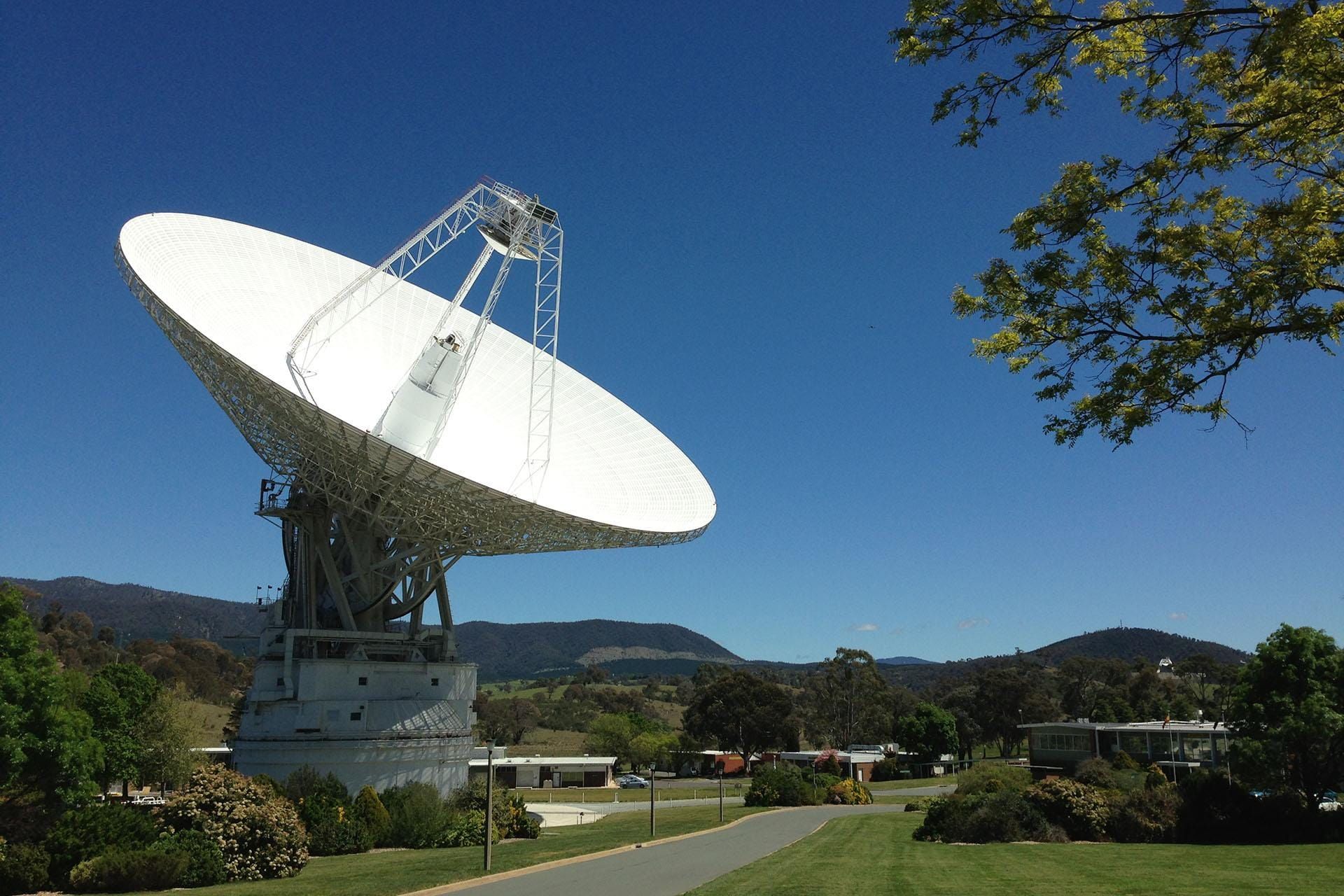
Deep Space Station 43 near Canberra, Australia, a 230-foot dish of the kind NASA needs to hear the faint Voyager signals. Photo, March 2020: NASA/Canberra Deep Space Communication Complex / Wikimedia Commons / Public domain
Who covered this
On this page · sections
The short version
- By NASA's calculation, Voyager 1 became the first spacecraft one light-day from Earth at 5:16 a.m. ET Wednesday, about 16.1 billion miles away.
- At that distance a radio message takes a full day each way, so every command and every fix now takes at least two days.
- The first signal sent from past the mark should reach Earth Thursday morning, and NASA holds a Voyager event at noon ET that day.
Voyager 1 became the first spacecraft to reach one light-day from Earth at 5:16 a.m. ET Wednesday, by NASA's calculation, so far that radio messages take a full day to arrive. That puts it about 16.1 billion miles from home. As of 5:45 a.m. ET, NASA had not posted a statement saying the crossing had happened.
A light-day is how far light travels in 24 hours, and radio waves move at the same speed. Voyager 1 launched in 1977 on a mission planned for five years. It is still sending data back from the space between the stars, on a shrinking supply of power.
Why it matters
No other working spacecraft is this far out, and only Voyager 1 and its twin, Voyager 2, have operated beyond the sun's protective bubble. So what they record there comes from nowhere else. The new distance also makes Voyager 1 harder to run: a command now takes two days to confirm, which slows any repair.
What one light-day from Earth means for Voyager 1
NASA's page on the milestone gives the distance to the mile: 16,094,799,096 miles, reached 49 years, two months and 11 days after launch. For scale, sunlight takes a little over eight minutes to reach Earth, and Neptune is about four light-hours away.
That same definition explains why nobody could watch the moment. The crossing is a position worked out from the probe's known path and speed, not an event anyone saw. Any signal Voyager 1 sent at 5:16 a.m. Wednesday is still on its way and should reach Earth a day later, around 5:16 a.m. Thursday. So the team will have to wait until Thursday for the first signal sent from past the mark, CBS News reported.
The probe will not slow down to mark the day. It moves at nearly 38,000 mph, which carries it about 900,000 miles every day. Even so, NASA estimates it will need about 18,000 more years to reach a full light-year from Earth. Voyager 2, on a slower path, should reach one light-day in November 2035.
How Voyager 1 got this far
Voyager 1 lifted off from Cape Canaveral on Sept. 5, 1977, 16 days after Voyager 2. It took a faster route and passed its twin within months. It flew past Jupiter in 1979, where it found a faint ring around the planet. At Saturn in 1980, it sent back images of the planet and its moons, including Titan, a moon with a thick nitrogen atmosphere.
The probe's cameras worked one last time on Feb. 14, 1990. From 3.7 billion miles away, they took a family portrait of six planets, with Earth as a tiny speck later called the Pale Blue Dot. The cameras have been off ever since.
In February 1998, Voyager 1 passed Pioneer 10 to become the most distant human-made object. It crossed into interstellar space in 2012, six years before Voyager 2 did. Each probe also carries a gold-plated record of sounds, images and greetings in 55 languages, in case anyone ever finds it.
I view it as an engineering milestone.
A spacecraft running on about 210 watts
Keeping Voyager 1 alive is now a power puzzle. The probe runs on heat from decaying plutonium. It started with about 470 watts and is now down to a little more than 210, enough for just two of its 10 instruments. Each Voyager loses about 4 watts a year, according to NASA.
That squeeze has forced hard choices. Earlier this year NASA shut off an instrument that measured charged particles, leaving one that measures magnetic fields and one that listens for plasma waves. Last month NASA lost contact with the probe for about two days, until the signal returned on Oct. 20 after its backup thrusters turned on.
A small team carries the load. Only 3 of the 13 people on the Voyager team at NASA's Jet Propulsion Laboratory work on it full time, and two are retirees who came back, CBS News reported. Kareem Badaruddin, the mission manager, said the mission is "one of the great things that people have ever done." Suzanne Dodd, the project manager, called the probe "a national treasure" in an interview with the AP.
Outside NASA, the praise sounds much the same. Casey Dreier of The Planetary Society told ABC News it is "the furthest out that any human thing has been sent" that still talks to us. Alan Cummings, a Caltech scientist on the mission since 1973, put it more plainly to Reuters: "I view it as an engineering milestone."
What comes next depends on the power supply. Engineers hope to keep data flowing for several more years, but the power keeps falling and more instruments will have to go.
What we don't know yet
NASA hasn't said whether it will announce the crossing on its own or wait for Thursday's signal. Its light-day page, updated Wednesday, still described the milestone in the future tense when we checked at 5:45 a.m. ET. The agency's Voyager event at JPL on Thursday at noon ET, streamed at nasa.gov/live, is the first chance to hear from the team after the signal arrives.
No one can say how long Voyager 1 will keep talking. NASA also hasn't said what caused October's loss of contact; the AP reported the cause was still under investigation.
Sources
Left
5 of 13 left-leaning outlets we track reported this
- CBS News: Voyager 1 probe now a full "light day" from Earth, the most distant human artifact in space
- ABC News: A NASA probe from the '70s is still talking, and Wednesday it will be a light-day away
- NPR: Far from home, Voyager 1 will soon be a 'light-day' from Earth
- USA Today: Voyager 1 spacecraft nears historic one light-day from Earth
- AP (via WPVI-TV 6abc): NASA's Voyager 1 closes in on a light-day in interstellar space for a new distance record
Center
2 of 9 center outlets we track reported this
Right
2 of 12 right-leaning outlets we track reported this
This article was produced by AI under our Editorial Standards. Corrections are reviewed before they go live.
How coverage differs
Free with a Fair Witness account
See how left, center and right covered this story
A free account shows where the coverage agrees and where it splits, what each side played up and played down, and, when one side's outlets missed a story, who missed it.
Keep reading
The newest stories in Science, then the rest of the site.

Newest · Science
Huge waves pound California coast, closing piers and beaches, with more due midweek
The weather service warns the surf can pull people into the sea from beaches and rocks, with advisories along most of the coast into Tuesday.
Latest
New stories and updates, newest first. Times are Eastern.
-
Nov 18
2:55 PMUpdated World
Part of Crimean Bridge collapses after Ukrainian strike as Russia hits Kyiv's bridges
Each side hit bridges it calls military routes, two days before Trump meets Putin and Xi in China.
-
Nov 18
11:14 AMUpdated World
Trump will meet Xi and Putin together Thursday to discuss nuclear arms, White House says
No treaty has capped the world's two largest nuclear arsenals since February, and Trump wants China in whatever replaces it.
-
Nov 18
11:14 AMUpdated U.S.
NSA's classified network goes down; White House says no sign of a cyberattack
The intelligence agency's internal system for sharing secrets failed in a week of U.S. tech outages, and Democrats want a briefing.
-
Nov 18
11:14 AMUpdated Technology
Apple outage: company says an internal update hit iCloud, Apple Pay and App Store
Many services were back by afternoon, but Apple's status page for app makers still listed key tools as down Tuesday evening.
-
Nov 18
9:15 AMNew Culture
Pope Leo says no to married priests for now, details his lung cancer surgery
His answer keeps on hold a 2019 proposal from Amazon bishops to make married deacons priests where communities wait years for one.
-
Nov 18
2:16 PMUpdated U.S.
Mullin defends flying government plane to LSU-Texas game a day after FAA ground stop
His department says he paid his way, but federal rules can set that at a coach fare, and no one has said what he paid.
-
Nov 18
2:15 PMUpdated World
Iran fires on U.S. air base in Kuwait and at Bahrain after U.S. strike on Qeshm
Iran's first attack on Kuwait in two months widens a weeklong exchange of fire, and Washington has not said how it will answer.
-
Nov 18
12:41 PMNew World
Britain hands Army officer accused of spying for Russia to U.S. military
The handover moves any prosecution to the United States, where officials have not said whether a military or civilian court would hear it.
Edge of Frame · Right
-
Nov 18
12:30 PMTop story U.S.
Garcia tells Vance, Trump's sons and others to preserve records for House probes
The letters map what Democrats plan to investigate once they take the House in January and gain the power to subpoena.
-
Nov 18
12:25 PMTop story U.S.
House Democrats nominate Hakeem Jeffries for speaker, 251-11, ahead of Jan. 3 vote
Eleven Democrats voted no in a count he asked for. His party's projected majority lets him lose almost 40 votes and still reach 218.
-
Nov 18
11:53 AMUpdated World
US Army soldier arrested in UK on suspicion of spying for Russia
The soldier, who has not been named or charged, was assigned to a NATO headquarters built to respond quickly to crises.
-
Nov 18
11:40 AMUpdated World
U.S. strikes Iran's Qeshm Island after third Iranian attack on Bahrain, officials say
It is the U.S. reply to Iranian attacks that ended a two-month lull, and Iran's next move will show whether the exchange keeps going.
-
Nov 18
11:39 AMUpdated U.S.
White House counsel warns Oversight Democrats their probes could be criminal
The letter escalates a fight over how far Congress can dig into the Trump administration once Democrats take over in January.
The Fair Witness Daily
Get each morning's Spin Meter in your inbox
The Daily leads with the Spin Meter, then the day's explainers. A free account also unlocks every Spin Meter on the site.
Free. Unsubscribe anytime. Already a member? Sign in