


DNC plans 12 debates for the 2028 primary, with a dark money pledge to qualify
The party has no legal power to ban super PACs, so it is using the one thing it controls: who gets a podium.

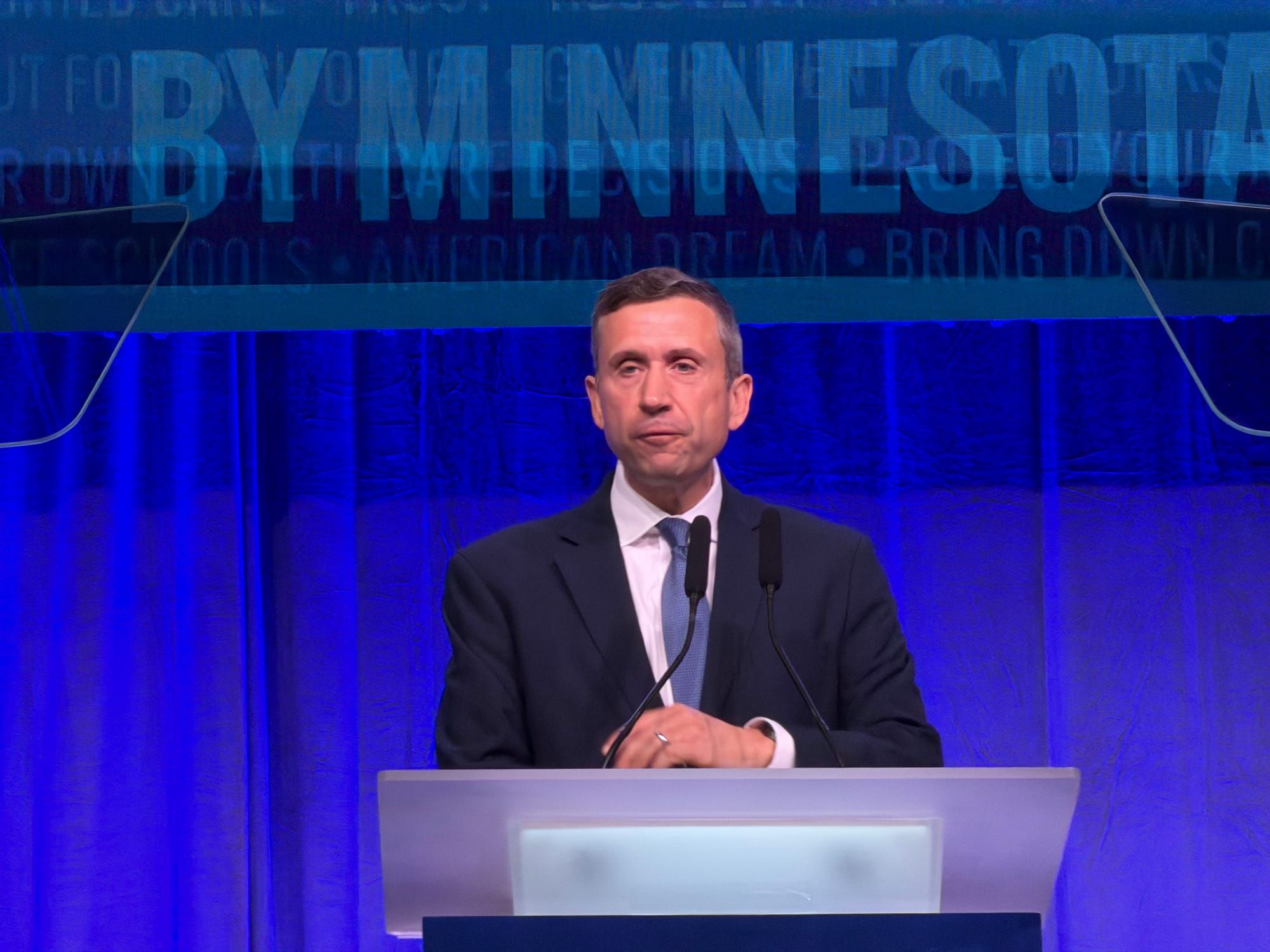
Ken Martin, the Democratic National Committee chair who announced the 2028 debate plan, speaks at the Minnesota DFL Party's state convention in May. Photo, May 2026: Awsamweston / Wikimedia Commons / CC BY-SA 4.0
Who covered this
On this page · sections
The short version
- The Democratic National Committee plans 12 debates for the 2028 presidential primary, starting in June 2027.
- To qualify, candidates must pledge to denounce super PAC and dark money ads, though the party can't stop those groups from spending.
- In January, the party will set dates, places and the polling and fundraising bars for the first two debates.
Documents in this story · 4
- RecordDNC Announces Framework for the 2028 Democratic Presidential Primary DebatesDNC · Web page · Nov. 23Open Archived
- RecordPresidential Primary Fair Campaign Practices Pledge (PDF)DNC · PDFOriginal Archived
- Record2028 presidential primary page, rules and pledge processDNC · Web pageOpen Archived
- RecordStatements of support for the effort to limit dark money in the 2028 primaryDNC · Web page · Nov. 23Open Archived
Democrats who want a spot on the 2028 presidential debate stage will first have to pledge to denounce super PAC and dark money ads, under a plan for 12 debates the DNC announced Monday.
The Democratic National Committee's announcement sets five debates in 2027, the first two in June and July, and seven in 2028, the last in March. Most of the plan follows the rules Democrats used in 2020. The pledge is new. It targets ads paid for by super PACs, which can raise unlimited sums, and by 501(c)(4) nonprofits, which don't have to name their donors. The party says it has no legal power to ban those groups. What it does control is who gets a podium.
DNC Chair Ken Martin said the process will "keep our party united, strengthen our eventual nominee." That promise gets its first test next year, once candidates enter the race and start trying to qualify.
Why it matters to you
The debates are where a crowded Democratic field shrinks to the handful of candidates you'll actually weigh in a primary. Early debates may be split over two nights, with lineups drawn at random and no more than 20 candidates in all. Beyond the pledge, candidates will need to clear polling and grassroots fundraising bars, which the party will announce in January along with dates, places and media partners.
The pledge could also change the ads you see. It covers TV, radio, digital, billboard and mail ads that promote a candidate or attack a Democratic rival. It does not reach the general election, or groups that attack Republicans without backing a particular Democrat. Its target is money spent inside the Democratic contest.
How the DNC's dark money pledge works
The party calls it the Fair Campaign Practices Pledge. Each campaign names a representative who can report outside spending to the DNC. If the party agrees the spending breaks the pledge, the candidate fills out a standard denunciation statement, once per group. A tracker on the DNC's website will list every complaint, its status and every denunciation.
The pledge's own text shows how narrow the trigger is, and how firm the penalty. The party acts only after a rival Democratic campaign reports the spending. A candidate who then misses the qualifying deadline to denounce it is barred from that debate and every later one until they do. Nothing in the pledge requires a super PAC to stop. A group that is denounced can keep buying ads, and super PACs are already barred by law from directly coordinating with candidates.
Repayment in the pledge applies only to party money. A candidate who asks for or approves ads by a state, county or local party committee must reimburse the full cost before debating again. Fox News reported that a framework it obtained also requires refunds when a candidate approved outside spending. Candidates also give up joint fundraising deals with party committees until they are the presumptive nominee, a step NBC News said is meant to keep the party neutral.
From a 2025 resolution to the 2028 debates
Martin has pushed for curbs on outside money since soon after he became chair in February 2025. In August of that year, he asked DNC members to explore limits on corporate and dark money in the presidential primary. The midterm primaries then raised the pressure. In April, the AP reported outside groups pouring money into Democratic races, and Rep. Ro Khanna of California, a possible 2028 contender, said every presidential candidate should pledge to keep super PACs out.
In Michigan, a super PAC tied to the American Israel Public Affairs Committee spent more than $30 million against Abdul El-Sayed in the Democratic Senate primary. El-Sayed won anyway and is now a senator-elect. In August, Sen. Bernie Sanders of Vermont renewed his call to ban super PAC spending in primaries.
After big wins in the Nov. 3 midterms, Democrats face a nominating fight with no clear front-runner, and no one has declared. Allies of Rep. Alexandria Ocasio-Cortez, Khanna and former Transportation Secretary Pete Buttigieg have launched committees urging them to run. A debate panel led by DNC senior adviser Minyon Moore and executive director Roger Lau, with alumni of past campaigns from Obama to Harris, will run the stage.
keep our party united, strengthen our eventual nominee
Who backs the pledge, and why some doubt it will bite
The DNC released statements of support from across the party, including Sanders, Sens. Elizabeth Warren and Andy Kim, Reps. Greg Casar and Jason Crow, former DNC chair Jaime Harrison and the group End Citizens United. Sanders said presidential candidates should be chosen by voters, "not billionaires and their Super PACs." Democratic strategist John McCarthy told Fox News the rules will push candidates to unite around party values. "This is a framework, and it's the first step," he said.
Some reporting on the plan questions how much it will change. NBC News, in its analysis, called the pledge relatively symbolic: it can't stop outside spending, but it tries to attach a political cost. Axios pointed out that Democratic presidential candidates have often welcomed super PACs. Joe Biden's 2020 campaign dropped its opposition to them, and Barack Obama's 2012 team promoted one.
Sen. Ruben Gallego of Arizona has warned against tying the party's hands. He said in April he could accept limits "provided that we don't handcuff ourselves in the general elections." The pledge leaves the general election alone. We found no public response from any likely 2028 candidate or from the super PACs the pledge targets as of noon ET Monday.
What we don't know yet
It isn't yet known which candidates will sign the pledge, or whether a leading contender will refuse. Qualifying for the first debate, in June 2027, is the first point where a refusal would cost someone a podium. Whether any super PAC keeps spending after a denunciation will show whether the pledge changes anything.
How the DNC will judge complaints is also open. The party says reporting deadlines will be announced in the coming months, and the polling and fundraising thresholds come in January. A separate rule bars candidates who take part in a primary the party hasn't sanctioned. That matters most in New Hampshire, where state law requires the nation's first primary and the secretary of state, Republican David Scanlan, has said he plans to honor it. The party's calendar puts South Carolina first.
How coverage differs
Whether you learned the pledge can't stop a super PAC from spending depended on your outlet more than your side: NBC, CNN, Axios, NewsNation and Fox News said so, while Reuters, The Hill, the New York Post and The Daily Wire didn't.
If you read the left 11 of 20 outlets
You were told it lacks teeth.
If you read the center 3 of 11 outlets
One of your three named the catch.
If you read the right 4 of 20 outlets
You got the schedule, then the fine print.
Sources
Left
11 of 20 left-leaning outlets we track reported this
- NBC News: Democratic National Committee sets broad rules for the party's 2028 presidential debates, Nov. 23
- CNN: DNC plans to hold 12 debates for 2028 primary, with a new rule for Democrats who want in, Nov. 23
- Axios: DNC limits 2028 primary candidates' ties to big-money groups, Nov. 23
- AP (via KSAT): Democrats tackle outside groups flooding their primaries with campaign cash, April 10
Center
3 of 11 center outlets we track reported this
Right
4 of 20 right-leaning outlets we track reported this
- Fox News: Democrats unveil 2028 debate rules with new dark money restrictions for presidential hopefuls, Nov. 23
- The Daily Wire: Dems Unveil 2028 Primary Debate Plan And Draw Their First Red Lines, Nov. 23
- New York Post: Democrats announce plan for 12 debates in 2028 primary, Nov. 23
- Just The News: DNC announces twelve 2028 presidential primary debates, starting in June 2027, Nov. 23
Primary
- DNC: DNC Announces Framework for the 2028 Democratic Presidential Primary Debates, Nov. 23 · Archived copy
- DNC: Presidential Primary Fair Campaign Practices Pledge (PDF) · Archived copy
- DNC: 2028 presidential primary page, rules and pledge process · Archived copy
- DNC: Statements of support for the effort to limit dark money in the 2028 primary, Nov. 23 · Archived copy
This article was produced by AI under our Editorial Standards. Corrections are reviewed before they go live.
How coverage differs
Free with a Fair Witness account
See how left, center and right covered this story
A free account shows where the coverage agrees and where it splits, what each side played up and played down, and, when one side's outlets missed a story, who missed it.
Keep reading
The newest stories in U.S., then the rest of the site.
Newest · U.S.
Appeals court gives Trump a new path to move his hush money case to federal court
The order pauses Trump's state appeal and could put his immunity claims before federal judges instead of New York's courts.
Edge of Frame · Right
Latest
New stories, newest first. Times are Eastern.
Updated See what changed
-
Nov 24
World12:10 PMNew
Iran flogs singer Parastoo Ahmadi over concert without hijab, lawyers say
Four men from her team were flogged with her, over a YouTube concert with no live audience, in a punishment rights groups call torture.
-
Nov 23
U.S.9:18 PMNew
Trump says his Justice Department is working to undo Newsom's death row commutations
The memo he signed Monday reaches only federal cases, and most of California's 548 commutations still need the state Supreme Court.
-
Nov 23
U.S.6:08 PMNew
Jimmy Gomez to resign after House Ethics report finds evidence of sexual misconduct
The bipartisan panel sided with a former staffer and said his conduct could be a misdemeanor under D.C. law. Gomez disputes its conclusions.
-
Nov 23
U.S.6:05 PMNew
Thanksgiving nor'easter threatens East Coast travel and Macy's parade balloons
A few hours' difference in the storm's timing could decide whether New York's giant balloons fly and how badly the coast floods.
-
Nov 23
World3:40 PMNew
Russia could launch nuclear-armed satellite within weeks, German media report
A nuclear weapon in orbit could disable the satellites behind navigation, communications and weather data, and a 1967 treaty Russia signed bans it.
-
Nov 24
World12:07 PMNew
Two men arrested after reported break-in at Prince William and Kate's country home
The family wasn't home, and police haven't said how the men got onto a royal estate or whether anything was taken.
-
Nov 24
Economy9:52 AMNew
CrowdStrike agrees to buy Zscaler for $43.9 billion in stock
Two of cybersecurity's biggest names would become one company, and holders of about a third of Zscaler's shares have already agreed to back it.
-
Nov 24
U.S.9:00 AMTop story
Appeals court gives Trump a new path to move his hush money case to federal court
The order pauses Trump's state appeal and could put his immunity claims before federal judges instead of New York's courts.
Edge of Frame · Right
-
Nov 24
Culture8:56 AMTop story
Pope Francis's private diary describes visions of the devil and a spiritual crisis
The late pope's notes show a man wrestling with temptation and with how he used power, but an aide chose which entries you can read.
-
Nov 24
U.S.6:26 AMTop story
Iowa lead azide detonation set for Wednesday after appeals court lets Army proceed
Trump tied the blast to the court and to Rob Sand. The court ruled, Sand deferred, and people downwind have a date again.
-
Nov 24
Technology6:23 AMTop story
Commerce adds Megaspeed, the firm at the center of the Nvidia inquiry, to the Entity List
U.S. suppliers now need a license, presumed denied, to sell Megaspeed anything under export rules, after Bessent said other agencies wanted it for months.
-
Nov 24
Disclosures12:06 AMNew
Court unseals Ilhan Omar search warrant records but keeps the affidavit secret
The 169 pages show a judge and prosecutors fighting over a lawmaker's privileges, but not which crimes the government suspects or why.
-
Nov 23
U.S.9:21 PMNew
Hegseth's former chief of staff Joe Kasper calls on him to resign
The man who ran Hegseth's office in his first months now says he should go, weeks before Democrats take over the House.
The Fair Witness Daily
Every morning around 7 a.m. Eastern, seven days a week.
Tuesday’s editionFree
In Tuesday’s Daily
Then the Spin Meter: one divided story, set side by side as the left, center and right told it.
Free. One email a day.
Unsubscribe in one click. Already a member? Sign in

