


Commerce rule targets China's remote access to advanced AI chips abroad
Chinese firms barred from buying top U.S. chips could rent their power in nearby countries' data centers. Washington now wants that route closed.

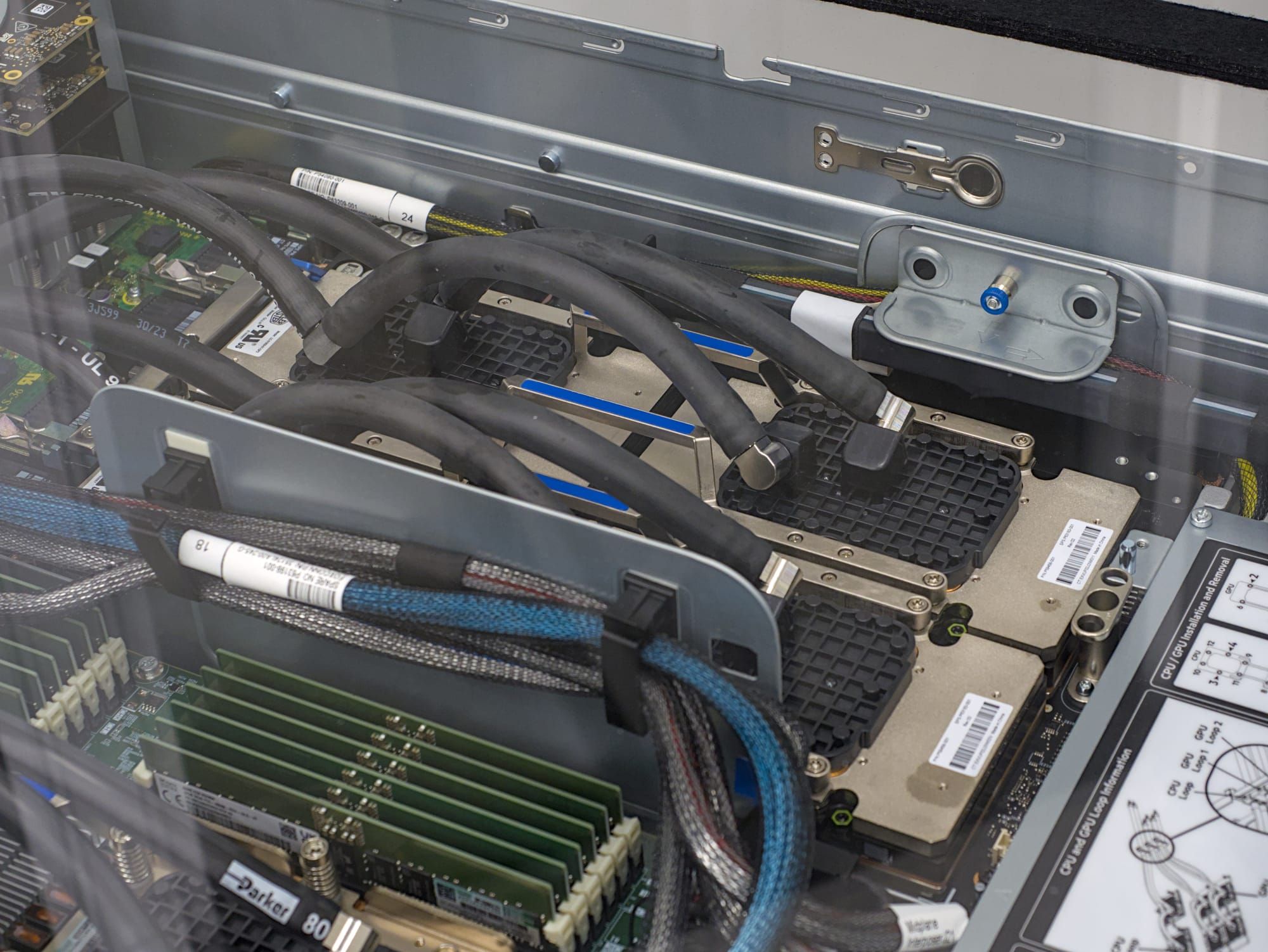
Four Nvidia H100 chips inside a node of the TSUBAME 4.0 supercomputer, the kind of advanced AI hardware the new rule covers. Photo, May 2026: Fukumoto / Wikimedia Commons / CC BY-SA 4.0
Who covered this
The story so far
Nvidia and CEO Jensen Huang
On this page · sections
The short version
- The Commerce Department issued a rule Monday to stop Chinese companies from using advanced U.S. AI chips through data centers in other countries.
- Chinese firms barred from buying the chips could rent their computing power abroad, and the old rules didn't cover that.
- The rule takes effect when published in the Federal Register, and data centers already serving Chinese firms then have 90 days to seek licenses.
Documents in this story · 5
- ReleaseBIS Issues Rule Addressing Remote Access to American Super Intelligence TechnologyBureau of Industry and Security · Press release · Nov. 16Open Archived
- ReleaseInterim final rule, "Addressing Remote Access to Advanced Semiconductors" (RIN 0694-AK50), text as released Nov. 16Bureau of Industry and Security · PDFOriginal Archived
- StatuteRoll call 13, Remote Access Security Act (H.R. 2683)Office of the Clerk, U.S. House · Web page · Jan. 12, 2026Open Archived
- ReleaseSpokesperson Guo Jiakun's regular press conferenceChina's Ministry of Foreign Affairs · Press release · Jan. 14, 2025Open Archived
- ReleaseSpokesperson Guo Jiakun's regular press conferenceChina's Ministry of Foreign Affairs · Press release · Nov. 17, 2026Open Archived
The Commerce Department issued a rule Monday to stop Chinese companies from using America's most advanced AI chips by remote access, through data centers in other countries.
Selling those chips in China has required a U.S. license since October 2022. But a Chinese company could still rent the same computing power from a data center in a nearby country, and the old rules didn't reach that. The rule arrives days after Nvidia co-founder Jensen Huang resigned as CEO under scrutiny for his ties to a former Megaspeed executive. And it lands as President Donald Trump leaves for Asia to meet Chinese President Xi Jinping.
Why it matters to you
The chips at stake power the AI tools many people now use. Washington treats them as a matter of security, not just business. The rule's text says large amounts of computing power could help a rival build better weapons or run cyberattacks. Nvidia and AMD make the chips it covers, and businesses in the five countries it names have bought billions of dollars' worth in recent years.
The rule also leaves some everyday uses alone. It doesn't apply to commercial recommender systems, the software online stores and social media apps use to suggest products and posts. Its target is the training of top AI models.
You can weigh in. Anyone has 60 days to comment at regulations.gov once the rule appears in the Federal Register, the government's daily journal of new rules.
How the AI chip rule closes the remote access gap
The first part covers data centers anywhere in the world. A license is now needed to send advanced chips to a data center that would give large amounts of computing power to firms based in China or Macau. The same goes for other restricted countries, such as Russia, Iran and Cuba. Data centers must check who owns their customers, so a Chinese firm can't get around the rule through a corporate restructuring or spinoff.
The rule sets the line at an amount of computing power it says is enough to train or run advanced AI models. A data center that starts serving such customers later also needs a license, even if the chips arrived before.
The second part names five countries. Shipping advanced chips to Indonesia, Malaysia, Singapore, Thailand or Brazil now needs a license, because the rule calls them "countries which present a higher-than-normal risk of diversion." That requirement doesn't apply to chips bound for companies based in the United States, as long as they file new monthly reports. Countries that tolerate evasion could face import limits or blacklisting of the people involved, the rule says.
The rule also formally scraps the AI Diffusion Rule. That Biden-era plan would have required chip licenses for countries around the world. The new rule's text says "super intelligence" where most people say AI, following an order Trump signed in September.
When does the rule take effect?
Early reports didn't agree. The Associated Press reported that the rule took effect immediately, while The Hill reported that it takes effect in 90 days.
The rule's text explains both. It takes effect the day it is published in the Federal Register. A data center that was already serving Chinese-owned customers before then has 90 days from that date to get a license if it wants to keep doing so. So the rule starts at once, and the grace period covers only business already under way.
Why Commerce moved now
The rule's own announcement points outside Commerce. The Bureau of Industry and Security, the part of Commerce that runs export controls, said the rule was written by and at the direction of the Treasury Department and the National Security Council. NBC News took that as a sign the push came from the wider Trump administration. The bureau said its goal is to make sure existing limits "cannot be circumvented through remote computing arrangements." Commerce had held off on new chip limits for a year.
That delay was the subject of a public fight last week. Treasury Secretary Scott Bessent said only Commerce could act on Megaspeed, the Singapore company at the center of the Nvidia scandal, as we reported. Megaspeed operates data centers in Malaysia and is suspected of diverting Nvidia chips to China. In a statement Sunday, it said it "conducts legitimate and lawful business" and has hired outside lawyers to investigate.
Trump said Monday that his team holds two views on how far to go in limiting chip sales to China. One is not to insult a country the U.S. gets along with. The other is to do whatever it takes. "Can't say either is wrong or right," he told reporters.
Two export-control experts praised the rule. Ryan Fedasiuk, an AI fellow at the Foundation for American Innovation, called it "a long-overdue step in the right direction." Chris McGuire, a Biden administration AI adviser now at the Council on Foreign Relations, called it a major step forward. He said it was the first good-faith effort to close export loopholes in a year and a half.
cannot be circumvented through remote computing arrangements.
How the remote access fight got here
The gap is old. The Biden administration barred Chinese companies from buying top AI chips directly in 2022. Many experts say Chinese firms then moved their computing to data centers in nearby countries, including the five the rule now names.
Biden's answer, five days before he left office, was the AI Diffusion Rule. It would have limited chips for risky countries and required licenses for many sales abroad. Trump's Commerce Department said in May 2025 that it would not enforce that rule, but it never formally withdrew it until Monday.
Congress has pushed too. Rep. Mike Lawler, a New York Republican, wrote a bill to extend export controls to remote access, warning that China could "access our tech through the cloud." The House passed it 369-22 in January.
What we don't know yet
What Beijing will do about the rule is not yet known. Trump and Xi meet Thursday in Shenzhen. On Tuesday, foreign ministry spokesman Guo Jiakun said China would do what is necessary to protect its rights, but he named no steps. When the Biden rule came out in January 2025, Guo accused the U.S. of "politicizing and weaponizing trade and tech issues" and said China would take firm measures.
We found no public response from Nvidia or from data center operators in the five countries as of 6 a.m. ET Tuesday. The bureau hasn't said how many data centers or chips the rule reaches. Its own paperwork estimate expects only about 100 more license applications a year. The rule's text leaves its Federal Register date blank, and Commerce hasn't said when it will run. That date starts both the 60-day and 90-day clocks.
Lawmakers want answers, too. Commerce Secretary Howard Lutnick has agreed to appear before the Senate Banking Committee, and the House Foreign Affairs Committee has asked for testimony from Jeffrey Kessler, who heads the bureau. Their answers may show why the rule took this long and how Commerce plans to police it.
Sources
Left
6 of 13 left-leaning outlets we track reported this
- NBC News: U.S. closes loophole that let Chinese companies use top AI chips in foreign data centers, Nov. 16
- NPR: U.S. tightens controls on remote access to AI technology amid Nvidia fallout, Nov. 16
- Associated Press: Trump administration moves to block China from indirect access to American AI technology, Nov. 16
Center
2 of 9 center outlets we track reported this
Right
2 of 12 right-leaning outlets we track reported this
Primary
- Bureau of Industry and Security: BIS Issues Rule Addressing Remote Access to American Super Intelligence Technology, Nov. 16 · Archived copy
- Bureau of Industry and Security: Interim final rule, "Addressing Remote Access to Advanced Semiconductors" (RIN 0694-AK50), text as released Nov. 16 · Archived copy
- Office of the Clerk, U.S. House: Roll call 13, Remote Access Security Act (H.R. 2683), Jan. 12, 2026 · Archived copy
- China's Ministry of Foreign Affairs: Spokesperson Guo Jiakun's regular press conference, Jan. 14, 2025 · Archived copy
- China's Ministry of Foreign Affairs: Spokesperson Guo Jiakun's regular press conference, Nov. 17, 2026 · Archived copy
This article was produced by AI under our Editorial Standards. Corrections are reviewed before they go live.
How coverage differs
Free with a Fair Witness account
See how left, center and right covered this story
A free account shows where the coverage agrees and where it splits, what each side played up and played down, and, when one side's outlets missed a story, who missed it.
Keep reading
The newest stories in Technology, then the rest of the site.
Newest · Technology
Officials see no sign of cyberattack behind week of tech outages; lawmakers want answers
The intelligence chief blames a rush of security upgrades, but lawmakers in both parties want a fuller account of why so much failed at once.
Latest
New stories and updates, newest first. Times are Eastern.
-
Nov 18
2:55 PMUpdated World
Part of Crimean Bridge collapses after Ukrainian strike as Russia hits Kyiv's bridges
Each side hit bridges it calls military routes, two days before Trump meets Putin and Xi in China.
-
Nov 18
11:14 AMUpdated World
Trump will meet Xi and Putin together Thursday to discuss nuclear arms, White House says
No treaty has capped the world's two largest nuclear arsenals since February, and Trump wants China in whatever replaces it.
-
Nov 18
11:14 AMUpdated U.S.
NSA's classified network goes down; White House says no sign of a cyberattack
The intelligence agency's internal system for sharing secrets failed in a week of U.S. tech outages, and Democrats want a briefing.
-
Nov 18
11:14 AMUpdated Technology
Apple outage: company says an internal update hit iCloud, Apple Pay and App Store
Many services were back by afternoon, but Apple's status page for app makers still listed key tools as down Tuesday evening.
-
Nov 18
9:15 AMNew Culture
Pope Leo says no to married priests for now, details his lung cancer surgery
His answer keeps on hold a 2019 proposal from Amazon bishops to make married deacons priests where communities wait years for one.
-
Nov 18
2:16 PMUpdated U.S.
Mullin defends flying government plane to LSU-Texas game a day after FAA ground stop
His department says he paid his way, but federal rules can set that at a coach fare, and no one has said what he paid.
-
Nov 18
2:15 PMUpdated World
Iran fires on U.S. air base in Kuwait and at Bahrain after U.S. strike on Qeshm
Iran's first attack on Kuwait in two months widens a weeklong exchange of fire, and Washington has not said how it will answer.
-
Nov 18
12:41 PMNew World
Britain hands Army officer accused of spying for Russia to U.S. military
The handover moves any prosecution to the United States, where officials have not said whether a military or civilian court would hear it.
Edge of Frame · Right
-
Nov 18
12:30 PMTop story U.S.
Garcia tells Vance, Trump's sons and others to preserve records for House probes
The letters map what Democrats plan to investigate once they take the House in January and gain the power to subpoena.
-
Nov 18
12:25 PMTop story U.S.
House Democrats nominate Hakeem Jeffries for speaker, 251-11, ahead of Jan. 3 vote
Eleven Democrats voted no in a count he asked for. His party's projected majority lets him lose almost 40 votes and still reach 218.
-
Nov 18
11:53 AMUpdated World
US Army soldier arrested in UK on suspicion of spying for Russia
The soldier, who has not been named or charged, was assigned to a NATO headquarters built to respond quickly to crises.
-
Nov 18
11:40 AMUpdated World
U.S. strikes Iran's Qeshm Island after third Iranian attack on Bahrain, officials say
It is the U.S. reply to Iranian attacks that ended a two-month lull, and Iran's next move will show whether the exchange keeps going.
-
Nov 18
11:39 AMUpdated U.S.
White House counsel warns Oversight Democrats their probes could be criminal
The letter escalates a fight over how far Congress can dig into the Trump administration once Democrats take over in January.
The Fair Witness Daily
Get each morning's Spin Meter in your inbox
The Daily leads with the Spin Meter, then the day's explainers. A free account also unlocks every Spin Meter on the site.
Free. Unsubscribe anytime. Already a member? Sign in