Nov 13
6:16 PMUpdatedU.S.
FAA orders nationwide ground stop after air traffic control communications outage
Departures were halted at every U.S. airport on a busy Friday afternoon. The stop was lifted Friday night, but delays are expected to continue.

Documents in this story · 6
- RecordTranscript of Transportation Secretary Sean Duffy on "Face the Nation," Nov. 15, 2026CBS News · Web pageOpen Archived
- RecordFAA National Airspace System statusnasstatus.faa.gov · Web pageOpen Archived
- RecordFAA Air Traffic Control System Command Center advisoriesfly.faa.gov · Web pageOpen Archived
- ReleaseHearing on the 2023 NOTAM outageSen. Maria Cantwell · Press release · Feb. 15, 2023Open Archived
- RecordPresident Nick Daniels appeared on CNN OutFront during the nationwide ground stopNATCA · Web page · Nov. 13Open Archived
- RecordPresident Nick Daniels appeared on BBC America's News NowNATCA · Web page · Nov. 14Open Archived
The Federal Aviation Administration (FAA) ordered a nationwide ground stop of all departing flights on Friday afternoon, citing "extraordinary circumstances and for reasons of safety." The FAA lifted it at 8:15 p.m. ET.
Officials blamed a communications failure at the centers that guide planes between airports, not an attack. That matters because those centers handle nearly every flight at cruising altitude, and the stop hit at the start of a busy weekend. It is only the second nationwide ground stop of all departures since the Sept. 11, 2001, attacks.
Why it matters to you
If you are flying this weekend, expect delays even after the stop ends. By 5:45 p.m. ET, more than 10,300 flights had been delayed and more than 1,300 canceled. About 11,000 more flights were scheduled to leave U.S. airports after 4 p.m., and crews who run out of legal working hours can make delays snowball into the next day.
Flights already in the air were allowed to land. Inbound international flights are being handled case by case. United Airlines said it would get customers to their destinations once the problem is fixed, and large airports such as Atlanta and Dallas-Fort Worth told travelers to check with their airline.
The thing to watch is the FAA's next advisory. Its status page lists ground stops by airport, and your airline's app will show when your flight is cleared to leave.
How the FAA nationwide ground stop unfolded
The trouble showed up first in Chicago. Shortly before the national order, the FAA halted traffic at O'Hare and Midway because of an equipment outage. One controller told Scripps News that a notice of a frequency problem arrived at about 3:36 p.m. ET, and that two more towers reported trouble within minutes.
The FAA's command center then issued its order around 4 p.m., telling all departing traffic to stay on the ground until further notice. Transportation Secretary Sean Duffy wrote on X that the stop followed a communication issue at the Air Route Traffic Control Centers. "FAA technicians are investigating the issue," he wrote.
There are 22 of these centers, and they manage flights above 18,000 feet. Accounts of how many were hit differ. Duffy's post said all of them, while the FAA's own statement to The Daily Caller said multiple centers. Reuters later reported that communications were overloaded at 17 of the 22.
What caused it?
Officials first described it as a telecommunications outage. Later Friday, Duffy blamed overloaded switches and routers (see the Update above). Homeland Security Secretary Markwayne Mullin said there was "no indication, as of yet, that this was a nefarious act against us." He added that every flight was accounted for. The FAA said the problem was not a cyberattack.
"It's just a telecommunications outage as of now," Mullin said, adding that officials could not yet rule anything out. The Transportation Security Administration is still looking for the root cause, according to two law enforcement sources cited by CBS News. One of them said it has to do with radio frequencies and how pilots communicate.
It's just a telecommunications outage as of now.
How we got here: an aging system and a funding fight
The last nationwide stop came on Jan. 11, 2023, when the FAA's system for sending safety notices to pilots failed. That outage lasted a little over an hour and a half and canceled more than 1,300 flights, according to Sen. Maria Cantwell's office.
Since then, the fight has been over money. Congress approved $12.5 billion for air traffic control upgrades in the tax and spending law signed in July 2025. Duffy called it a partial down payment. In September, he said the FAA still runs on an operating system from the 1990s and is moving from old copper wires to fiber.
The Transportation Department has since sought about $30 billion more from Congress. On Friday, the same day as the stop, the FAA and the White House sent Congress a request for $30.1 billion.
What we don't know yet
The stop was lifted at 8:15 p.m. ET Friday (see the Update above). The open question now is how quickly airlines recover over the weekend.
We also don't know why the old equipment failed now, or why a problem that started in a few places spread nationwide. Mullin said he would not "get ahead of FAA" on the cause. Asked about the FAA's new artificial intelligence planning tool, which it expanded to all 22 centers on Nov. 10, he said officials were looking at it. No official has linked the tool to the outage.
Finally, we found no public response from congressional Democrats or the National Air Traffic Controllers Association, the controllers' union, as of 5:40 p.m. ET Friday. Whether they speak, and what Congress does with the funding request, may come next week.
The case each side makes
The administration: the system is old and needs rebuilding
Duffy, Mullin and the FAA have stressed two points: travelers are safe, and the cause appears to be technical. Mullin said every flight was accounted for and that people had no reason to fear for loved ones in the air. Duffy promised immediate updates and said technicians were on the problem.
The administration's larger argument is that outages like this are what an aging network produces. Duffy has said the full rebuild needs both pots of money. "If we get the rest of this money, we can rearchitect our telecom," he said in September. He wants most of the work done by the end of 2028.
Democrats in Congress: redundancy and oversight
We found no public response to Friday's stop from congressional Democrats as of 5:40 p.m. ET. Their earlier statements, made before this outage, focus on backup systems and oversight. After the 2023 outage, Sen. Maria Cantwell, a Washington Democrat, said at a hearing, "I don't think we have true redundancy here."
In October, before this outage, more than two dozen House Democrats asked Duffy to pause the AI planning tool. They said frontline workers were told "mere days in advance or not at all." Their case is that new systems need testing before they spread, and that the FAA should show Congress how it tests and backs up its systems.
Sources
Left
11 of 13 left-leaning outlets we track reported this
- NBC News: Ground stop ordered for all airports nationwide for 'reasons of safety'
- CNN: FAA issues nationwide ground stop for all flights
- Politico: FAA orders nationwide grounding of passenger planes
- ABC News: Rare nationwide ground stop ordered at airports over communication issues
- CBS News: FAA issues nationwide ground stop due to "extraordinary circumstances"
- NBC News live updates: FAA ground stop brings chaos to U.S. airports as flights canceled (for the Update)
- ABC7 San Francisco (ABC News): FAA says ground stop remains in effect, some flights will be allowed to depart (for the Update)
- ABC7 San Francisco (ABC News): Where flights are taking off amid ground stop (for the Update)
- ABC7 San Francisco (ABC News): United, JetBlue to cancel most of the night's remaining flights (for the Update)
- ABC7 New York (ABC News): 'Inconsistency' in data led to ground stop: Duffy (for the Update)
- AP: Thousands of flights canceled as airlines work to dig out from nationwide ground stop (for the Update)
- ABC News live updates: Duffy believes ground stop was result of FAA system that 'didn't meet the moment' (for the Update)
- ABC News live updates: 'Zero evidence of anything nefarious,' FAA administrator says (for the Update)
- ABC News live updates: New York governor calls on Duffy to resign (for the Update)
- CBS News: A timeline of Trump administration's response to FAA ground stop (for the Update)
- AP (via PBS NewsHour): Trump breaks silence on nationwide ground stop and demands more money from Congress (for the Update)
- CBS News: Ground stop shows "we have to get off old network," Duffy says (for the Update)
- CBS News: Duffy pitches skeptical Senate GOP on $50 billion for FAA after ground stop (Nov. 17; for the Update)
- AP via WDIO: Trump administration asks for billions to overhaul FAA. Democrats question how money was spent (Nov. 15)
- ABC News: Transportation Secretary Duffy says ATC router's ability to broadcast data turned off, being investigated (Nov. 15) (for the Update)
- ABC News live updates: Manufacturer says routers 'functioned as configured to by the installer' when outage occurred (Nov. 15) (for the Update)
Center
4 of 9 center outlets we track reported this
- Reuters: US FAA grounds all departing flights due to extraordinary circumstance, safety reasons
- The Hill: FAA orders nationwide ground stop
- Newsweek: FAA issues rare national ground stop due to "extraordinary" circumstance
- The Hill: House Democrat calls FAA stop 'quite disturbing' (for the Update)
- The Hill: AI company behind FAA's SMART tool denies link to ground stop, Duffy confirms (for the Update)
- Reuters, via HuffPost: US aviation shutdown blamed on L3Harris installed router (for the Update)
- Newsweek: FAA router rollout paused as senators press for safety testing (Nov. 17; for the Update)
- NewsNation: Nationwide ground stop root cause remains unclear, Sean Duffy says (Nov. 17; for the Update)
Right
6 of 12 right-leaning outlets we track reported this
- Fox Business: Who is L3Harris, the federal contractor Sec. Duffy says may have caused the FAA outage? (Nov. 14)
- The Daily Caller: FAA Issues Nationwide Ground Stop, Halting All US Flight Departures
- New York Post: Planes halted across US as FAA issues nationwide ground stop
- Just The News: FAA issues nationwide ground stop on all departing flights
- Just The News: Duckworth says she will demand answers from FAA on nationwide ground stop (for the Update)
- Fox Business: FAA pauses router installations nationwide after tech issue caused Friday's ground stop (Nov. 17; for the Update)
- Fox Weather (Fox News): Ground stop ordered by FAA at all airports in America
- Fox News live coverage: FAA issues nationwide ground stop, cites communications issues
Primary
- CBS News: Transcript of Transportation Secretary Sean Duffy on "Face the Nation," Nov. 15, 2026 · Archived copy
- FAA National Airspace System status · Archived copy
- FAA Air Traffic Control System Command Center advisories · Archived copy
- Sen. Maria Cantwell: hearing on the 2023 NOTAM outage, Feb. 15, 2023 · Archived copy
- NATCA: President Nick Daniels appeared on CNN OutFront during the nationwide ground stop, Nov. 13 (for the Update) · Archived copy
- NATCA: President Nick Daniels appeared on BBC America's News Now, Nov. 14 (for the Update) · Archived copy
Other outlets (not in our coverage pool)
- Mediaite, via Yahoo News: Mike Johnson tells Fox we "don't really need an investigation" into flight stoppage (media news site; Nov. 14) · Archived copy
- CNBC: FAA issues nationwide ground stop citing communication issues (business news) · Archived copy
- Scripps News: FAA orders nationwide ground stop (broadcast news) · Archived copy
- Nextgov/FCW: $30B more is needed for air traffic control modernization, Sept. 29 (government technology news) · Archived copy
- FedScoop: House Democrats push FAA to pause AI tool, Oct. 14 (government technology news) · Archived copy
- AeroTime: FAA expands AI traffic planning tool to all 22 en route centers (aviation trade news) · Archived copy
- TechCrunch: Transportation secretary blames 'routine' equipment upgrade for grounding flights nationwide (technology news; for the Update) · Archived copy
This article was produced by AI under our Editorial Standards. Corrections are reviewed before they go live.
How coverage differs
Free with a Fair Witness account
See how left, center and right covered this story
A free account shows where the coverage agrees and where it splits, what each side played up and played down, and, when one side's outlets missed a story, who missed it.
Nov 13
6:11 PMUpdatedU.S.
Lauren Boebert loses Colorado House seat to Democrat Eileen Laubacher
A district that backed Trump by 18 points flips, and one of the best-known Republicans in Congress will leave in January.

Rep. Lauren Boebert, a Colorado Republican, lost her House seat on Friday to Democrat Eileen Laubacher, a retired Navy rear admiral. The Associated Press called the race Friday afternoon, 10 days after Election Day.
The margin was thin, but the place makes it notable. Colorado's 4th District backed President Donald Trump by 18 points in 2024, and Boebert was one of the best-known Republicans in Congress. Boebert conceded late Friday.
Why it matters to you
If you live on Colorado's eastern plains, your representative changes in January. The district covers the eastern third of the state, plus part of Douglas County south of Denver and the city of Loveland. Laubacher has said her top goals are lower costs, fighting corruption and better health care access in rural areas.
For everyone else, the race adds one more seat to a larger Democratic majority. Democrats won both chambers on Nov. 3, and Fox News counted 256 Democratic House seats to 169 on Friday, with several races still uncalled. A bigger cushion means House Democratic leaders can lose more of their own members on a vote and still pass a bill.
The date to watch is Nov. 25. That is the deadline for Colorado counties to finish their official count, and for a candidate to ask for a recount at their own cost, Denver TV station KDVR reported.
How Boebert's Colorado House race was called
The count took more than a week. With 99% of ballots counted, Laubacher had 48.7% to Boebert's 47.9% in the AP count, as Fox News reported it. The New York Post put her at 48.8%. Libertarian Douglas Mangeris had a little over 3%. NBC News and CBS News made the same call. The Hill, using Decision Desk HQ's count, had the gap at about one point.
Laubacher had already claimed the seat. She declared victory on Monday, Nov. 9, when she led by about 3,200 votes out of some 380,000 with an estimated 98% counted. She then joined other incoming members at the Capitol for new-member orientation.
After Friday's call, she thanked voters in a statement: "This campaign was never about party labels." She promised to work just as hard for the people who voted against her.
This campaign was never about party labels.
Could a recount change the result?
Not automatically. Colorado orders a recount on its own only when the gap is half a percentage point or less of the leader's total. This gap is wider, so a candidate who wants one must ask for it and pay for it.
Boebert's campaign has said it expects one. Her lawyer, former Colorado Secretary of State Scott Gessler, said in a statement last week that the campaign was looking into what he called unusual voting patterns. He said it expects the race "to head to a recount, one way or another," the New York Post reported. He did not say which patterns. KDVR noted that the statement was not a formal request.
How Boebert and Laubacher got here
Before politics, Boebert owned a restaurant in Rifle, Colorado. In 2020 she beat a five-term Republican in a primary and won the 3rd District that fall. In 2022 she held that seat by just 546 votes. Rather than face the same rival again, she moved to the 4th District, then held by a retiring Republican. She won it in 2024 by 11 points by the New York Post's count, or about 12 by The Hill's.
Her ties to Trump then frayed. In November 2025 she was one of four House Republicans who signed a petition to force a vote on releasing the Justice Department's Jeffrey Epstein files, which Trump opposed. Trump later vetoed a water project bill she sponsored, which had passed both chambers unanimously. In May he called her weak-minded and a carpetbagger on Truth Social, after she campaigned for Rep. Thomas Massie. He threatened to pull his endorsement but never did.
Laubacher came from a different world. She spent 34 years in the Navy, with posts in Afghanistan and India, and then served on President Joe Biden's National Security Council. She was a Republican until 2025, when she registered as a Democrat. She also raised millions more than Boebert, according to federal filings The Hill reviewed.
What we don't know yet
Boebert conceded late Friday (see the Update above), and we found no recount request. A candidate can still ask for a paid recount until Nov. 25, the deadline for the official count. A recount would push back the final result by weeks, since a paid recount has until Dec. 8 to finish.
We also don't know what Boebert does next. On Wednesday she told reporters she would not run again in 2028 if she lost, Colorado TV station KKTV reported.
The size of the House majority is also still moving. Several races remain uncalled, so the exact size of the Democratic majority won't be clear for days.
The case each side makes
Laubacher and Democrats
Laubacher ran on her service record. She made her military service and national security record the center of her campaign, and pressed on affordability, health care and fiscal responsibility. She also criticized Trump's tariffs and the handling of the war with Iran. Her case to Republican voters was that she had been one of them: she told Boebert in a debate that the party had changed almost beyond recognition.
Democrats cast the result as a vote on conduct as much as policy. On election night, Laubacher told supporters that character and truth matter, and that public service should be about others, NBC News reported, citing The Colorado Sun. Suzan DelBene, who chairs the House Democrats' campaign arm, said in a statement that Boebert's time in office was over.
Boebert and her campaign
Boebert conceded late Friday (see the Update above). Her case here comes from before the call. Her first argument is about the count. Before the call, she said every vote should count, adding, "We still have military and overseas ballots that are coming in," CBS News reported. Asked Wednesday whether she would concede, she answered with a question: "So why would I concede if the votes aren't all in?" Her campaign was blunter in a Nov. 9 fundraising email: "Make no mistake, this race is NOT over!"
Her second argument is about money and the national mood. "There was a lot of money dumped on my head," she said after the election, NBC News reported. She also blamed the Senate for not passing bills the House had approved. And she has stood on her record of breaking with Trump, from the Epstein files to a water project for her district that Trump vetoed, which she said would have served 50,000 people.
Sources
Left
8 of 13 left-leaning outlets we track reported this
- NBC News: Rep. Lauren Boebert, conservative firebrand from Colorado, loses her race for re-election, Nov. 13
- CBS News (CBS Colorado): Democrat Eileen Laubacher defeats incumbent Republican Congresswoman Lauren Boebert, Nov. 13
- CBS News (CBS Colorado): Boebert concedes; results await certification, Nov. 13
- The Guardian: Trump-backed Maga firebrand Lauren Boebert defeated in Colorado congressional race, Nov. 13
Center
3 of 9 center outlets we track reported this
Right
4 of 12 right-leaning outlets we track reported this
Other reporting
- Colorado Politics: Laubacher claims victory over Boebert, Nov. 9 (Colorado political news site)
- KDVR (Fox31 Denver): Boebert campaign expects recount in Colorado's 4th District (Denver TV station)
- KKTV: Boebert says she won't run again in 2028 if she loses, Nov. 11 (Colorado Springs TV station)
This article was produced by AI under our Editorial Standards. Corrections are reviewed before they go live.
How coverage differs
Free with a Fair Witness account
See how left, center and right covered this story
A free account shows where the coverage agrees and where it splits, what each side played up and played down, and, when one side's outlets missed a story, who missed it.
Nov 13
3:06 PMUpdatedWorld
Europe to send a diplomat team to Ukraine peace talks, but the Kremlin sets a condition
Europe has been left out of the U.S.-led talks to end the war in Ukraine, and its seat now depends on Moscow's say-so.

Europe will send a team of diplomats from the European Union and five countries to the next U.S.-led Ukraine peace talks, European Council President António Costa said Friday in Dublin.
Whether Europe gets that seat is still in dispute. U.S. envoys said Thursday that Russian President Vladimir Putin had agreed to let Europe in, but the Kremlin said Friday that no decision has been made. For now, Europe's place at the table depends on whose account holds.
Why it matters to you
Europe has a large stake in how the war ends: it has armed Kyiv and put sanctions on Moscow. Kaja Kallas, the EU's top diplomat, pointed to that support and to the frozen Russian assets Europe holds, and argued that without Europe no deal could be carried out.
The talks also touch on security guarantees for Ukraine. U.S. officials have said they hope Russia will accept protection for Ukraine similar to NATO's mutual-defense pledge, under which allies treat an attack on one as an attack on all. What Europe says at the table could shape what Washington is asked to back.
No date is set for the next round, but the next sign may come next week, when President Donald Trump could meet Putin in China. The AP reported that Trump is due in Beijing to meet him, while the BBC said a meeting may come at an Asia-Pacific summit in Shenzhen.
How Europe got a seat at the Ukraine peace talks
Europe was shut out of the last round. The first U.S.-led talks between Russia and Ukraine in nine months were held in Abu Dhabi, and as Fair Witness reported Tuesday, Europe was kept out of that room. Britain, France, Germany and other European countries sent officials to side discussions nearby, not to the main talks. The talks produced a prisoner deal but no breakthrough on land.
This week's opening came in Moscow. U.S. envoys Steve Witkoff and Jared Kushner met Putin on Thursday for just over two hours, and afterward Witkoff said Putin had agreed to European participation. "The Europeans will join at the next meeting," he said. He also said they had settled the details of a large prisoner exchange with Ukraine.
The envoys then flew to Dublin to brief Ukrainian President Volodymyr Zelenskyy, who was meeting European leaders there. Kushner said Putin was willing to give it a try.
We cannot conclude this deal without the Europeans being at the table
"We cannot conclude this deal without the Europeans being at the table," Kushner said. Zelenskyy welcomed the news and said Europe would be on the negotiating team, not off to the side.
Who will speak for Europe?
That question split the summit. Leaders debated whether to send one envoy or a team, and they chose a team: the EU plus the U.K., France, Germany, Italy and Poland, Costa said. Those five belong to the coalition of the willing, a group of countries that have pledged to back a future ceasefire with military support. A team lets Britain, which left the EU in 2020, take part.
Who represents the EU itself is still open. Kallas claimed the role, while Italian Prime Minister Giorgia Meloni had pushed for a single voice. German Chancellor Friedrich Merz said talks on the line-up would continue.
What the Kremlin says
Moscow tells a different story. Kremlin spokesman Dmitry Peskov said Friday that Russia would decide on a wider format only after it sees Europe's real intentions and its "readiness to contribute to the peace process." He said no concrete talks with Europe had taken place. Vladimir Medinsky, Russia's lead negotiator, said it was unclear what there is to discuss with Europe.
Russia has also widened its demands. After the Moscow meeting, the Kremlin said peace requires a new security order for all of Europe. That revives draft treaties it offered in December 2021, which would have barred Ukraine from NATO and pulled the alliance back from eastern Europe. Western leaders rejected them, and Russia invaded two months later.
What we don't know yet
The biggest question is whether Russia will accept Europe at all. Peskov tied the decision to Europe's intentions without saying what would count. Until Moscow says yes, Russia has not confirmed the U.S. account that Putin agreed, and we may not know until a date and guest list are set.
We also don't know who will sit in Europe's chairs, or what they will ask for. Europe wants a ceasefire first, while Russia wants a wider security deal before that. Whether Trump and Putin meet next week, and what they agree on, could settle some of this before Europe ever reaches the table. The size and timing of the prisoner exchange have also not been announced.
The case each side makes
European leaders and Ukraine
European leaders argue that a deal about Europe's security can't be made without Europe. There should be "no discussions about Europe without Europe," Merz said, and he called Russia's demand to redraw the continent's security the same old game. Forty European countries signed a declaration in Dublin saying Europeans must be involved in any matter affecting their security.
Kallas warned that Russia's security talk is a trap to pull attention from its own attack. "We have one aggressor and one victim," she said. Her order of steps is a ceasefire first, then a peace deal, then talks on Europe's wider security. Zelenskyy says Europe's place at the table matters because the war is in Europe and Ukraine plans to join the EU.
Russia
Moscow argues that the war can't end until Europe's security order changes. Putin told the U.S. envoys that Europe keeps saying no to wider security arrangements until a peace deal is done, and then plans to send troops, which he said would continue the war. "So this is a vicious circle," he said in televised remarks.
The Kremlin says it wants a lasting settlement, not a pause. It says it wants a full peace settlement, not a ceasefire, and Foreign Minister Sergei Lavrov said Europe's security framework should come before the war's details. Russia's goal is "a new, long-term architecture of indivisible security and peace," the Kremlin said. Moscow has also objected that Europe arms and pays for Ukraine's war effort.
Sources
Left
4 of 13 left-leaning outlets we track reported this
- Associated Press via PBS NewsHour: Europe to send a diplomat team to Ukraine talks as leaders push for a voice, Nov. 13
- The Guardian: Russia is 'setting traps' in Ukraine talks, EU foreign policy chief warns, Nov. 13
- CNN (analysis): Europe and Ukraine get a boost in peace talks, but Putin is playing for time, Nov. 13
- CBS News (with AP): U.S. facilitating direct engagement between Europe and Russia amid push for peace in Ukraine, Kushner says, Nov. 14
Center
5 of 9 center outlets we track reported this
- Reuters: Russia says Europeans can join Ukraine peace talks if they show 'readiness to contribute', Nov. 13
- Reuters: Europe's security cannot be part of Ukraine peace talks, EU leaders say, Nov. 13
- BBC (analysis by Steve Rosenberg): Uncompromising Putin ups demands for peace with Ukraine, Nov. 13
- UPI: U.S., Ukraine herald European involvement in peace talks with Russia, Nov. 13
Right
2 of 12 right-leaning outlets we track reported this
- The Washington Times: U.S. envoys meet with Putin over prisoner swap, European inclusion in Ukraine talks, Nov. 12
- The New York Sun: Trump Envoys Arrive in Moscow for Talks With Putin as Russia and Ukraine Agree in Principle to Largest Prisoner Exchange of War, Nov. 12 (headline only; text unavailable)
Other reporting
Primary
- On-record statements by Costa, Kushner, Kallas, Merz and Meloni (AP via PBS, Reuters, The Guardian), Peskov and Medinsky (Reuters, The Guardian, BBC), Witkoff (The Washington Times) and Putin's televised remarks (CNN). We found no official transcript of Costa's Dublin remarks or of the 40-nation declaration as of 2:45 p.m. ET Friday.
This article was produced by AI under our Editorial Standards. Corrections are reviewed before they go live.
How coverage differs
Free with a Fair Witness account
See how left, center and right covered this story
A free account shows where the coverage agrees and where it splits, what each side played up and played down, and, when one side's outlets missed a story, who missed it.
Nov 13
2:55 PMUpdatedHealth
US measles cases top 5,400 as a ruling on measles elimination status nears
A ruling expected next week could end 26 years of measles elimination in the U.S., a sign of how far vaccination has slipped.

The short version
- The U.S. has 5,412 measles cases this year, the most since 1991.
- Experts expect a health panel to rule that measles spreads here again, ending the elimination status held since 2000.
- Pan American Health Organization officials said the ruling is being scheduled for next week.
Documents in this story · 3
The United States may be days from losing its measles elimination status, the official finding it has held since 2000 that the virus no longer spreads continuously here. Cases this year reached 5,412, the most since 1991, the Centers for Disease Control and Prevention said Friday.
That is 230 more than a week earlier. From 2000 to 2024, the country averaged about 180 cases a year. Experts widely expect an international health panel to rule against the U.S., and Reuters called the ruling a new test for the Trump administration's health policy. As of 2:30 p.m. ET Friday, no ruling had been announced.
Why it matters to you
Measles is one of the most contagious diseases there is. A sick person can infect about 9 in 10 unvaccinated people they meet, and the virus can linger in a room's air for two hours. About 1 in 5 unvaccinated people who catch it end up in the hospital.
Babies are most at risk, because they are too young for the shot. The first dose of the measles, mumps and rubella (MMR) vaccine is given at 12 to 15 months, and the second at 4 to 6 years. Two doses are about 97% effective. Infants depend on the people around them being immune. If you aren't sure you or your children had both doses, your doctor or state health department can check your records.
Losing elimination status would not by itself change how federal health officials fight outbreaks, the CDC director has said. It is a formal finding that one chain of the virus has spread for a year or more, and a clear marker of where protection has worn thin.
Why the US may lose its measles elimination status
The decision belongs to the Pan American Health Organization (PAHO), the World Health Organization's office for the Americas. Its panel of outside experts reviews whether one chain of the virus, of the same strain, has spread without a break for 12 months or more. That is why the review rests on the virus's genetic code, not case counts alone. The panel then advises PAHO's director, Jarbas Barbosa, who makes the final call.
The panel met behind closed doors in Washington through Friday and is weighing Mexico's status too. PAHO officials said an announcement is being scheduled for next week, the Associated Press reported.
An outbreak in Arizona and Utah began in June 2025 and is still going. Noel Brewer, a public health professor who chairs an independent U.S. measles panel, said public data suggest it likely meets the 12-month test. Utah alone recorded 725 cases from June 2025 through Nov. 3, Bloomberg News reported.
How many people have died?
The numbers differ by source. State health departments have reported 10 deaths this year: seven in Pennsylvania, two in Wisconsin and one in New York. At least four were infants or children. The CDC counts six deaths and hasn't said which states they were in. The gap followed a change in how it tracks measles deaths: it now uses data from the National Center for Health Statistics, a switch it posted in September.
How measles came back
The U.S. declared measles eliminated in 2000, after vaccination drives pushed childhood coverage above 97%. Experts warned that the gain was fragile, and members of the CDC's expert group later called it "an inherently unstable situation" that depended on keeping vaccination rates very high.
Those rates have slipped. About 95% of kindergartners had the MMR shot in the 2019-20 school year, and that fell to about 92% in 2025-26. That left roughly 300,000 kindergartners unvaccinated this year, and kept coverage below the 95% level that usually stops spread.
Cases have climbed fast since. The country had about 2,300 cases in 2025, and this year's total is more than double that. About 96% of this year's cases are linked to outbreaks.
The U.S. would not be alone. Canada lost its status in November 2025, and Spain and the United Kingdom have lost theirs since. Mexico has had more than 20,000 cases since early 2025, Bloomberg News reported.
The U.S. review itself was delayed. PAHO first planned it for April, then moved it to November while U.S. officials finished genetic testing of the virus. That is the review now waiting on a ruling.
What we don't know yet
PAHO hasn't said which day it will announce its ruling, though The New York Sun reported a date of Nov. 17. We will report the decision when PAHO makes it public.
We also don't know the full death toll, or when the CDC's count of six will match the 10 that states have reported. And it is unclear what the federal government will do next. The CDC director says the response won't change, while critics want a national plan. Pennsylvania's health secretary is among the officials calling for one.
Finally, regaining the status will take time. The U.S. must show the outbreak chain has been broken for at least 12 months. No one has said when that could happen.
The case each side makes
The split is over why measles came back and what Washington should do now. Both sides agree the MMR vaccine works.
The administration: vaccination rates fell before this term
The Department of Health and Human Services (HHS) says national vaccination rates declined before Health Secretary Robert F. Kennedy Jr. took office. CDC Director Erica Schwartz traces the outbreaks to close-knit communities that often don't vaccinate. Their families, she said, made choices about the shot 20 to 30 years ago.
The administration says its message is clear. HHS spokesperson Emily Hilliard said Kennedy and Schwartz still recommend the MMR shot as the best protection, Bloomberg News reported. Kennedy, who has cast doubt on the vaccine in the past, has also said, "So people should get vaccinated."
Schwartz says a ruling won't change the CDC's work with the states. "The measles elimination designation is not what protects Americans. Vaccination does," she said, according to the AP.
The critics: mixed signals from the top
Public health experts, joined by a leading Republican senator, say the administration's own words have made things worse. Kennedy has moved to shrink the childhood vaccine schedule, and President Trump has said without evidence that the MMR shot may be dangerous. An August order from Trump suggested splitting it into three shots. Spacing out the shots runs against medical groups' advice, experts told the AP.
Sen. Bill Cassidy, a Louisiana Republican and a doctor, chairs the Senate health committee. He has blamed the administration's approach for measles deaths, Reuters reported. In a September TV interview, he asked of the president, "Why do you think this vaccine is lethal?"
Demetre Daskalakis, a former top CDC official who resigned after Kennedy took office, sees a wider problem. "Measles is the great indicator of where the cracks are in our foundation," he told Reuters.
Sources
Left
4 of 13 left-leaning outlets we track reported this
- ABC News: Measles cases nationwide top 5,400 as outbreaks spread across the US
- AP, via ABC News: US, Mexico are on the verge of forfeiting a major health victory
- The Guardian: CDC reports six measles deaths in 2026
- CNN: Timeline: How the US wrangled the deadly measles virus and how it has come raging back
- CBS News: Cassidy says Trump needs to be "radically honest" on vaccines
- NBC News: U.S. measles deaths rise to 10 after new reports in Pennsylvania and Wisconsin
Center
3 of 9 center outlets we track reported this
Right
3 of 12 right-leaning outlets we track reported this
Other reporting
- Bloomberg News, via the News Tribune: Measles forges deadly trail across America (business news service)
- CIDRAP: Canada loses measles elimination status after record year of outbreaks (University of Minnesota infectious-disease research center)
This article was produced by AI under our Editorial Standards. Corrections are reviewed before they go live.
How coverage differs
Free with a Fair Witness account
See how left, center and right covered this story
A free account shows where the coverage agrees and where it splits, what each side played up and played down, and, when one side's outlets missed a story, who missed it.
Nov 13
1:04 PMUpdatedEconomy
Anthropic IPO: $70 to $78 price range would value it at about $1 trillion or more
The Claude maker's stock debut, expected next week, is a real-time test of whether investors still trust the AI boom.

Anthropic, the maker of the Claude chatbot, will offer 825 million shares at $70 to $78 each in its initial public offering (IPO), its first sale of stock to the public. The shares will trade on the Nasdaq under the symbol ANT.
That range would make Anthropic one of the most valuable companies ever to go public. It also arrives at a shaky moment. AI stocks fell sharply after last week's elections, and Nvidia, a key partner, lost its chief executive on Thursday. How the shares trade will tell you a lot about how much faith Wall Street still has in AI.
Disclosure: Fair Witness's articles are researched and drafted by AI agents built on Anthropic's Claude. Anthropic has no role in our editorial decisions.
Why it matters to you
If you own an index fund or a 401(k), the AI trade already touches your savings. AI-linked stocks have driven much of the market's gains for about two years. A strong debut could lift that mood. A weak one would be another warning sign that investors are growing nervous, Patrick Ryan of Madison Investments told Reuters.
You may also be able to buy shares directly. Anthropic's filing says a minority of the shares may go to retail investors, meaning individuals rather than big funds. Demand looks heavy, though. Orders reached about six times the shares on offer, Bloomberg News reported, and bankers said existing backers would get first call.
Two dates matter next week. Nvidia reports earnings on Tuesday, and Anthropic's shares are expected to start trading two days later.
What Anthropic's IPO filing says
The share count and price range come from an updated filing with the Securities and Exchange Commission (SEC), the agency that oversees stock sales. Anthropic itself is selling about 801 million shares, and early shareholders are selling the rest. The company also lined up a $26 billion private sale of a separate class of stock to Google, Nvidia, AMD, Broadcom, Micron, Microsoft and TSMC. Those buyers pay the same price as the public.
At the top of the range, the public sale would raise about $64.4 billion. Add the private sale, and the total could reach about $90 billion.
So what is Anthropic worth?
It depends on which shares you count. Fox Business put the value at up to $1.02 trillion, and Politico said about $1.3 trillion. CNN and The Hill reached $1.4 trillion at the top of the range on a fully diluted basis, a count that includes stock options and other shares that could be issued later. Even the highest estimate is well below the $2 trillion some investors had expected at one point this year.
When will the shares trade?
Anthropic hasn't announced a date, and it declined to comment to CNN on timing. Reuters reported that trading is expected to begin on Nov. 19. CNN's sources said late next week but warned the date could move. This is what we know as of 12:30 p.m. ET Friday.
Fast growth, big costs and a tangle with Nvidia
The filing shows a business growing at a pace few companies have matched. Revenue reached $33.2 billion in the first nine months of 2026, up from $2.5 billion a year earlier. Its operating loss, the money lost running the business, shrank to $1.3 billion from $5.2 billion.
Yet the costs ahead are huge. Anthropic has committed to spend nearly $900 billion over the next few years on computing power and data centers. It also booked a $104 billion net loss for the nine months, mostly from accounting charges tied to its financing that didn't cost cash.
Then there is Nvidia. The chipmaker agreed to buy around $10 billion of Anthropic stock in the private sale, and Anthropic has pledged huge sums for computing deals that run on Nvidia chips. Nvidia's chief executive, Jensen Huang, resigned Thursday after reports of two affairs. Axios found no sign Nvidia would back out, but said future deals between the two now look uncertain.
How Anthropic got here
Founded in 2021 by former OpenAI researchers, Anthropic is led by chief executive Dario Amodei. It filed its IPO paperwork confidentially in June, and rival OpenAI did the same a week later. In May, private investors had valued Anthropic at $965 billion.
Anthropic is a public benefit corporation, a legal form that requires it to weigh the public good alongside profits. Its stated purpose is the "responsible development and maintenance of advanced AI for the long-term benefit of humanity". An independent trust can elect most of its board, and a company owned by its seven co-founders will hold just over half the shareholder votes.
The timing got harder this month. The Nasdaq lost $2.5 trillion in value in one day after Democrats swept the midterms, as investors feared limits on data centers. Some commentators then wondered whether Anthropic would delay the sale or cut its price.
What we don't know yet
The final price is still open. Anthropic will set it after its sales pitch to investors ends. The demand figures come from unnamed people who spoke to Bloomberg News, and they could still change.
We also don't know how Nvidia's change at the top will affect its ties to Anthropic. Nvidia's earnings report on Tuesday may offer the first clues. Finally, no one knows how a stock like this will trade. A company that only builds AI models has never gone public before.
The case each side makes
Anthropic and its backers: growth and demand
Anthropic's case rests on its growth. Revenue rose more than tenfold in a year, and operating cash flow, the cash the business itself brought in, was positive at $6.6 billion.
The company also presents its structure as a strength. It says its trust and its seven co-founders are well suited to guard its mission. In its first public filing last month, it described explaining AI's dangers as "our personal responsibility to help the world understand these risks". Its new filing is also frank about limits: "We do not expect our revenue will continue to grow at comparable rates", it says.
We do not expect our revenue will continue to grow at comparable rates
Some analysts read the deal as a sign of confidence. Fiona Cincotta of City Index said the offering shows Anthropic remains upbeat about demand for AI. Paul Marino of Themes ETFs told CNN he is watching the customer risk, but his faith in AI's future outweighs it.
Skeptics: too much risk at this price
Critics say the price leaves little room for error. Michael Baker of Capital.com called it a huge valuation and said "it will take a lot to convince investors that it represents a fair price". Ipek Ozkardeskaya of Swissquote Bank said investors now care more about what that growth costs.
Others worry about who gets paid. David Trainer, head of research firm New Constructs, told CNN the payout to early insiders is "a horrific misallocation of capital". Some insiders may sell part of their shares on the very first day. New York City Comptroller Mark Levine told Bloomberg News that setups like this tip power away from shareholders and toward management, CNN reported.
Skeptics also point to risks in the filing itself. Anthropic's top five customers bring in about a quarter of its revenue, and many can cut spending at any time. And it has pledged nearly $900 billion for computing power even as it warns that its growth will slow.
Sources
Left
4 of 13 left-leaning outlets we track reported this
- CNN: Anthropic to seek $1.4 trillion valuation in blockbuster IPO
- CNN: Market turmoil saps enthusiasm for the buzziest IPO of the year
- Politico: Anthropic seeks $1.3T valuation for blockbuster IPO
- Axios: Anthropic to IPO amid Nvidia fiasco
- ABC News: Anthropic seeks $70 to $78 a share in new IPO filing
Center
2 of 9 center outlets we track reported this
Right
2 of 12 right-leaning outlets we track reported this
This article was produced by AI under our Editorial Standards. Corrections are reviewed before they go live.
How coverage differs
Free with a Fair Witness account
See how left, center and right covered this story
A free account shows where the coverage agrees and where it splits, what each side played up and played down, and, when one side's outlets missed a story, who missed it.
Nov 13
12:56 PMUpdatedU.S.
Bessent blames Lutnick's Commerce Department for not blacklisting Megaspeed
The Cabinet split over a chip buyer tied to the Nvidia scandal is a fight over how well the U.S. keeps advanced chips from China.

Documents in this story · 4
- ReleaseExcerpts of Treasury Secretary Scott Bessent's "Squawk Box" interviewCNBC · Press release · Nov. 13Open Archived
- RecordJoint statement on the Megaspeed investigationDepartments of Commerce and Justice · Web page · Nov. 17, 2026Open Archived
- LetterLetter to Commerce Secretary Howard Lutnick on MegaspeedSen. Tom Cotton · PDF · Oct. 13, 2025Original Archived
- ReleaseWarren presses Trump administration over export controlsSenate Banking Committee minority · Press release · July 30, 2026Open Archived
Treasury Secretary Scott Bessent said Friday that four parts of the government wanted Megaspeed, the chip buyer at the center of the Nvidia scandal, put on a U.S. trade blacklist. The decision, he said, belonged to Commerce Secretary Howard Lutnick's department.
It is the most public sign yet of a fight inside President Donald Trump's administration over why Megaspeed hasn't been blacklisted. Fair Witness reported Thursday that Nvidia CEO Jensen Huang had resigned after reports tied him to a former Megaspeed executive whom U.S. officials suspect of spying for China. Now the questions have moved from Nvidia's boardroom to the Cabinet, and some of Trump's advisers have begun discussing whether Lutnick should go, CNN reported, citing people familiar with the talks.
Why it matters to you
The fight is over how well the government keeps America's most advanced computer chips out of China. These chips power artificial intelligence (AI), and Washington limits their sale to China on national security grounds. Bessent said any chips that slip through hurt U.S. companies in the AI race and give China an advantage.
It is also a question about Nvidia itself. Bessent said the real story is whether Nvidia knew its own customers, and he said anyone at the company responsible for lapses should be held accountable.
The next date to watch is Dec. 10. Lutnick has agreed to testify that day before the Senate Banking Committee, CBS News reported. The committee has also asked Huang to appear on Dec. 3.
What Bessent said about Commerce and Megaspeed
On CNBC's "Squawk Box" Friday morning, Bessent said Treasury, the Pentagon, the State Department and the U.S. Trade Representative "were in favor of putting Megaspeed on the entity list for months." The entity list is a Commerce Department list of foreign companies that U.S. firms can't sell to without a special license.
were in favor of putting Megaspeed on the entity list for months
Then he pointed at Commerce. "But Commerce has the pen," he said, adding that reporters would have to ask that department about its own process. He said the call belongs to Commerce's Bureau of Industry and Security, which runs export controls, and that Treasury's sanctions office has no control over it.
Bessent said he was frustrated because Trump had made clear that China should get no Nvidia chips more advanced than its H100 model. Asked whether Congress needed to act, he said no: "We have all the authorities that we need." The rules, he said, just need to be carried out.
Did Bessent confront Lutnick in private?
CNN previously reported that Bessent challenged Lutnick about Megaspeed at a tense meeting in the White House Situation Room last week. On Friday, Bessent would not discuss it, saying such talks stay private. He also didn't deny reports of tension between the two men.
How Megaspeed became a fight inside the Cabinet
Megaspeed is a cloud computing company based in Singapore and an Nvidia customer. U.S. officials suspect it of steering advanced Nvidia chips to China in spite of a U.S. export ban. It was once led by Alice Huang, the woman U.S. officials suspect of spying for China, with whom Jensen Huang had an affair. China has denied the spy claim. The two Huangs are not related.
The warnings are not new. In October 2025, Republican Sen. Tom Cotton asked Lutnick to investigate Megaspeed, writing that the case raised questions of "who is aiding the Chinese Communist Party in skirting American export control laws." Commerce did look into the company last year, according to The New York Times, while the Financial Times reported that the department was slowing efforts to list it.
Critics have also questioned the pace of the list as a whole. In July, Democratic Sen. Elizabeth Warren wrote, "There have been no additions to the Entity List since October 9, 2025."
Senior officials, Lutnick among them, were briefed months ago about Jensen Huang's relationship with Alice Huang, CNN reported. Earlier this month, Axios reported that Lutnick told Bessent he would look into the matter, according to The Hill. Axios also reported, citing unnamed sources, that Lutnick had spent the past year rolling back efforts to scrutinize the company.
What the White House and Lutnick have said
The White House has stood by Lutnick. In a statement Thursday, before Bessent spoke, it said Trump "maintains complete confidence in the secretary" and called him the most transformative Commerce secretary in modern history. Trump and Lutnick are longtime friends.
Even so, CNN reported that some advisers are discussing whether Lutnick should be dismissed, and that Trump has taken calls from officials raising alarms about him. Those accounts come from unnamed people, and the White House has not said Trump is weighing a change.
We found no public response from Lutnick or the Commerce Department to Bessent's remarks as of 12:30 p.m. ET Friday. Commerce did not immediately respond to a request for comment from CBS News. Its only statement Friday came from spokeswoman Kristen Eichamer, who said Lutnick had "proactively agreed to appear voluntarily" before the Senate panel.
What we don't know yet
We don't know why Commerce hasn't listed Megaspeed, or whether it plans to. Lutnick hasn't explained the delay in public, and his Dec. 10 testimony may be the first time he answers questions about it in public. Whether he responds to Bessent before then is also open.
Trump said Nov. 16 he has no plans to replace Lutnick (see the Update above). We don't know if his advisers still talk about Lutnick's future. Reports of those talks rested on unnamed sources. Finally, Bessent's own question, whether Nvidia knew it was selling to shell companies, has no public answer yet. Huang's Senate appearance, if it happens, could shed light on it.
The case each side makes
Bessent and Commerce's critics: the tools existed and weren't used
Bessent's case is that the government already had the power to stop Megaspeed and that several agencies wanted to use it. In his view, the hold-up sat in one place, and he named it. He argues that any leak of advanced chips hurts American companies and helps China in the race for AI. "We have all the authorities that we need," he said.
Lawmakers in both parties have pressed the same point. Republican Sen. Jim Banks of Indiana said Commerce, under Lutnick, appeared to have "used loopholes to allow some of these chip sales to occur," against Trump's wishes.
Lutnick, the White House and Megaspeed: no verdict before the facts
We found no public response from Lutnick or Commerce to Bessent as of 12:30 p.m. ET Friday, and no statement from him on Megaspeed. His side of the story so far is that he will face Congress. His spokeswoman said he agreed to testify voluntarily. The White House says Trump still has full confidence in him.
On chip sales to China, Lutnick's earlier record is that the U.S. keeps its best chips at home. In July 2025, before these reports, he told CNBC, "We don't sell them our best stuff, not our second best stuff," and said China wasn't getting the third best either. Megaspeed, for its part, denies wrongdoing and has said inspections found no evidence of violations.
Sources
Left
7 of 13 left-leaning outlets we track reported this
- CNN: Bessent points finger at Commerce Department in Nvidia scandal as Trump advisers discuss possible Lutnick ouster
- Politico: Bessent faults Lutnick for not cracking down on firm at center of Nvidia scandal
- Axios: Bessent puts Megaspeed heat on Lutnick
- CBS News: Lutnick agrees to testify as Bessent blames him for not banning Nvidia chip exports to China-linked firm
- Axios: MAGA turns on Lutnick amid China spy scandal
- ABC News: House and Senate Republicans call on Howard Lutnick, Jensen Huang to testify about Nvidia
Center
4 of 9 center outlets we track reported this
- The Hill: Blumenthal says Lutnick 'must go' following Nvidia scandal (Nov. 14)
- Reuters: Bessent says Treasury favored limits on Megaspeed
- The Hill: Bessent: Treasury pushed to blacklist Megaspeed, but 'Commerce has the pen'
- The Hill: Crawford says it's 'premature' to place blame on Lutnick for Nvidia chip sales (Nov. 15)
- BBC: Pressure grows on Trump's Commerce Secretary Lutnick in fallout from Nvidia scandal
- CNBC via NBC 7 San Diego: Commerce Secretary Lutnick says China is only getting Nvidia's '4th best' AI chip, July 15, 2025 (not in our coverage pool; cited for Lutnick's earlier words)
- CNBC: Jensen Huang's affair with alleged Chinese spy further complicates Nvidia's China problem, Nov. 10 (not in our coverage pool; cited for Megaspeed's statement and China's denial)
- Deseret News: Curtis demands answers from Lutnick after delaying a ban on Nvidia chip exports to China, Nov. 13
- Reuters: Megaspeed says Alice Huang left company in August 2025 (for the Update)
- Reuters: Senator accuses US Commerce Department of failing to stem flow of AI chips to China (Nov. 16) (for the Update)
Right
4 of 12 right-leaning outlets we track reported this
- The Washington Times: Bessent to Commerce Dept.: Enforce export controls on Nvidia chips
- Just The News: Bessent blames Commerce Department for handling of Nvidia as scrutiny over sales to China grows
- The Daily Caller: Bessent Throws Lutnick Under The Bus On Trump's Chip Export Fiasco, Nov. 13
- New York Post: Howard Lutnick in the hot seat as lawmakers demand answers on Nvidia sales to China (for the Update)
- The New York Sun: Bessent Declines To Defend Lutnick After Commerce Secretary Comes Under Fire Amid Nvidia Scandal (Nov. 15)
- New York Post: Trump defends Commerce boss Lutnick over Nvidia-Megaspeed controversy (Nov. 16) (for the Update)
- Just The News: Trump says former Nvidia CEO Huang's affairs didn't create national security risk, defends Lutnick (Nov. 16) (for the Update)
Primary
- CNBC: Excerpts of Treasury Secretary Scott Bessent's "Squawk Box" interview, Nov. 13 · Archived copy
- Departments of Commerce and Justice: Joint statement on the Megaspeed investigation, Nov. 17, 2026 · Archived copy
- Sen. Tom Cotton: Letter to Commerce Secretary Howard Lutnick on Megaspeed, Oct. 13, 2025 · Archived copy
- Senate Banking Committee minority: Warren presses Trump administration over export controls, July 30, 2026 · Archived copy
This article was produced by AI under our Editorial Standards. Corrections are reviewed before they go live.
How coverage differs
Free with a Fair Witness account
See how left, center and right covered this story
A free account shows where the coverage agrees and where it splits, what each side played up and played down, and, when one side's outlets missed a story, who missed it.
Nov 13
12:45 PMUpdatedEconomy
Wholesale prices rose 0.3% in October, but the yearly rise is the largest since 2022
A slower month hides a hotter year, and the gap between the two is what the Federal Reserve will weigh before its December rate decision.
The short version
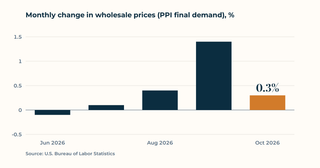
- Wholesale prices rose 0.3% in October, slower than September's jump.
- Over the past year they are up 6.5%, the fastest pace since 2022, as fuel costs spread into food and freight.
- The Federal Reserve decides on Dec. 9 whether to raise rates again; the next wholesale price report is Dec. 15.
Documents in this story · 5
- ReleaseProducer Price Index, October 2026Bureau of Labor Statistics · Press releaseOpen Archived
- ReleasePPI Table 1, final demand and intermediate demand, October 2026Bureau of Labor Statistics · Press releaseOpen Archived
- ReleaseConsumer Price Index, October 2026Bureau of Labor Statistics · Press releaseOpen Archived
- ReleaseFOMC statementFederal Reserve · Press release · Oct. 28, 2026Open Archived
- RecordGovernor Christopher Waller speechFederal Reserve · Web page · Nov. 10, 2026Open Archived
Wholesale prices rose more slowly in October, but over the past year they have climbed 6.5%, the fastest pace since November 2022. That gap between a calmer month and a hotter year is what the Federal Reserve, the nation's central bank, will weigh when it decides in December whether to raise interest rates again.
The government's producer price index, or PPI, tracks what businesses are paid for goods and services before they reach you. It rose 0.3% in October, down from a 1.4% jump in September and a bit under the 0.4% that economists polled by Reuters expected. Outlets told the story two ways, depending on whether they put the monthly 0.3% or the yearly 6.5% first.
Why it matters to you
Wholesale prices are an early signal. When businesses pay more for fuel, freight and raw materials, some of that cost tends to reach store shelves later, which makes the PPI a hint of where consumer prices may be headed.
Food shows it most clearly this month. Wholesale food prices rose 1.3% in October alone. Diesel, which moves groceries and almost everything else, costs about $6 a gallon, roughly 61% more than a year ago, according to AAA figures cited by ABC News.
The report also bears on what you borrow. When the Fed raises its key rate, credit cards, car loans and some mortgages tend to cost more. Traders put the odds of a quarter-point increase at the Fed's Dec. 8–9 meeting at about 89%.
Why the month slowed but the year didn't
Energy explains the calmer month. Wholesale energy prices edged down 0.1% in October after a 10% jump in September, the Bureau of Labor Statistics said. Diesel alone fell 7.9% in a single month.
But fuel costs from earlier in the year are now showing up in other prices. Trucking prices for freight rose 3.9%, and that one item made up more than 80% of the rise in services. Goods prices rose 0.5%, mostly because of food and basic chemicals used to make other products. Food and transportation costs "climbed sharply as high fuel prices flow into other parts of the economy," Ben Ayers, a senior economist at Nationwide, wrote in a note the AP cited.
The AP also tied part of the rise to the construction of data centers for artificial intelligence. Prices for electronic components rose 4.2% in the month, and industrial chemicals rose 3.1%.
The bureau's detailed table separates the energy shock from everything else. Leave out food and energy, which swing a lot, and what economists call core prices were still up 5% from a year earlier. Wholesale energy alone was up 37%. That split, between an energy shock that may be fading and price increases that have spread beyond it, is at the center of the argument over what the Fed should do next.
How wholesale prices sped up this year
A year ago, wholesale prices were rising 3.1% a year. They sped up after the war with Iran drove up fuel costs earlier this year, ABC News reported.
The Fed has already started to respond. In September it raised its key rate for the first time in three years, then held it between 3.75% and 4% at its Oct. 28 meeting. Since then, Fed Governor Christopher Waller has said a larger, half-point hike should be considered if core consumer prices keep rising at about their recent pace.
Two reports since that meeting came in above forecasts. Three days before this report, consumer prices showed a 0.4% rise in October, more than forecasters expected, and employers added far more jobs than expected, as Fair Witness reported last week. A strong job market, The Washington Times wrote, lets the Fed focus on inflation.
Prices are political, too. The AP tied stubborn inflation to the big gains Democrats made in the midterms, when they won control of Congress. Senate Democratic leader Chuck Schumer blamed President Donald Trump's tariffs and the war after Tuesday's consumer price report.
What we don't know yet
No one knows yet whether the energy shock is fading or spreading. If cheaper diesel works its way through trucking and food, wholesale inflation could cool. If not, higher costs could keep reaching shoppers. The November report, out Dec. 15, is the next clue.
How far the Fed will go is also open. Traders expect a hike in December, most of them a quarter point, but markets have wavered over leaving room for a half-point move. Before then, the Fed's preferred inflation gauge comes out later this month. Morgan Stanley economists expect its core measure to rise about 0.3% for October. We found no public response from Democratic congressional leaders to Friday's wholesale report as of 12:30 p.m. ET Friday.
The case each side makes
The sharpest split on Friday came from inside the government. Treasury Secretary Scott Bessent and Chicago Fed President Austan Goolsbee read the same numbers differently, both in CNBC interviews that morning.
Bessent: an energy shock the Fed shouldn't overreact to
Bessent argues that today's inflation comes mainly from the war's hit to energy supplies, and that the shock is already easing. "I think the Fed should understand that this is an energy supply shock," he said, Reuters reported. He called the underlying economy very strong.
In his view, the Fed should look ahead rather than raise rates too much into a shock that is already coming down. He said he would not tell the Fed what to do, but that in its place he would not dramatically reverse last year's rate cuts over an energy shock. October's flat energy prices and the drop in diesel fit his reading.
Goolsbee: inflation has spread beyond oil
Goolsbee argues that prices are rising well beyond fuel. Even in categories not driven by oil or tariffs, he said, "You're still seeing stalled progress and in some cases going the wrong way," UPI reported.
He pointed to services, medical care and demand from AI data centers, and said the Fed has work to do to rebuild its credibility, according to Reuters. He did not commit to a hike. October's jump in trucking and food prices, and core prices up 5% over the year, fit his reading.
Sources
Left
3 of 13 left-leaning outlets we track reported this
Center
2 of 9 center outlets we track reported this
Right
4 of 12 right-leaning outlets we track reported this
- The Washington Times: Wholesale prices rose slightly less than expected in October, Nov. 13
- The Daily Caller: Major inflation indicator hits highest rate since Biden era, Nov. 13
- Just The News: Wholesale prices increased 0.3% in October, less than forecasted, but inflation pressures persist, Nov. 13
Other reporting
- Common Dreams: Schumer on the October consumer price report, Nov. 10 (progressive news site)
Primary
- Bureau of Labor Statistics: Producer Price Index, October 2026 · Archived copy
- Bureau of Labor Statistics: PPI Table 1, final demand and intermediate demand, October 2026 · Archived copy
- Bureau of Labor Statistics: Consumer Price Index, October 2026 · Archived copy
- Federal Reserve: FOMC statement, Oct. 28, 2026 · Archived copy
- Federal Reserve: Governor Christopher Waller speech, Nov. 10, 2026 · Archived copy
This article was produced by AI under our Editorial Standards. Corrections are reviewed before they go live.
How coverage differs
Free with a Fair Witness account
See how left, center and right covered this story
A free account shows where the coverage agrees and where it splits, what each side played up and played down, and, when one side's outlets missed a story, who missed it.
Nov 13
9:00 AMUpdatedU.S.
Van Hollen challenges Schumer for Senate majority leader
Senate Democrats now have a contested leadership race for the first time since 1994, and the winner will run the floor in January.
Spin Meter: how each side framed it · 3/5
Documents in this story · 2
Sen. Chris Van Hollen of Maryland said Thursday night that he will challenge Chuck Schumer for Senate majority leader, in a statement from his office. It is the first contested race to lead Senate Democrats since 1994.
The winner becomes majority leader in January, because Democrats won control of the Senate last week. That makes this a fight over who sets the Senate's agenda for the next two years, not a party formality. Schumer has led the caucus since 2017 and says the votes are already his. Van Hollen says the election was a demand for something different.
Why it matters to you
The Senate majority leader decides which bills reach the floor, and when. That power shapes what gets a vote on health care, prices and war powers in the last two years of President Donald Trump's term. Whoever wins on Dec. 1 will make those calls for a majority of at least 55 seats.
The first test is close. Government funding runs out on Dec. 11, and Van Hollen is one of four senators who say they will not accept a short-term deal that keeps paying for the war with Iran without limits. Schumer is not among the four who signed it.
Two dates are worth marking: the closed-door vote on Dec. 1, and the funding deadline on Dec. 11.
The race for Senate majority leader, and how the vote works
Van Hollen made his case in plain terms. "In this election, the American people called for change," he said in his statement. Voters wanted a change from a status quo that is not working for working people, he said, and meeting that moment takes new leadership.
In this election, the American people called for change.
Schumer answered on X after the announcement. He said he is proud of a result that has reached 55 seats and counting, and that "I have the votes to continue serving as Democratic Leader," NBC News reported. He also said he welcomes a discussion about the caucus's future.
The vote itself is short and private. Democratic senators meet behind closed doors on Dec. 1 and vote by secret ballot, and the winner needs only a simple majority of the caucus, or at least 28 votes. Senate Democrats have not held a contested leadership election since 1994, when Tom Daschle beat Chris Dodd by a single vote.
Van Hollen is not predicting a win. "Am I the underdog? Yes," he told MS NOW's Jen Psaki on Thursday night, in the same interview where he said he believes the race is still unsettled. He told CNN he had commitments from more than 10 senators.
How a week of defections turned into a challenge
The opening came from other senators, not from Van Hollen. Sens. Bernie Sanders and Elissa Slotkin said on Nov. 10 that they would not back Schumer. Several incoming Democrats had already said they want a new leader. Frustration with Schumer among progressives goes back further, to his decision in March 2025 to help advance a Republican spending bill rather than force a shutdown, UPI reported.
Van Hollen moved slowly. He told CNN last Saturday that running was not his focus, and he had told a Washington television station he was weighing a 2028 presidential run instead. Since then, he says, he has talked to almost every Democratic senator. Sen.-elect Abdul El-Sayed of Michigan, who had urged him to run since April, endorsed him shortly after the announcement.
Van Hollen, 67, has spent 23 years in Congress, a record CNN said makes him a somewhat unlikely anti-establishment candidate. His national profile grew sharply after he flew to El Salvador to meet Kilmar Abrego Garcia, a Maryland man the government had deported by mistake.
Where Van Hollen says he would differ from Schumer
His most specific complaint is about primaries. Van Hollen says Schumer and the party's Senate campaign arm should have stayed out of this year's contests. They "sided with the crypto industry and AIPAC" against candidates who went on to win, he said this week. Two of the newly elected senators, he said, would not be in the caucus if Schumer and the committee had had their way.
The second difference is the Iran war. Van Hollen wants to use every tool to end it, starting with the December funding bill. He has also said he would use the full power of the Senate to lower the cost of living, and that he would not intervene in primaries for open seats.
What we don't know yet
The biggest unknown is the count. Schumer says he has a majority, Van Hollen says he has more than 10 senators and that the race is in flux, and neither claim can be checked before a secret ballot. Many Democratic senators have not said publicly where they stand.
We also don't know whether anyone else runs. Slotkin has said she is a no on any candidate without a concrete plan, and she is not seeking the job. A third candidate would change the math, because the winner still needs a majority of the caucus.
Finally, we don't know what a Van Hollen win would mean for the funding fight. He has said he wants war limits in the December bill, but he has not said whether he would let the government shut down to get them. That answer may not come until the week of Dec. 11.
The case each side makes
Van Hollen and the senators who want new leadership
The argument starts with the election. Van Hollen says voters rejected the status quo, and that a caucus answering that call needs a different leader. He points to the two senators-elect who won primaries the party's committee worked against. The new majority should use every tool it has on the war, he argues, starting with the December funding bill. His case is not that Schumer failed in the midterms, but that the moment calls for someone who will fight differently.
Sanders, who caucuses with Democrats, put his support behind Van Hollen the same night. He said the country wants a party that will "take on the billionaire class and fight for working families". El-Sayed, who will be sworn in next year, told NPR that Van Hollen takes risks when it matters and named the El Salvador trip as proof.
Schumer and his backers
Schumer's case is the record. Democrats flipped eight seats and will hold at least 55, and his allies credit him as a principal architect of that win. He says there is great unity in the caucus and that he has the votes, and his allies see no reason to swap leaders weeks before taking the majority.
Sen. Angus King of Maine made the argument in a line: "Why would you fire the manager when you just won the World Series?" UPI reported. Sen. Catherine Cortez Masto of Nevada also backed Schumer, crediting him for the seats the party flipped, and Sen. Kirsten Gillibrand, who ran the campaign committee, praised his work this cycle.
Supporters also point to experience. Sen. Brian Schatz of Hawaii, who is running for whip, said "I endorse Senator Schumer for leader" and that the caucus has no time to waste, Fox News reported. Running the Senate floor is a craft, the pitch goes, and King credits Schumer with rare skill at running it.
Sources
Left
- CNN: Chris Van Hollen launches challenge against Chuck Schumer to lead Senate Democrats, Nov. 12
- NBC News: Sen. Chris Van Hollen says he will challenge Sen. Chuck Schumer for majority leader, Nov. 12
- The Guardian: Chris Van Hollen to challenge Chuck Schumer for Senate majority leader, Nov. 12 (headline only; text unavailable)
- Axios: Second union opposes Schumer in leadership fight, Nov. 13
- Politico: Van Hollen's challenge throws Senate Democrats into all-consuming leadership brawl, Nov. 13
- Politico: Van Hollen disputes Schumer's claim that he has the votes to stay leader, Nov. 15
- ABC News: Van Hollen says Schumer trying to 'instill fear' to retain Senate leadership, Nov. 15
Center
- The Hill: Fetterman: Naming Van Hollen Majority Leader 'would be troubling', Nov. 14
- The Hill: Van Hollen: Senators who pledged to support Schumer will switch vote, Nov. 15
- Newsweek: Chuck Schumer faces Senate majority challenger as Van Hollen enters race, Nov. 12
- UPI: Van Hollen announces run for Democratic Senate leader, Nov. 13
- The Hill: Van Hollen says he will challenge Schumer for majority leader, Nov. 12 (headline only; text unavailable)
- The Hill: Democratic Sen.-elect Flanagan backs Van Hollen over Schumer, Nov. 13
- Newsweek: DSA Backs Challenge to Schumer as Senate Democratic Leader, Nov. 13
Right
- The Washington Times: Fetterman says he might leave party if Maryland's Van Hollen elected Senate leader, Nov. 14
- The Washington Times: Van Hollen sees 'open lane' to ousting Schumer as top Senate Democrat, Nov. 15
- Fox News: Van Hollen challenges Schumer for Senate leadership after Democratic election sweep, Nov. 12
- New York Post: Chris Van Hollen challenging Chuck Schumer for Senate majority leader, Nov. 12
- Just The News: Van Hollen says he will challenge Schumer for Senate Majority Leader, Nov. 12
- The Daily Wire: Senator launches bid to overthrow Schumer as Dem civil war begins, Nov. 13
- The Washington Times: Senate majority leader race: Van Hollen jumps in, but Schumer says he has the votes, Nov. 13 (headline only; text unavailable)
Primary
- Sen. Chris Van Hollen: Van Hollen statement on running for majority leader, Nov. 12 · Archived copy
- Sens. Van Hollen, Bennet, Sanders and Duckworth: joint statement opposing a spending package that funds the war with Iran, Nov. 12 · Archived copy
- Sen. Chuck Schumer, post on X, Nov. 12 (X blocks our reader; the post is quoted and linked by NBC News above)
This article was produced by AI under our Editorial Standards. Corrections are reviewed before they go live.
How coverage differs
Free with a Fair Witness account
See how left, center and right covered this story
A free account shows where the coverage agrees and where it splits, what each side played up and played down, and, when one side's outlets missed a story, who missed it.
Nov 13
4:44 AMUpdatedSpin Meter
Spin Meter: Why did the Treasury Secretary leave home? It depends what you read
Every outlet blamed Iran. Only some mentioned a newspaper photo of his house, and only Fox quoted an official saying the threats against him had gone past an advanced stage.
Nov 12
8:43 PMUpdatedTechnology
Microsoft outage cut off Outlook email into a second day; service now restored
Email went dark for offices, state and city governments and parts of Congress; Microsoft now says service is fully restored and the email backlog processed.

A Microsoft outage on Thursday cut off Outlook email for users across the United States for much of the workday. It also hit Teams, Copilot and other Microsoft 365 services.
By Thursday evening, Microsoft still had not said the problem was fixed. Its own status page listed the service as degraded just after 8 p.m. Eastern time, and the company said it had started to undo a recent network change. That matters because Microsoft 365 runs the email, calendars and shared files for many offices, schools and governments, including congressional offices in Washington.
Why it matters to you
If your work or school email runs on Outlook, messages sent to you on Thursday may arrive late. Microsoft said email delivery may be delayed, and some users could not reach their mailbox on the web, the desktop app or a phone. Teams calls and chats mostly kept working, but calendars and meeting scheduling that depend on email could fail.
If you rely on a city or state office, you may see slow replies too. New York City's emergency management office warned of delays in email and some online city services, and told residents to call 311 for non-emergency help and 911 for emergencies. Massachusetts texted its workers that state email was down.
What to watch for is Microsoft's full explanation. If you manage email for a business, the incident is listed as EX1550543 in the Microsoft 365 admin center.
How the Microsoft outage spread
Trouble began shortly after noon Eastern time. Around 12:20 p.m., reports on Downdetector, a website that collects user complaints about outages, started climbing. Just before 1 p.m., Microsoft said it was looking into problems reaching Exchange Online mailboxes in the Americas. Exchange Online is the system that stores and delivers Outlook email.
The size of the spike depends on when you look. Just before 1 p.m., UPI counted nearly 83,000 Outlook reports. The Washington Times put the peak at more than 130,000 around 1:15 p.m., a peak CNN also reported, and the New York Post reported more than 140,000 by 1:30. These are user reports, not a count of everyone affected. By 3:30 p.m., reports had fallen to almost 60,000.
The problem soon spread past the Americas. Microsoft said users in any region could be hit, and the BBC reported that Outlook complaints worldwide peaked at nearly 140,000. On Capitol Hill, House staff lost email for much of the afternoon, days into the lame-duck session. The House's chief administrative office sent a campus-wide alert, and staff told Politico that work on bills stalled.
What Microsoft says went wrong
Microsoft's explanation changed as the day went on. At first it pointed to heavy load on part of its system. It then said the extra load probably came from several servers that had become unavailable, which put strain on the rest. Microsoft also said the servers were failing automatic health checks, the tests that decide whether a server stays in use, and traced the failures to one part of the servers.
Before 2 p.m., Microsoft said it had "paused all deployments and configuration changes" while it checked recent changes. It restarted servers and moved traffic around. Shortly after 4:30 p.m., it said it was weighing whether to reverse a few recent configuration updates.
Recovery was slow. Around 6 p.m., some servers were back and stable, but Microsoft then warned they "can become unresponsive again once they receive traffic." Its post just after 8 p.m. gave the clearest cause so far. A process that sets up secure connections on the servers was getting overwhelmed. Microsoft said it had begun undoing "a recent network configuration change that correlates with the start of impact." Teams problems in North America had been fixed earlier in the day.
Has this happened before?
Yes, and recently. In January, a Microsoft 365 outage left email down for nearly 10 hours, the tech site The Register reported. Microsoft blamed part of its North American network for not handling traffic as expected. In October 2025, a configuration change in Microsoft's Azure cloud knocked out Office 365, Xbox and Alaska Airlines check-in. And in July 2024, a faulty update from security firm CrowdStrike crashed about 8.5 million Windows computers, Microsoft said.
What we don't know yet
We don't know the full details of what failed. Microsoft's first review blames a flaw in a July change, The Register reported, and Microsoft plans a final report on Nov. 20.
We also don't know how many people were affected in total. Downdetector numbers count only people who chose to file a report. Microsoft has not given a figure for users or businesses hit.
The case each side makes
This is not a partisan fight. The split is between Microsoft, which says it moved fast and kept customers informed, and the offices and workers who lost a day of email.
Microsoft: working every option, updating as it goes
Microsoft's case is that it found the problem fast, said so in public and tried several fixes at once. It posted updates on its status page and on X through the afternoon and evening. "We're aggressively pursuing all pathways to reduce impact," the company wrote on X, as the BBC reported.
We're aggressively pursuing all pathways to reduce impact.
The company also points to the steps it took to limit damage: freezing changes, moving traffic and restarting servers. By evening it said it had narrowed the cause to an overloaded process and a recent network change. Teams messaging and meetings largely kept working, according to the company's status page.
Users and offices: one outage, a lost day
For the people on the other end, the cost was a lost workday. House staff told Politico that Outlook holds their calendars, their bosses' schedules and nearly all their work. Some said bills and year-end talks stalled while email was down.
The frustration was public too. The communications director for Del. Eleanor Holmes Norton, D-D.C., asked on X, "shall we start conducting all official business via DM?" State and city governments, from Massachusetts to New York City, had to warn the public about slower service. Politico wrote that the outage showed why Hill offices need backup ways to talk outside of email.
Sources
Left
- CNN: Microsoft outage cripples office workers nationwide
- Politico: Congressional offices paralyzed by Microsoft outage
- AP: Is Outlook down? Widespread outage hits Microsoft apps
- AP: Microsoft says services fully restored after hourslong global outage (Nov. 14)
- ABC News: Microsoft Outlook outage stretches on for hours
- GBH News and AP: Widespread outage hits Microsoft Outlook, affecting Mass. government emails (Boston public broadcaster with AP copy; counts as AP)
- AP via WABC-TV: Microsoft Azure cloud service hit with outage (Oct. 29, 2025)
Center
- BBC: Microsoft outage sees Teams, Outlook and Copilot suffer 'connectivity issues'
- UPI: Microsoft reports widespread Outlook outages in United States
- Reuters: Microsoft 365, Outlook down for thousands of US users, Downdetector shows (headline only; text unavailable)
- The Register: Microsoft 365 outage drags on for nearly 10 hours (Jan. 23, 2026) (tech news site, not in our coverage pool; cited for a fact only)
Right
Other reporting
- The Register: Microsoft blames monster email outage on software defect introduced in July fix (Nov. 16) (British technology news site; for the Update)
Primary
- Microsoft service health status page (Microsoft 365 admin center post, updated 8:06 p.m. ET, Nov. 12) · Archived copy
- Microsoft: Helping our customers through the CrowdStrike outage (July 20, 2024) · Archived copy
This article was produced by AI under our Editorial Standards. Corrections are reviewed before they go live.
How coverage differs
Free with a Fair Witness account
See how left, center and right covered this story
A free account shows where the coverage agrees and where it splits, what each side played up and played down, and, when one side's outlets missed a story, who missed it.
Nov 12
5:39 PMUpdatedWorld
Trump says U.S. doesn't need an Iran deal, tells Vance to focus on Democratic states
The vice president who led the peace talks was told to focus elsewhere, leaving no clear path to end a war that has raised fuel prices.

President Donald Trump said Thursday that the U.S. doesn't need a deal with Iran and told Vice President JD Vance, who led the peace talks, to focus on alleged corruption in Democratic-run states.
The post came about a week after Vance blamed the war for Republicans' midterm losses. It leaves the war in a standoff: no deal, no full-scale fighting, and no named person now in charge of getting to peace.
Why it matters to you
The war has kept fuel prices high, and gas went above $4 a gallon this fall. Oil shipments through the Strait of Hormuz, the narrow sea lane that carries much of the world's oil, have recovered to near prewar levels. But tankers now rely on U.S. Navy escorts, and at least two were hit by projectiles this week. Without a deal, those risks stay in the price of oil, and gas prices tend to follow.
The war is also heading into a money fight in Congress. Government funding runs out on Dec. 11, and some Democratic senators say they won't vote for more war spending. That sets up a possible government shutdown next month, which could touch federal services and paychecks. Democrats take control of both chambers in January.
What Trump wrote about Vance and Iran
Trump made the change in a Truth Social post at about 8 a.m. Eastern on Nov. 12. He wrote that he wanted Vance to give his "complete and total attention" to what he called massive corruption and crime in Democratic-run places. He named Minnesota, California and Illinois. He also claimed the federal budget could be balanced by stopping that alleged theft, without giving specific examples, as Fox News noted.
Then he turned to Iran. "We don't need a deal with Iran. Those days have long since passed," he wrote, adding that the U.S. has Iran's money and its strait. He did not explain either claim.
We don't need a deal with Iran. Those days have long since passed.
Vance already runs a fraud effort. He chairs the Task Force to Eliminate Fraud, which Trump created by executive order this year, and Trump named him his "fraud czar" in April. The task force says it has found more than $260 billion in suspected fraud, a figure that has not been independently verified.
Why now?
The post came hours after The Wall Street Journal reported that Vance was weighing new direct talks with a senior Iranian official, according to the AP. That official, Mohsen Rezaei, is the secretary of Iran's top security council, and the Journal reported that Vance had reached out to him days before the election. The AP also described the post as partly a response to Democrats, who are laying out plans to investigate the administration.
What it means for the talks is still unclear. Vance's office did not respond to the AP. The White House press office, in an email, pointed back to the post and said Trump sees no need to negotiate.
How Vance and the war split
Vance has long argued against U.S. military action overseas, and he defended the war only mildly after Trump launched it, the AP reported. Even so, he became the face of the effort to end it.
After Republicans' losses in the Nov. 3 midterms, Vance wrote a long post on X. "The reason we lost is the war," he wrote, according to The Guardian. He dared supporters of the war to argue that losing the Senate was worth it. Trump later said Vance was right, but added that he would launch the war again.
Not every Republican agreed. Former Vice President Mike Pence told Fox News that voters were upset the administration stopped short of finishing the war, not that it started one.
How the Iran talks got here
The war began on Feb. 28, when the U.S. and Israel attacked Iran, according to an AP timeline. Iran answered by choking off the Strait of Hormuz.
Vance took the lead on diplomacy. In April, he went to Pakistan for a long session with Iranian leaders that ended without an agreement. In June, he helped negotiate a 14-point memorandum that opened a 60-day window to finish a deal, but that window passed without one. The AP timeline shows the interim arrangement fell apart in July, when the U.S. restored sanctions after attacks on ships.
Before the midterms, Trump often predicted a deal. At the United Nations in September, he said, "I believe we'll make a deal right after the election." This week, after meeting Qatar's prime minister, he called the war effectively over militarily. Thursday's post goes a step further: it treats the current standoff, with a U.S. blockade of Iran's ports and no major strikes for months, as good enough, as The Guardian put it in its analysis.
What we don't know yet
We don't know whether Vance's role in the Iran talks has formally ended, or who now leads them. Envoy Steve Witkoff and Jared Kushner, Trump's son-in-law, have also worked on the talks, but the White House has not said whether either takes over.
We also don't know how Iran will read the post. Its chief negotiator says Tehran is waiting for a U.S. reply to its terms, so a long silence could keep the standoff going or tip it back toward fighting. Some of Trump's advisers have told him the window to restart major combat is closing before Democrats take over Congress in January, NBC News reported. The next marker is the Dec. 11 funding deadline.
The case each side makes
The Trump administration
The White House argues that the U.S. already holds the upper hand, so a signed deal is no longer needed. In Trump's telling, the blockade and Iran's money in U.S. hands give America what it needs without more talks. He has said Gulf allies prefer the status quo and that new strikes look unlikely.
Trump also argues that the bigger fight is at home. He says fraud in Democratic-run states drains billions of dollars a month, and that Vance's task force can recover it. He has stood by the war itself, saying history will judge it well.
Iran
Iran says the next move belongs to Washington. Its parliament speaker and chief negotiator, Mohammad Bagher Qalibaf, told Al Jazeera that Iran has sent the U.S. its terms and is waiting for an answer. If the U.S. chooses war instead, he said, "we are fully prepared for that as well." Al Jazeera is funded by the government of Qatar, which is helping mediate the talks.
Qalibaf also said the Americans had asked Russian President Vladimir Putin to help start direct talks with Iran. The White House did not directly respond to that claim, the AP reported.
Democrats in Congress
Democrats argue the war was never approved by Congress and has cost voters at the pump and the grocery store. Sen. Michael Bennet of Colorado urged colleagues to reject more war funding and to "bring President Trump's disastrous war with Iran to an end." Colorado Politics, which reported his letter, is a state news site.
Sen. Bernie Sanders and three Democratic senators want any short-term spending bill to bar money for the war, The Daily Caller reported. The Pentagon put the war's cost at about $47 billion as of mid-October.
Sources
Left
- Associated Press: Trump bluntly tells JD Vance to shift focus from Iran to targeting "corruption and crime" at home, Nov. 12
- NBC News: Trump says the U.S. doesn't "need" a deal with Iran, Nov. 12
- The Guardian: Trump orders JD Vance to stop Iran war negotiations and focus on domestic policy, Nov. 12
- Associated Press via WTOP: A timeline of the Iran conflict and talks aimed at ending it
- Associated Press via ABC7: gasoline above $4 a gallon
Center
- Reuters: Trump says Vance should focus on domestic corruption, "we don't need a deal with Iran," Nov. 12
- The Hill: Trump: Vance to focus solely on "Massive Corruption and Crime" in Democrat-led cities, states, Nov. 12
- UPI: Trump shifts Vance's focus from Iran to corruption in Democratic areas, Nov. 12
- Colorado Politics (state news site, not in the coverage pool): Bennet urges U.S. Senate to reject more funding for Iran war, Nov. 9
Right
- Fox News: Trump asks Vance to focus on "corruption and crime" in Dem-run cities, states, Nov. 12
- Fox News: Pence rebukes Vance's Iran war assessment, Nov. 12
- The Washington Times: Trump pulling J.D. Vance off Iran talks, Nov. 12
- New York Post: Trump orders Vance to focus on blue state "corruption and crime," Nov. 12
- The Daily Wire: Trump pulls Vance from Iran talks, Nov. 12
- The Daily Caller: Democrats seek Iran war funding freeze in government funding deal, Nov. 12
Primary
- President Donald Trump, Truth Social post, Nov. 12, 8:07 a.m. ET · Archived copy
- Mohammad Bagher Qalibaf, interview with Al Jazeera (funded by the government of Qatar), as quoted by the Associated Press above
- White House press office email to the Associated Press, Nov. 12, as reported above
This article was produced by AI under our Editorial Standards. Corrections are reviewed before they go live.
How coverage differs
Free with a Fair Witness account
See how left, center and right covered this story
A free account shows where the coverage agrees and where it splits, what each side played up and played down, and, when one side's outlets missed a story, who missed it.
Nov 12
3:15 PMUpdatedU.S.
Brooklyn building collapse kills 8 as city investigates the construction site next door
The construction site next door was fined this spring for working through a stop-work order, and that record is now central to the investigation.

Documents in this story · 4
- RecordOATH/ECB violation 39553409Z, 2625 Bedford Ave.NYC Department of Buildings · Web pageOpen Archived
- RecordComplaints at 2625 Bedford Ave.NYC Department of Buildings · Web pageOpen Archived
- RecordProperty profile, 2625 Bedford Ave.NYC Department of Buildings · Web pageOpen Archived
- RecordTranscript, Gov. Hochul updates search efforts after building collapse in BrooklynOffice of the Governor · Web page · Nov. 12Open Archived
A Brooklyn building collapse killed eight people, two of them children, when a three-story building in Flatbush fell into a construction pit next door on Wednesday afternoon, Mayor Zohran Mamdani said on Thursday.
The cause is not yet known. But city records show the construction site next door was ordered to stop work this spring and was fined for carrying on anyway. That history is now at the center of an investigation by the city's Department of Buildings, the agency that issues building permits and enforces the building code, and by Brooklyn prosecutors.
Why it matters to you
If you rent or own in an older building, the ground next door matters as much as your own walls. New projects often dig right up against older buildings like this one. The city's open records let you look up any address and see its permits, complaints and stop-work orders in the Buildings Information System, the same database that shows this site's history.
The city is now checking about 100 other sites tied to the five entities connected to this project. If you live near one of them, those inspections could bring new orders in the coming days. Three buildings on Flatbush Avenue were also put under vacate orders, and water was shut off to about 100 nearby buildings during the search.
If you see digging that looks unsafe next to an occupied building, you can report it to the city through 311. This site's own record now includes a complaint filed after the collapse asking inspectors to check whether the dig exposed too much of the old building's foundation at once.
How the Brooklyn building collapse unfolded
The first 911 call came in at 4:01 p.m. Wednesday. The building at 1321 Flatbush Ave., a store with apartments above, fell into the excavation pit next door while workers were digging there. The collapse also tore the wall off the building beside it, leaving rooms open to the street.
More than 250 firefighters and EMS workers responded. Six people died at the scene and two more in the hospital, officials said, and two of the six adults who died were construction workers. Officials said some victims came from Mexico, Colombia, Ecuador and Trinidad.
Counts of the injured differ by source and by hour. Mamdani's Thursday morning post put it at at least 17, including three firefighters. At his briefing later that day he said 18, including four firefighters, with one person in critical condition. Some reports put the figure at 19.
By Thursday, crews were still treating it as a rescue, digging by hand and with excavators in heavy rain. "To be clear, we have not shifted from rescue to recovery," Fire Commissioner Lillian Bonsignore told reporters. Fire Chief John Esposito warned that the damaged building next door could also fall.
What records show about the site next door
The lot next door, 2625 Bedford Ave., held a one-story building that was torn down to make way for a new one. The Department of Buildings ordered demolition to stop in March, after inspectors found no proper overhead protection, such as netting, for the buildings beside it.
When inspectors came back in April, the building was already gone. The city's violation record shows that on April 23 the demolition contractor, N Tech Design of America, was cited for continuing work during a stop-work order. The record shows the company admitted the violation and paid a $10,000 penalty. The city lifted the order on May 8 once the problems were fixed, according to PIX11, a New York TV station.
The project held active permits for excavation and foundation work. Officials said it was approved for a three-story building, while a plan for a nine-story building was still awaiting approval.
After the collapse, inspectors served a new full stop-work order on the site, listed in city records as due to the collapse. PIX11 reported that a city notice ties the collapse to unsafe construction operations next door. The records we viewed do not state a cause, and officials say the investigation is still open.
What about the building that fell?
It was built in 1930 and renovated in 1960, with four apartments and a store. Buildings Commissioner Ahmed Tigani said the building had no building code violations on record before the collapse. The city's housing agency, which tracks conditions in apartments, has logged almost 100 violations there since 1972, local news channel NY1 reported. It is the city's second serious structural failure in five months, after support columns buckled in a Manhattan skyscraper in July.
What we don't know yet
The biggest open question is why the building fell. Mamdani said the buildings department will investigate both the construction site and the collapsed building. Which one gave way first, and whether the digging followed the approved plans, will shape who, if anyone, is held responsible.
We also don't know whether anyone else is trapped. It is not clear whether anyone has been reported missing, and the fire department says it will keep searching until it can reach the ground under the rubble. Nor do we know whether the city's sweeps of about 100 related sites will turn up problems, or whether prosecutors will bring charges. Officials have not given a timeline for either.
The case each side makes
This is not a partisan fight. The divide is between officials pressing for accountability now and those urging that blame wait for the facts.
Officials pressing for accountability
Mamdani has promised a full accounting. "We will find out what happened," he said on Thursday, and he ordered sweeps of every site tied to the companies behind the project. Brooklyn District Attorney Eric Gonzalez said his office is working to "determine whether any criminal conduct contributed to this tragedy."
We will find out what happened.
In this view, the site's record is a warning that was already on file. The contractor kept tearing down a building after the city told it to stop. In May, the city also logged work that did not match the approved drawings, along with missing protection for the buildings next door, NY1 reported. Gov. Kathy Hochul said the state will give the investigation its "full support."
Those urging caution before blame
The demolition contractor says it was not the company doing the digging. N Tech Design of America declined an interview, but it said in an email to CBS News that it did the demolition months ago, not the digging, NewsNation reported. The architect, owner and general contractor listed in city records did not respond to the AP's requests for comment.
In this view, the spring violations were corrected, and the city itself let the work go on in May. The fallen building was nearly a century old, and investigators have not said what failed. Tigani said the agency's inquiry would cover "all aspects of the building and the neighboring construction site," not just the dig.
Sources
Left
- CBS News New York: Brooklyn building collapse highlights need to address staffing, funding for NYC DOB, Menin says (Nov. 14)
- AP: Brooklyn building collapse killed 2 children and 6 adults, mayor says
- NBC News: 2 children among the 8 dead in New York City building collapse, officials say
- ABC News: At least 8 dead, including 2 children, after building collapses in Brooklyn
Center
- UPI: Death toll up to at least 8 in Brooklyn building collapse
- BBC: What we know about Brooklyn building collapse that killed eight people
- NewsNation: Brooklyn building collapse, what we know about the victims
- NewsNation via Yahoo News: Brooklyn building collapse raises questions about neighboring site cited in April
- PIX11: Construction caused fatal building collapse in Brooklyn, DOB (New York TV station; not on our outlet panel)
- The City Reporter: 8 dead in Brooklyn building collapse as search and rescue continues (nonprofit New York local news site, formerly THE CITY; not on our outlet panel)
- NY1: People trapped in collapsed Brooklyn building, FDNY says (New York local TV news channel; not on our outlet panel)
- NY1: Death toll reaches 8 after Brooklyn building collapse, officials say (New York local TV news channel; not on our outlet panel)
- 6sqft: Flatbush building collapse leaves 8 dead and at least 18 injured (New York real estate news site; not on our outlet panel)
Right
Primary
- NYC Department of Buildings: OATH/ECB violation 39553409Z, 2625 Bedford Ave. · Archived copy
- NYC Department of Buildings: complaints at 2625 Bedford Ave. · Archived copy
- NYC Department of Buildings: property profile, 2625 Bedford Ave. · Archived copy
- Office of the Governor: transcript, Gov. Hochul updates search efforts after building collapse in Brooklyn, Nov. 12 · Archived copy
This article was produced by AI under our Editorial Standards. Corrections are reviewed before they go live.
How coverage differs
Free with a Fair Witness account
See how left, center and right covered this story
A free account shows where the coverage agrees and where it splits, what each side played up and played down, and, when one side's outlets missed a story, who missed it.