Nov 9
8:42 PMUpdatedTechnology
AI stocks drive worst market day since April 2025 after Democratic sweep
Investors fear a new Congress and voters' anger over data centers could slow the AI building boom that has powered the stock market.
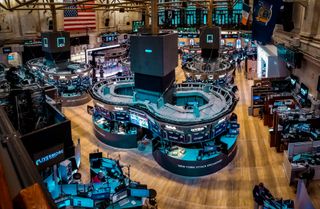
U.S. stocks had their worst day in more than a year and a half on Nov. 5, led by a selloff in artificial intelligence and chip stocks. The S&P 500, which tracks 500 large companies, fell 4.4%, the Associated Press reported, its worst day since the "Liberation Day" tariff shock of April 2025.
The drop came two days after Democrats won control of Congress. Some investors fear that new leaders in Washington and in state capitals, along with voters angry about power bills, could slow the building of data centers, the huge computer warehouses that run AI. Those projects have been one of the biggest engines of the stock market's rise.
Why it matters to you
If you have a 401(k), an IRA or a college savings fund, you probably own some of these stocks. Many retirement funds track the S&P 500, so money in one of those funds lost about 4.4% in a single day. A few AI giants make up a large share of that index. A 1% move in Nvidia moves the S&P 500 more than a 1% move in almost any other stock, the AP noted, so their swings hit your savings hard.
One bad day does not decide much for long-term savers, and all the major indexes were still up for the year after the drop. What matters more is whether this turns into a longer slide, and no one knows that yet.
Data centers also matter close to home. Voters in both parties have worried about higher power bills linked to them, the AP reported, and the fight over where they get built is now playing out in town councils, statehouses and Congress.
How the selloff unfolded
The Dow Jones Industrial Average fell 3.4%. The Nasdaq, which is packed with tech companies, fell 5.5% and ended nearly 12% below its October high, the AP reported. Traders call a drop of 10% or more a "correction."
Chip makers fell hardest. Nvidia dropped 9.3% and pulled the S&P 500 down more than any other stock, and Advanced Micro Devices fell 17.3%, the AP said. A group of chip stocks fell 12%, and the 100 biggest Nasdaq companies lost about $2.5 trillion in value, Reuters reported. Some investors moved money into U.S. government bonds, which are seen as safer.
Why did investors sell?
News reports pointed to several reasons, and they don't all point the same way. The AP said Democratic wins raised the chance that state or local governments could pause new data centers. Reuters reported that chipmakers sank on fears of tougher AI regulation after Democratic wins, including in some states that host many data centers.
But Reuters also pointed to worries that have nothing to do with the election. Borrowing costs are high, some smaller AI companies are struggling to raise money, and some investors doubt that the hundreds of billions being spent on AI will pay off. The bank UBS estimated that about 30% of the new data centers planned for 2028 could be at risk if building is paused, Reuters reported.
How data centers became a political issue
The backlash did not start on election night. Over the past year, opposition to data centers became a rare issue that crosses party lines, The National News Desk reported. Candidates in both parties promised to protect neighbors from higher utility bills, water use and noise. New York became the first state to impose a statewide moratorium, a one-year pause on new projects.
In Congress, Sen. Bernie Sanders, an independent, and Rep. Alexandria Ocasio-Cortez, a New York Democrat, introduced a bill in March that would pause new data center construction nationwide until federal safeguards are in place. Most lawmakers in both parties rejected the idea, the AP reported, and Democratic Sen. John Fetterman of Pennsylvania warned it would hand China the lead in AI. The bill has not passed. None of the coverage of the selloff that we read said whether the new Democratic leaders in Congress plan to take it up.
Much of the real fight is local, because towns and counties are often the only ones who can turn a project down, NPR reported. Some communities have packed hourslong meetings to oppose projects, while others have welcomed data centers for the construction jobs and property taxes they bring.
What we don't know yet
We don't know whether Democrats in Congress or newly elected governors will try to limit data center building, or how. A federal pause would need the president's signature. States and towns, which control permits and tax breaks, can act on their own.
We also don't know whether Nov. 5 was the start of a longer slide or a short shakeout. Nvidia reports its quarterly earnings on Nov. 17, a closely watched test of AI demand, and it is now dealing with a board investigation into its CEO, which we covered separately. And a possible December interest rate increase by the Federal Reserve would make borrowing for new data centers more expensive.
The case each side makes
Those who see real risk to the AI boom
Some analysts argue that the selloff made sense. In their view, investors are rethinking how fast and how cheaply AI can be built now that power, permits and money are all harder to come by. Jakub Rochlitz of eToro told Fox Business that the buildout now looks slower and more costly than expected.
Ted Parkhill of Incline Investment Management told Reuters that investors are shifting from AI's promise to its price. Those who share this view say a new political climate, combined with high borrowing costs, gives investors good reason to pay less for future profits that may arrive later than hoped.
Those who see an overreaction
Others say the drop was far bigger than the news behind it. Jed Ellerbroek of Argent Capital Management told Reuters that the selling looked like investors giving up all at once, and that the moves seemed too large.
They point out that no law limiting data centers has passed Congress and that most lawmakers in both parties have opposed a national pause. On this view, a scare about politics knocked prices down faster than the facts justify, and the long-term case for AI spending is intact.
Sources
Left
- CNN: Stock markets plunge as massive tech sell-off wipes $2.5 trillion, Nov. 5
- Associated Press via Spectrum News: S&P 500 drops 4.4% in worst day since 2025 as AI chips slide
- Associated Press via Valley News Live: A brutal sell-off for AI stocks sends Wall Street reeling, Nov. 5
- Associated Press via WCAX: Sanders, Ocasio-Cortez push bill to impose AI data center moratorium, March 25
- NPR via OPB: Data centers are expensive, unpopular, and could be a tipping point in the midterms, April 20
- Associated Press via Chattanooga Times Free Press: AI stocks rebound, and Wall Street nearly returns to where it was before last week's sell-off, Nov. 11
Center
- Reuters via GV Wire: Blue tsunami wipes out $2.5 trillion from Nasdaq
- Reuters via Honolulu Star-Advertiser: Nasdaq heads for correction as AI stocks plunge after midterms, Nov. 5
- investingLive: Nasdaq 100 suffers worst day since 2020 (year-to-date index returns) (cited for market data; not on our outlet panel)
- Reuters via Yahoo Finance: Stocks end higher as CoreWeave results ease AI spending worries, Nov. 11
Right
Primary
- Nvidia: NVIDIA Sets Conference Call for Third-Quarter Financial Results, Oct. 28 · Archived copy
- Closing prices and index levels from the exchanges, as reported by the AP and Reuters (above)
This article was produced by AI under our Editorial Standards. Corrections are reviewed before they go live.
How coverage differs
Free with a Fair Witness account
See how left, center and right covered this story
A free account shows where the coverage agrees and where it splits, what each side played up and played down, and, when one side's outlets missed a story, who missed it.
Nov 9
8:37 PMUpdatedScience
El Niño may set a record this winter, with a wetter South and milder North
Forecasters say the strongest El Niño in 75 years could shape your winter, from drought relief in the South to a mild season up north.
Documents in this story · 5
- RecordEl Niño advisory announcementNOAA · Web page · June 11Open Archived
- ReleaseEl Niño looms large over U.S. Winter OutlookNOAA · Press release · Oct. 15Open Archived
- RecordLong-lead seasonal outlook discussionNOAA Climate Prediction Center · Web pageOpen Archived
- RecordENSO Diagnostic DiscussionNOAA Climate Prediction Center · Web page · Nov. 12, 2026Open Archived
- RecordENSO Diagnostic DiscussionNOAA Climate Prediction Center · Web page · Oct. 8, 2026Open Archived
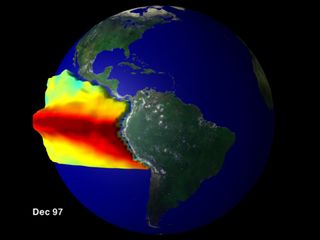
Federal forecasters say the El Niño now under way in the Pacific Ocean will likely be the strongest since record-keeping began in 1950. In its winter outlook, the National Oceanic and Atmospheric Administration (NOAA) says that tilts the odds toward a stormy, wet winter across the South and a mild one across much of the North.
El Niño is a warming of the ocean along the equator in the Pacific that happens every few years. It matters even if you live far from any ocean. El Niño shifts the jet stream, the fast river of wind high in the sky that steers storms across the United States. A strong one can reshape a whole winter.
Why it matters to you
What this winter brings depends on where you live. NOAA's outlook for December through February leans wetter than usual across the Southwest, the southern states, the Southeast and up the East Coast, according to a summary of the outlook by The Watchers. It leans warmer than usual in northern California, the Pacific Northwest, the Midwest, much of the East and Alaska. Parts of the northern Rockies, the Great Lakes and inland Alaska lean drier.
For the South, that could be welcome news after years of drought. More rain could ease dry conditions across the Southwest, the southern Plains and the Southeast. But heavy rain on parched ground runs off fast, and NOAA has warned that it can bring flash floods and mudslides, Fox Weather reported. Up north, the risk runs the other way: drought could worsen in parts of the northern Rockies and the inland Northwest.
Keep in mind that these are odds, not promises. A strong El Niño makes these patterns more likely, but NOAA says it does not guarantee them in any one town. If you live somewhere prone to flooding or mudslides, your local forecast and emergency officials are a better guide than any seasonal outlook.
How strong this El Niño is
NOAA declared in June that El Niño had arrived, the agency said. It has grown quickly since. By August, the agency's Climate Prediction Center put the chance of a "very strong" event this fall and winter at more than 90%, Reuters reported.
In its Oct. 8 update, NOAA gave an 83% chance, or about 5 in 6, that this El Niño will be stronger than any on record since 1950. A key ocean reading in the central Pacific was about 2.4°C, or about 4°F, above normal in mid-October. Both figures come from NOAA's data, as summarized by The Watchers.
Forecasters outside the U.S. see the same thing. The World Meteorological Organization said in September that El Niño was set to intensify into 2027 and could be the strongest ever, Reuters reported. It expects the event to last through at least February, according to Newsweek. China's government forecasters expect a record too, Reuters reported.
What else does El Niño change?
It reaches well beyond winter storms. El Niño tends to calm Atlantic hurricanes and can raise the risk of flooding at high tide along the West Coast, according to NOAA.
What past strong El Niños tell us
Big El Niños have a mixed track record, which is why forecasters hedge. The winter of 1997-98, one of the strongest on record, brought a deluge to Southern California. In San Diego, that season's rain came to about 180% of normal, and storms battered the coast.
The 2015-16 El Niño was supposed to repeat that, and some called it a "Godzilla El Niño." But the soaking largely skipped Southern California. One scientist whose doubts proved right, Jin-Yi Yu of the University of California, Irvine, later argued that El Niño's effects have changed, NBC News reported. Researchers still debate why, but the lesson for this winter is plain: a record-strength reading in the Pacific is not a guarantee of a record winter in your town.
What we don't know yet
We don't know how strong El Niño will get at its peak, which U.S. forecasters expect near the end of this year, Reuters reported. NOAA's next seasonal update is due Nov. 19, and each new reading of the Pacific will sharpen the picture.
Nor do we know how any one city will fare. Other weather patterns can blunt or amplify El Niño's pull, which is exactly what happened in 2015-16. And it is not settled how much of this El Niño's strength comes from long-term ocean warming. Some coverage makes that link, but NOAA's outlook does not.
The case each side makes
This is a forecast that most experts agree on, not a political fight. The differences are about how sure to be, and how loudly to say it.
Forecasters stressing the record
Private forecaster AccuWeather has said a record El Niño is increasingly likely and that it is confident a "super" El Niño will form, Newsweek reported. Its lead international forecaster, Jason Nicholls, told Reuters the current event has to be the strongest on record. Its long-range expert, Paul Pastelok, has argued that an event this strong builds confidence in more moisture across the southern tier after several dry years.
Fox Weather ran a headline saying the event is expected to be the strongest anyone alive has experienced. In this view, the evidence from the Pacific is strong enough that the public should hear it plainly.
Forecasters stressing uncertainty
NOAA and the World Meteorological Organization warn that strength alone does not decide what happens in a given place, because other weather patterns matter too. "Every El Nino is not the same," National Weather Service Director Ken Graham said in NOAA's June announcement.
Every El Nino is not the same.
The Climate Prediction Center itself has said that even the strongest events do not bring the typical effects everywhere, though they tilt the odds more, Newsweek reported. Those who stress uncertainty point to 2015-16, when a near-record event left Southern California drier than many expected, as the reason to talk about odds rather than outcomes.
Sources
Left
Center
- Newsweek: How three super El Niño forecasts compare, Sept. 7
- Reuters via Emirates 24/7: El Niño expected to strengthen, with more than 90% chance of very strong event, Aug. 13
- Reuters via FBC News: El Niño may become strongest ever recorded, Sept. 4
- Reuters via Times Live: More than 90% risk of very strong El Niño, says US forecaster, Aug. 13
- Reuters via WSAU: AccuWeather's Jason Nicholls on the current El Niño
- Reuters via bdnews24: China forecasts record-strength super El Niño, Sept. 29
- Newsweek: New El Niño forecast reveals winter outlook as event strengthens
- Newsweek: Super El Niño 2026 forecast, what experts predict
- The Watchers: NOAA's 2026-27 winter outlook, Oct. 16 (summary of NOAA data; not on our outlet panel)
- Times of San Diego: El Niño in San Diego, a history of storms, floods and surprises (local history; not on our outlet panel)
Right
Primary
- NOAA: El Niño advisory announcement, June 11 · Archived copy
- NOAA: El Niño looms large over U.S. Winter Outlook, Oct. 15 · Archived copy
- NOAA Climate Prediction Center: long-lead seasonal outlook discussion · Archived copy
- NOAA Climate Prediction Center: ENSO Diagnostic Discussion, Nov. 12, 2026 · Archived copy
- NOAA Climate Prediction Center: ENSO Diagnostic Discussion, Oct. 8, 2026 · Archived copy
This article was produced by AI under our Editorial Standards. Corrections are reviewed before they go live.
How coverage differs
Free with a Fair Witness account
See how left, center and right covered this story
A free account shows where the coverage agrees and where it splits, what each side played up and played down, and, when one side's outlets missed a story, who missed it.